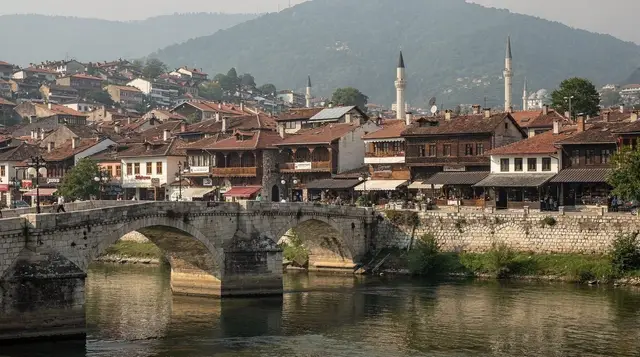
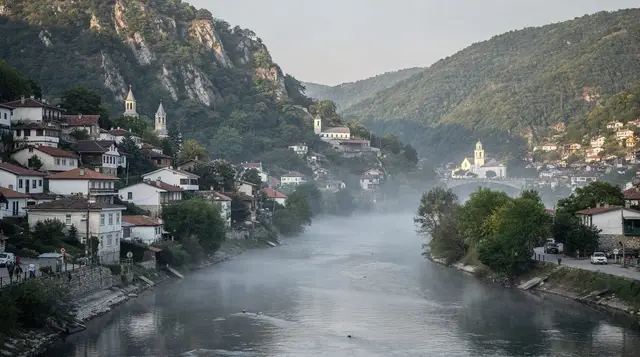
The Blagaj tekke: a practical visiting guide
What do I need to know before visiting the Blagaj tekke?
The Blagaj tekke is a 16th-century Sufi lodge built at the foot of a 200m cliff at the source of the Buna, about 140km (2h30) from Sarajevo and 12km from Mostar. It remains an active place of worship for the Naqshbandi order, so shoulders and knees need to be covered and shoes come off before you enter the prayer rooms.
Why this is not just another photo stop
Every itinerary that runs through Herzegovina puts the Blagaj tekke on the list, usually next to a photo of a white building tucked under an overhanging cliff. What the photo doesn’t show is that this is a working Sufi lodge, home to the Naqshbandi order since the 16th century, and that a service or a private prayer session can be underway when a coach group walks in. Treat it the way you’d treat any active place of worship you’re visiting as a guest: it holds up on its own merits, and it also happens to be one of the more striking buildings in Herzegovina.
The tekke sits directly against a 200-metre limestone cliff, at the point where the Buna river emerges from a cave mouth at the base of the rock. The Buna is one of the most powerful karst springs in Europe, and the volume of water coming out of the cliff, cold and green, is the real reason the site was built here in the first place. Dervish lodges were often sited at dramatic natural features; this is one of the more complete surviving examples in the Balkans.
Getting there from Sarajevo
Blagaj is around 140km from Sarajevo, a drive of roughly 2h30 on the road that runs through Konjic and down towards Mostar. There’s no direct train or scheduled bus to Blagaj itself, so realistically you’re choosing between three options: self-drive, an organised day tour that includes it, or public transport to Mostar followed by a short taxi or local bus for the last 12km.
Most people don’t visit Blagaj on its own. It sits close enough to Mostar, Počitelj and Konjic that a single day out of Sarajevo can reasonably cover two or three of them. If you’re planning the logistics yourself, the guide to getting to Mostar from Sarajevo and the Sarajevo car rental guide cover the driving and train alternatives in more detail than fits here.
For a first-timer who doesn’t want to manage the driving and the itinerary at the same time, an organised day out is the simpler route. A day tour from Sarajevo that runs through Blagaj, Kravice and Mostar covers the ground in one sitting, with someone else doing the driving on mountain roads that aren’t always well lit or well signed after dark.
Distances at a glance
| From | Distance | Typical driving time |
|---|---|---|
| Sarajevo | ~140km | ~2h30 |
| Mostar centre | ~12km | ~20 minutes |
| Konjic | ~65km | ~1h |
| Počitelj | ~30km | ~40 minutes |
| Kravice waterfalls | ~40km | ~45 minutes |
Opening hours and what a visit costs
The tekke opens daily, generally from mid-morning to early evening, with the window running longer through the summer months and shorter from autumn into winter. It closes briefly around each of the five daily prayer times, and those times move through the calendar year, so a schedule you find online in spring won’t hold in August. If you arrive and the door is shut, it’s worth waiting ten or fifteen minutes rather than assuming the site is closed for the day.
There’s a small entrance fee, generally a few convertible marks per person, though the exact figure at the gate can change from one season to the next, so don’t plan a tight budget around a specific number you’ve read in advance. Parking near the site, in the small area by the river, is usually a modest separate charge. Card payment isn’t reliable this far outside Sarajevo and Mostar, so bring KM in cash — see the general money and currency guide if you haven’t sorted cash before leaving the city.
Dress code and entering the prayer rooms
This is the point where Blagaj differs most from a standard heritage-site visit: the rooms you’re walking through are still used for prayer and remembrance by the Naqshbandi order, not preserved behind glass as a museum exhibit. The dress code follows from that. Shoulders and knees need to be covered for everyone, and shoes come off before stepping onto the carpeted floors inside. Loud conversation or phone calls inside the rooms are out of place, whatever your religion or lack of one.
Women should bring a headscarf. Some visitors report scarves being available to borrow at the entrance, similar to the practice at the Gazi Husrev-bey mosque in Sarajevo, but a small rural tekke doesn’t have the same volume of visitors or the same stock of loaner scarves as a city landmark, and supply isn’t something to count on in high season. Carrying a lightweight scarf in a day bag costs nothing and solves the problem before it comes up.
Photography inside the prayer rooms is a judgement call rather than a fixed rule. If a service is underway, or if dervishes are present for private prayer, put the camera away and ask before raising it again. The courtyard, the cliff face and the spring itself are unambiguously fine to photograph at any time. For a broader look at etiquette across the city’s religious sites, the mosque etiquette guide covers ground that mostly transfers here too, even though this is a Sufi lodge rather than a mosque in the everyday sense.
What you’ll see inside
The complex is compact: a handful of rooms arranged over two low storeys, connected by narrow wooden staircases and galleries that lean out slightly over the water. Furnishings are simple — carpets, low seating, calligraphy panels — which is in keeping with the ascetic character of the order rather than a sign of neglect. One room typically holds relics and older manuscripts associated with the lodge’s history; captioning in English is limited, so a little background reading beforehand, or a guide on the day, adds more than the room itself will explain.
The setting does more work than the architecture. Standing on the balcony with the Buna running directly beneath the floorboards and the cliff rising 200 metres almost overhead gives a sense of why a Sufi order chose this exact spot roughly five centuries ago — water, rock and shelter together, away from the centre of a town but still reachable from it.
Outside, a short path follows the riverbank past a scatter of restaurant terraces built out over the water on stilts, serving grilled trout pulled straight from the Buna. It’s touristy by local standards, but the fish is genuinely fresh, and a riverside table after the visit is a reasonable way to spend half an hour before heading back to the car.
Crowds, vendors and the best time to go
Blagaj is a fixed stop on most Herzegovina day-tour routes out of both Sarajevo and Mostar, and it shows between roughly 11am and 3pm from June to August, when several coaches can be parked at once and the approach path fills with stalls selling drinks, magnets and printed scarves. None of it is aggressive, but it changes the feel of the place from contemplative to busy.
Arriving before 10am or after 4pm avoids most of that. Early morning also gives better light on the cliff face, and a quieter path means you’re less likely to be walking through someone else’s photo, or standing in the way of someone else’s prayer. Outside the peak summer window — spring and early autumn especially — the site is close to empty for long stretches of the day.
Combining Blagaj with Mostar and the rest of Herzegovina
Because Blagaj sits only 12km from central Mostar and roughly the same distance from Počitelj and the Kravice waterfalls, it’s rarely worth treating as a single-destination trip from Sarajevo. The 140km, 2h30 drive each way makes far more sense spread across two or three stops.
A common pairing is Blagaj plus Mostar’s Old Bridge and bazaar, doable as a half-day once you’re already in the area — the Mostar day trip guide lays out timing for that combination. A longer version adds Kravice for swimming in summer, covered in the Kravice and Blagaj day trip guide, or swaps in the Ottoman terraces of Počitelj, covered in the Počitelj and Stolac day trip guide.
For travellers who’d rather not drive Herzegovina’s roads themselves, especially with a full day of stops planned, an organised tour removes the navigation and parking logistics entirely. A route covering Mostar, Konjic, the Blagaj tekke and Počitelj in one day hits most of what’s realistic to see from Sarajevo without an overnight stay. A shorter, more focused option, an Ottoman-heritage day through Mostar and Blagaj, keeps the pace calmer if the waterfalls and via ferrata add-ons aren’t of interest.
If Kravice’s waterfalls are the priority and Blagaj is the secondary stop rather than the main draw, a day tour built around Kravice with Blagaj and Počitelj included flips the emphasis while still stopping at the tekke on the way.
None of this rules out visiting Blagaj as a two-hour stop bolted onto an otherwise independent Mostar day — plenty of travellers park in Mostar, take a short taxi or local bus out to Blagaj, and come straight back. It’s simply worth knowing before you commit a full day of driving from Sarajevo that the tekke itself is a 20 to 40 minute visit, and the rest of the value comes from what else is nearby.
Practical checklist before you go
| Item | Note |
|---|---|
| Distance from Sarajevo | ~140km, ~2h30 by car |
| Distance from Mostar | ~12km, ~20 minutes |
| Dress code | Shoulders and knees covered; shoes off indoors |
| Headscarf | Bring your own; borrowing isn’t guaranteed |
| Entrance fee | A few KM; treat exact price as approximate |
| Payment | Cash (KM) — cards unreliable here |
| Best visiting window | Before 10am or after 4pm in summer |
| Status | Active Naqshbandi Sufi lodge, not a museum |
Frequently asked questions about visiting the Blagaj tekke
How far is Blagaj from Sarajevo?
About 140km, which takes roughly 2h30 by car on the road through Konjic and Mostar. There’s no direct public transport link, so most visitors come by rental car, organised tour, or as an add-on to a Mostar day trip using a taxi or bus from Mostar’s centre, 12km away.
What are the opening hours of the Blagaj tekke?
The tekke is generally open daily from morning until early evening, with hours running longer in the summer season and shorter in winter. It closes to visitors during the five daily prayer times, and those windows shift through the year, so treat any posted hours as a guide rather than a guarantee and build in some slack.
Do I need to cover my head to enter the tekke?
Shoulders and knees must be covered for everyone, and women should bring a headscarf as a precaution. A scarf may be available to borrow at the door, as at other religious sites around Sarajevo, but supply isn’t guaranteed at a small rural tekke, so carrying your own is the safer plan.
Is the Blagaj tekke still an active place of worship?
Yes. It’s a working lodge of the Naqshbandi Sufi order, not a museum piece kept for visitors. Dervishes still use the rooms for prayer and remembrance, which is why shoes come off at the threshold, voices stay low, and photography inside the prayer rooms should wait until you’ve checked it’s welcome that day.
Can I combine Blagaj with Mostar in one day?
Easily. Blagaj is only 12km from central Mostar, around 20 minutes by road, and most organised itineraries pair the two along with a third or fourth stop such as Počitelj or the Kravice waterfalls. Doing Blagaj as a standalone half-day trip from Sarajevo, without Mostar, is a long way to drive for one building.
How much does it cost to visit the Blagaj tekke?
There’s a modest entrance fee, generally a few convertible marks, though the exact figure at the door shifts from year to year and season to season, so treat any specific number you read in advance as approximate. Parking near the site is usually a small separate charge.
Is Blagaj crowded in summer?
The riverside path and the small square in front of the tekke fill with coach groups between roughly 11am and 3pm in July and August, alongside a row of stalls selling drinks and souvenirs. Arriving before 10am or after 4pm gives a noticeably calmer visit and better light on the cliff face above.
Do I need a guide to visit Blagaj tekke?
No, the site is straightforward to visit independently if you’re driving yourself or arrive via Mostar. A guide adds value mainly through the history of the Naqshbandi order and the wider Herzegovina context if you’re combining Blagaj with Mostar, Počitelj and Kravice in a single organised day.
Religious heritage & sacred sites tours on GetYourGuide
Verified deep-linked GetYourGuide tours. Book through these links and we earn a small commission at no cost to you.
GetYourGuide does not provide a product photo for this activity — the image shows the meeting point, photographed by us.