Visočica is a hill above the town of Visoko, 30 km northwest of Sarajevo. Since 2005 it has been marketed as the “Bosnian Pyramid of the Sun”, supposedly the largest pyramid on Earth and thousands of years older than Giza. It is a natural hill. Geologists who have surveyed the site, and Bosnia and Herzegovina’s own institute for the protection of cultural heritage, have said so consistently for two decades. This page treats that as settled, because it is, and describes what a visitor actually finds when they drive out to Visoko: a hillside with a self-guided viewpoint, a set of excavated tunnels with a paid guided tour, and a small industry of gift shops built around a claim that professional archaeology rejects.
None of that makes the trip worthless. The tunnels are a genuine, if modest, excavation you can walk through. The hill has a good view over the Bosna valley. And the story of how the theory took hold — and why it still draws visitors from around the world — is itself a piece of contemporary Bosnian history worth understanding before you buy a ticket.
What you’re actually visiting at Visočica
Two separate things sit under the “Bosnian pyramid” name, and it helps to keep them apart before you go.
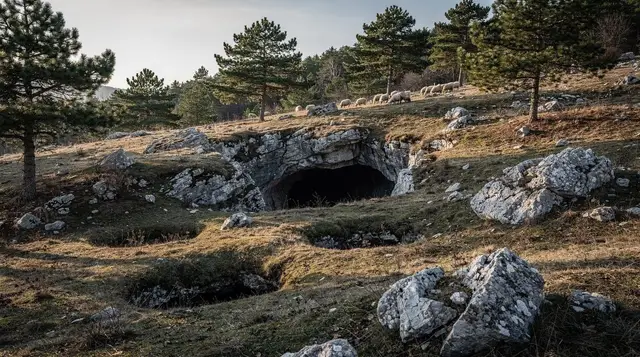
The hill itself (Visočica). From the road and from several marked viewpoints in Visoko, the hill has a roughly triangular profile that resembles a pyramid from certain angles, particularly in low winter light or under snow. That resemblance is the entire visual case for the theory. Geologically, Visočica is a klippe — a remnant hill of harder rock left standing after softer surrounding rock eroded away — a landform documented across the Balkans and worldwide.
Its faces are exposed sandstone and conglomerate, with natural fracture patterns that the pyramid project has photographed and presented as cut stone “blocks” and “megaliths”. You can walk up to some of these exposures yourself; there is no fee for viewing the hill from the marked paths, though the steeper approach trails can be muddy and are not maintained to the standard of Bosnia’s national park trails.
The Ravne tunnels. A few kilometres from the hill, at Ravne, a network of narrow galleries has been excavated and partly reinforced for visitors — a few hundred metres of accessible passage in total, well short of the “kilometres of prehistoric tunnels” claimed in project literature. This is the part of the site with an actual entry fee, a car park, a small visitor building, and scheduled guided tours. It is also the only part of the complex where excavation has produced anything to look at beyond rock formations: narrow stone-lined corridors, some ceramic fragments displayed on site, and information panels presenting the project’s own interpretation. A tour runs about 45 minutes and costs in the region of 10-15 KM (roughly 5-7.50 EUR).
Neither site requires more than a couple of hours combined, which is why Visoko works well as a stop on the way to or from Travnik or Zenica rather than a destination in its own right.
The project, and the scientific verdict
The “Bosnian Pyramid of the Sun” project was launched in April 2005 by Semir Osmanagić, a Bosnian-American businessman with no formal archaeological training, who announced that Visočica and several neighbouring hills were a complex of man-made pyramids built by an unknown civilisation more than 10,000 years ago. The claim was picked up quickly by international media, drew funding and volunteer labour, and turned Visoko into a minor tourism economy almost overnight.
The response from professional archaeology and geology was, and has remained, close to unanimous rejection. Bosnia and Herzegovina’s own National Commission for Preservation of National Monuments and the Association of Geologists of Bosnia and Herzegovina issued statements describing the site as a natural formation and criticising excavation methods at Ravne.
The European Association of Archaeologists issued an open letter in 2006 calling the project “a cruel hoax” on the Bosnian public and warning that it risked damaging genuine archaeological sites in the country while diverting funding and attention from them. Geological surveys published since have consistently identified the “pyramid” faces as naturally fractured sandstone and breccia, and the “megalithic blocks” at Ravne as natural rock, not cut or transported stone.
That is the state of the evidence, and it has not meaningfully changed since. This page will not present the pyramid theory and the scientific consensus as two equally weighted sides of an ongoing debate, because they are not: one is a fringe claim promoted primarily by the project itself and its tourism operation, and the other is the position of every relevant scientific and heritage body that has examined the site, in Bosnia and internationally. Visiting Visoko to see the tunnels and the hill, and to understand how the claim spread, is a reasonable way to spend a morning. Visiting expecting confirmed archaeological proof of an ancient pyramid civilisation is not.
What a visit actually looks like
Most visitors start at the Ravne tunnel complex, since it is the only part of the site with fixed opening hours, a ticket booth, and guides. Tours are conducted in groups, run roughly every 30-45 minutes through the day in high season, and take you through the reinforced sections of the galleries with commentary from the guide — commentary that presents the project’s interpretation of the site rather than the geological consensus described above. Wear closed shoes; the passages are unlit beyond installed lighting, low in places, and can be damp underfoot.
From Ravne, it’s a short drive back towards Visoko to reach the marked hillside paths on Visočica itself, where a viewpoint gives a clear look at the hill’s triangular profile and across the valley towards the town and the ruins of the medieval Bosnian royal fortress above it. The path is unpaved and has no facilities; there is no fee to walk it.
| Stop | What’s there | Cost | Time needed |
|---|---|---|---|
| Ravne tunnels | Guided walk through excavated galleries | 10-15 KM (5-7.50 EUR) | About 45 minutes |
| Visočica viewpoint | Marked path, hillside view over the Bosna valley | Free | 30-45 minutes |
| Visoko town centre | Cafés, gift shops, the medieval old town | Free to walk | 30-60 minutes |
Combine the two sites and you have a well-paced two-to-three-hour visit, which fits comfortably into a longer day out from Sarajevo that also takes in Travnik or the industrial city of Zenica.
Getting there from Sarajevo
Visoko sits close enough to Sarajevo that it doesn’t need to be an overnight trip. By car it’s a straightforward 30 km, about 40 minutes on the main road north, and most of the route is dual carriageway. Public transport runs but takes longer and requires checking current timetables locally, since regional bus schedules in this part of Bosnia and Herzegovina change without much online notice; ask at your accommodation or at the Sarajevo bus station the day before.
| From | Distance | Driving time |
|---|---|---|
| Sarajevo | 30 km | About 40 minutes |
| Zenica | 25 km | About 30 minutes |
| Travnik | 60 km | About 1 hour |
| Kraljeva Sutjeska | 20 km | About 25 minutes |
If you’d rather not drive, a day tour that pairs Sarajevo’s old town with a broader look at central Bosnia’s history is a reasonable way to see the region without renting a car — the walking tour of Sarajevo’s old town is a good orientation the day before you head out to Visoko independently.
Making a full day of central Bosnia
Visoko alone rarely fills more than half a day, so most visitors pair it with something else in the region rather than driving back to Sarajevo immediately. Two directions work well.
Towards Zenica and the medieval fortresses. Central Bosnia’s royal history predates the Ottoman period covered so thoroughly in Sarajevo, and the ruins scattered around Kraljeva Sutjeska, Vranduk and Fojnica are the tangible, dated, professionally excavated counterpart to Visočica’s undated claims — medieval Bosnian kings really were crowned in this valley, with the documents and masonry to show for it.
Zenica itself, better known for its steelworks than its tourism, has an industrial heritage worth an hour if you’re curious about the region beyond castles and hills; the industrial heritage tour of Zenica covers that side of the city properly. For the fortress trail specifically, a guided walk such as the walk through the Bobovac royal paths and ruins near Kraljeva Sutjeska puts the region’s genuine medieval history alongside the pyramid site, which is a useful contrast to have in the same day.
Towards Travnik and Jajce. If you’re continuing north rather than looping back to Sarajevo, Visoko fits naturally at the start of a run through Travnik, birthplace of Ivo Andrić, and on to Jajce with its waterfall in the middle of town. Our Jajce and Travnik day trip guide lays out that route in full; it’s a long day if you also fit in Visoko, so consider it for travellers who are moving on from Sarajevo rather than based there for a single day trip.
For visitors interested specifically in how the Bosnian pyramid claim fits into the country’s wider relationship with its own history, our guide to visiting Sarajevo respectfully and Yugoslav heritage in Sarajevo both touch on the same tension between marketed narrative and documented fact that runs through Visoko — and the Sarajevo tour tracing the rise and fall of Yugoslavia is a useful way to see how that broader history is presented to visitors elsewhere in the region.
Planning notes
Visoko is an easy add-on rather than a headline stop, and it’s worth setting expectations before you go rather than after. Our full list of best day trips from Sarajevo ranks it alongside Mostar, Konjic and Jajce; Visoko is the shortest and least demanding of the group, which is partly why it’s popular with visitors on a tight schedule. If you’re weighing up which day trips are worth the ticket price and which are overpriced for what they deliver, our Sarajevo tourist traps guide covers Visoko directly, alongside other sites where marketing outruns substance.
If you don’t have a car and don’t want to book a tour, our guide to day trips without a car covers the practicalities of reaching Visoko independently by public transport, including where timetables tend to be unreliable and when a shared taxi is the more sensible option. And if central Bosnia’s medieval and Ottoman layers interest you more than the pyramid claim itself, the Bosnia history week itinerary builds a full week around exactly that, with Visoko as one stop among many rather than the reason for the trip.
Frequently asked questions about the Bosnian pyramids
Are the Bosnian pyramids real pyramids?
No. Visočica hill is a natural rock formation known geologically as a klippe. Bosnia and Herzegovina’s own heritage protection commission, the national association of geologists, and the European Association of Archaeologists have all concluded the same thing: there is no evidence of human construction on the scale claimed, and the “megalithic blocks” shown to visitors are naturally fractured sandstone and conglomerate.
Who started the Bosnian pyramid project, and when?
Semir Osmanagić, a Bosnian-American businessman with no formal training in archaeology or geology, announced the discovery in April 2005 and has run the excavation and tourism operation since. He named several nearby hills the Pyramid of the Sun, the Pyramid of the Moon and the Pyramid of the Dragon.
What do professional archaeologists and geologists actually say?
They reject the claim. Statements from Bosnia and Herzegovina’s National Commission for Preservation of National Monuments, the Association of Geologists of Bosnia and Herzegovina, and an open letter from the European Association of Archaeologists in 2006 all describe Visočica as a natural formation and criticise the project’s excavation methods and its effect on the country’s genuine archaeological sites.
What can you actually see if you visit?
Two things: the Ravne tunnels, a few hundred metres of excavated and reinforced galleries with a paid, guided 45-minute tour costing roughly 10-15 KM, and Visočica hill itself, viewable for free from marked paths above Visoko, with information panels presenting the project’s interpretation rather than the scientific consensus.
Is it worth visiting if I don’t believe the pyramid theory?
It can be, as a short, cheap stop on the way to somewhere else in central Bosnia, and as a case study in how a fringe claim became a national talking point and a functioning tourism business. Go with that framing rather than expecting confirmed archaeology, and budget half a day at most.
How do I get from Sarajevo to Visoko without a car?
Regional buses run between Sarajevo and Visoko, but schedules are not reliably published online; check at the Sarajevo bus station the day before or ask your accommodation. Driving takes about 40 minutes and is the more practical option if you’re also stopping at Kraljeva Sutjeska, Zenica or Travnik the same day, which is difficult to arrange on public transport in a single day.
Should I combine Visoko with other central Bosnia stops?
Yes — Visoko alone rarely takes more than two to three hours. Pairing it with the medieval fortress sites around Kraljeva Sutjeska and Vranduk, or continuing to Travnik and Jajce, makes better use of the drive north from Sarajevo than treating Visoko as a standalone trip.
Is the site well signposted and easy to find on my own?
Reasonably. The Ravne tunnel complex has its own car park and signage from the main road into Visoko, and staff sell tickets and run tours on site. The hillside viewpoint paths are marked but not staffed, and a printed or offline map is useful since mobile signal is inconsistent on the approach paths.