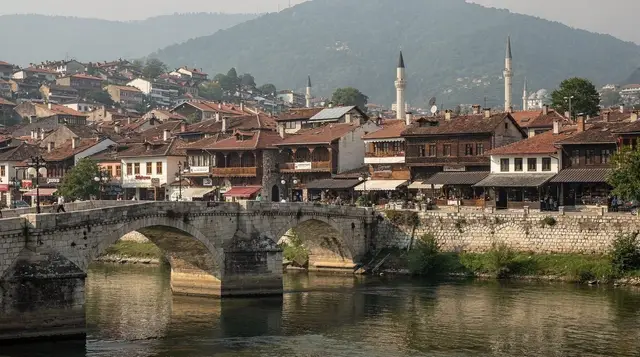
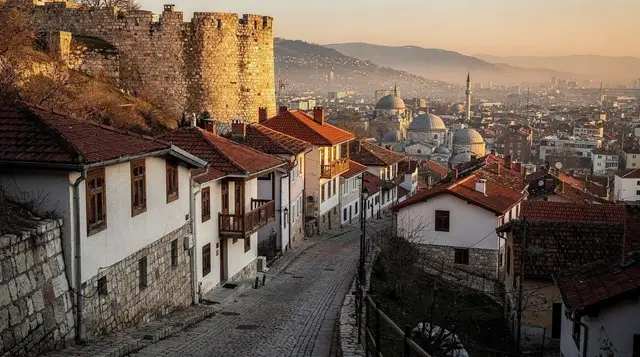
Three days in Sarajevo, plus a day in Mostar
What's a realistic three-day Sarajevo itinerary?
Spend day one and two exactly as you would on a two-day trip — Baščaršija and the Ottoman old town, then the siege sites and Trebević — and give the whole third day to Mostar, 2 hours 15 to 2 hours 30 each way by car or around 2 hours 40 by train. A same-day add-on to Blagaj or Počitelj is possible if you leave Sarajevo early; Kravice or Međugorje in the same day is not.
How the three days split
Three days in Sarajevo is not “two days plus a bit more of the same.” It’s two full days in the city — old town, siege history, the mountain above town — followed by a third day that leaves Sarajevo altogether. That third day goes to Mostar, 130 km and 2 hours 15 to 2 hours 30 away by road, or about 2 hours 40 by train. It’s a real excursion with a real return time, not a loose afternoon, and it’s the thing that separates a three-day trip from a two-day one padded with filler.
| Day | Focus | Where |
|---|---|---|
| Day 1 | Old town, siege sites | Sarajevo city centre |
| Day 2 | Trebević, museums, faiths | Sarajevo hills and centre |
| Day 3 | Mostar day trip | Herzegovina, round trip |
If you want the fuller reasoning behind days one and two — pacing, opening hours, what to skip in each — see two days in Sarajevo, which this itinerary follows exactly for its first 48 hours.
Day one: Baščaršija and the siege
Start in Baščaršija, the Ottoman bazaar founded around 1462 by Isa-beg Ishaković. The Sebilj fountain, built in 1891, is the natural meeting point and a fair place to get your bearings before the crowds arrive — go by 9am if you can. The copper workshops of the Kazandžiluk still hammer sheet metal by hand; it’s worth watching even if you don’t buy. From there, the Gazi Husrev-bey Mosque (1531) is open to visitors outside prayer times for around 5 KM — shoulders and knees covered, headscarves are loaned free at the entrance for women.
Walk west along Ferhadija, the Austro-Hungarian shopping street, to reach the spot where the two empires visibly meet — Ottoman stone paving turns to Habsburg facades within a few metres, marked on the pavement itself. This continues to Vijećnica, the pseudo-Moorish city hall of 1896 that became the National Library and was burned on the nights of 25–26 August 1992, destroying an estimated two million books and manuscripts. It reopened on 9 May 2014; entry is around 10 KM and the rebuilt interior is worth the half hour.
From Vijećnica it’s a short walk to the Latin Bridge, where Gavrilo Princip shot Archduke Franz Ferdinand on 28 June 1914 — the Sarajevo 1878–1918 Museum occupies the corner building. The First World War was triggered here, not simply “started here”; it’s a distinction worth keeping in the way you talk about the spot.
Afternoon is for the siege, which lasted 1,425 days between 5 April 1992 and 29 February 1996 and killed an estimated 11,000 people, including close to 1,600 children — the longest siege of a capital city in modern warfare. This is the most present subject in Sarajevo and it deserves a plain, factual telling rather than anything that sounds like an attraction.
The Historical Museum of Bosnia and Herzegovina covers the siege directly; the War Childhood Museum, winner of the Council of Europe Museum Prize in 2018, tells it through the objects and testimony of people who were children at the time. A guided Sarajevo siege walking tour links these sites with route and context in a couple of hours if you’d rather not self-navigate the day’s heavier material.
Look down as you walk: the Sarajevo Roses — mortar impact scars filled with red resin, marking where people were killed — are set into the pavement across the centre. They aren’t stepped on.
Day two: Trebević, faiths and Vrelo Bosne
Start with the cable car to Trebević, reopened on 6 April 2018 after 26 years out of service, a nine-minute ride from Bistrik up to 1,164 m for around 20 KM return. It’s the fastest way to understand Sarajevo’s shape — a city wedged into the Miljacka valley, hills on three sides. At the top, the 1984 Winter Olympics bobsled track sits abandoned and covered in graffiti, freely walkable and one of the most photographed spots in the city; nearby Bjelašnica hosted men’s skiing and Jahorina the women’s.
Back in town, give an hour to the “Jerusalem of Europe” — a mosque, an Orthodox church, a Catholic cathedral and a synagogue within about fifteen minutes’ walk of each other: the Old Orthodox Church (16th century), the Sacred Heart Cathedral (1889), the Ashkenazi Synagogue (1902) and the Jewish Museum in the former Sephardic synagogue. If timing allows, the National Museum holds the Sarajevo Haggadah, a 14th-century Sephardic manuscript shown only at limited hours — check before making it the reason for your visit.
In the afternoon, take a tram or taxi out to Vrelo Bosne in Ilidža, the spring where the Bosna River begins, reached along the 3.5 km Velika aleja avenue of plane trees on foot, by bike or by horse-drawn carriage. It’s an easy, green counterpoint to two dense history-heavy days.
If you’d rather cover Trebević and the old mahala neighbourhoods on foot with a guide, a city hike through Sarajevo’s traditional mahala neighbourhoods takes in the residential hillside streets most visitors miss entirely, or a broader grand walking tour of Sarajevo ties day one and two’s sights together in a single guided outing if you’re short on planning time.
For a fuller picture of how these two days work together — order, timing, what’s worth skipping — see the dedicated two-day Sarajevo guide.
Day three: why it’s all Mostar
This is where three days earns its shape. Mostar is 130 km from Sarajevo — 2 hours 15 to 2 hours 30 by car, about 2 hours 40 by train — which means a round trip alone takes 4.5 to 5.5 hours out of your day. Treat day three as a Mostar day, full stop, and build in Blagaj or Počitelj only if your timing genuinely allows it.
| Option | One-way time | Approx. cost | Notes |
|---|---|---|---|
| Train | ~2h40 | ~12 KM | Two departures daily, scenic, fixed schedule |
| Self-drive / bus | 2h15–2h30 | Bus fare or fuel | Most flexible for add-ons |
| Guided day tour | 2h15–2h30 | Tour price | Includes commentary, no logistics to plan |
Leave Sarajevo by 7:30–8am regardless of how you travel. In Mostar, the centrepiece is the Stari Most, the Ottoman bridge built in 1566, destroyed on 9 November 1993 during the war and rebuilt to reopen on 23 July 2004; it’s been a UNESCO World Heritage Site since 2005. The local diving club’s jumpers leap from roughly 21 m into the Neretva — they jump when the collection basket among watchers is full, not on a fixed schedule, so don’t plan your day around seeing one.
If you left early and the train timetable or your driving plan allows an extra hour or two, Blagaj — a 16th-century dervish tekke built into a 200 m cliff face at the source of the Buna, one of Europe’s most powerful springs — is about 12 km outside Mostar. Počitelj, a terraced Ottoman village with the Hadži Alija mosque (1563) and its clock tower, sits roughly 20 minutes south, more or less on the way back towards Sarajevo, so it costs you less extra driving than a return trip to Blagaj would.
Don’t attempt both on top of Mostar itself unless you’re driving and started very early — a guided Sarajevo to Mostar and Herzegovina tour with lunch is built around exactly this trade-off and handles the routing for you.
What day three should not include: Kravice Waterfalls or Međugorje. Kravice sits another 30–40 minutes past Mostar, and reaching it on top of Stari Most, the return drive and possibly Blagaj or Počitelj turns a full day into a rushed one where you see everything for twenty minutes. It’s a better fit for its own guided outing — see the Kravice and Blagaj day trip guide — or as a stop if you’re basing part of your trip in Mostar rather than Sarajevo.
The Dubrovnik and Split question
It comes up constantly, so it’s worth being direct: a day trip to Dubrovnik or Split from Sarajevo is not honest on a three-day trip, and arguably not on any trip based in Sarajevo. Dubrovnik is around 280 km and 4.5 hours each way; Split is further. That’s 9 hours or more of driving before you factor in a border crossing out of Bosnia and Herzegovina into Croatia and back — Bosnia and Herzegovina is outside the EU and outside Schengen, so expect a passport check each way, not a wave-through. Doing that round trip for a few hours on the Adriatic coast leaves you exhausted and having barely seen either city.
If the coast is the draw, the honest options are: extend your trip by at least one more day and stay overnight in Dubrovnik, or accept that Mostar — closer, deeply worthwhile, and reachable within a normal day — is what a Sarajevo base genuinely allows. For travellers set on combining both cities properly, the Sarajevo–Mostar three-day itinerary and the transport specifics in getting from Sarajevo to Mostar lay out the realistic version of that plan.
Two stations, one city: a practical note before you book
Sarajevo has two bus stations, and it trips people up. The main bus station, on the Federation side near the city centre, serves Mostar, Zagreb, Split and Vienna — this is the one for day three. The Istočno Sarajevo (Lukavica) station, on the Republika Srpska side, serves Belgrade, Trebinje and destinations east. If you’re booking a Mostar bus or checking a timetable, confirm it’s the main station, not Lukavica — the two are around 20 minutes apart by taxi and missing this distinction is the single most common transport mix-up in the city. Trains to Mostar depart from Sarajevo’s main railway station, adjacent to the main bus station, so no separate crossing of town is needed if you choose rail.
Budget across three days
| Item | Approx. cost |
|---|---|
| Cevapi (10, with somun) | 8–12 KM |
| Bosnian coffee | 2–3 KM |
| Museum or mosque entry | 5–10 KM each |
| Trebević cable car return | ~20 KM |
| Tunnel of Hope entry | 10–15 KM |
| Train to Mostar, one way | ~12 KM |
| Guest apartment, per night | 60–110 KM |
Prices are in convertible marks (KM, BAM), pegged to the euro at 1 EUR = 1.95583 KM — close enough to two KM per euro to convert in your head. Euros are sometimes accepted around Baščaršija and in Mostar, but the exchange rate offered is worse than paying in KM. Sarajevo runs noticeably cheaper than neighbouring Croatia across food, accommodation and museum entry, which is worth factoring in if Mostar has you tempted to cross over for a Croatian coastal add-on instead — see the question above on why that’s not a fit for three days.
Weather and timing notes for this itinerary
May–June and September–early October give the most comfortable conditions for two days of walking plus a day on the road to Mostar, which gets noticeably hotter in the Herzegovina lowlands than Sarajevo’s valley in summer — expect 30–35°C in July and August in both cities. Winter (December–February) brings snow, skiing 45 minutes from town and a genuinely striking old town, but Sarajevo’s valley setting traps an inversion layer that regularly puts the city among the world’s worst for air quality in December and January; check the day’s air quality index and consider that the road to Mostar, which drops in elevation, often clears once you’re out of the Sarajevo basin.
If your three days fall during Ramadan, note that the cannon at the Žuta tabija (Yellow Fortress) marks the breaking of the fast each evening and Baščaršija fills after sunset — worth experiencing on day one or two, treated as the community moment it is rather than a spectacle.
Frequently asked questions about a three-day Sarajevo and Mostar trip
Is three days enough for Sarajevo and Mostar?
Yes, if you accept that day three is entirely given to Mostar. Two full days cover Sarajevo’s old town, siege history and Trebević properly; the third day is a genuine excursion, not a half-day add-on, because the round trip alone takes 4.5 to 5 hours.
Should I drive to Mostar or take the train?
The train is more comfortable and scenic but slower (about 2 hours 40 minutes, two departures a day, around 12 KM) and locks you into a fixed return time. Driving or a guided tour (2 hours 15 to 2 hours 30) gives more flexibility to add Blagaj or Počitelj if you leave Sarajevo by 8am.
Can I fit Kravice waterfalls into a Sarajevo–Mostar day trip?
Not comfortably. Kravice is roughly another 40 minutes past Mostar. Combining Mostar and Kravice in one day from Sarajevo means eight or more hours on the road out of maybe eleven usable hours — it can be done but leaves very little time in Mostar itself. It works far better as its own guided day trip, or from a Mostar base.
Is a day trip to Dubrovnik or Split possible from Sarajevo?
Not honestly, and not on a three-day trip. Dubrovnik is around 280 km and 4.5 hours each way, Split further still — that’s 9 hours or more of driving for a few hours on the coast, before you add a border crossing out of Bosnia and Herzegovina and back in. Mostar, at 2 hours 15 to 2 hours 30, is the trip that actually fits.
Which bus or train station do I need for Mostar?
Sarajevo’s main bus station, on the Federation side near the Holiday Inn, not the Istočno Sarajevo (Lukavica) station on the Republika Srpska side, which serves Belgrade and Trebinje instead. Trains to Mostar leave from Sarajevo’s main railway station, next to the bus station.
Do I need a guide for Mostar, or can I go independently?
Independently is straightforward — buses and trains run daily and Stari Most is a five-minute walk from either station. A guided tour adds commentary on the 1993 destruction and 2004 reconstruction and can bundle in Blagaj or Počitelj without you having to plan onward transport, which matters more on a tight one-day timetable.
What should I skip if I only have three days?
Skip Visoko, Jajce, Travnik and Višegrad — all are worthwhile but need their own day, and squeezing one in on top of an already full Mostar day means arriving back in Sarajevo late and seeing everywhere rushed. Three days is Sarajevo plus one confident regional trip, not five destinations.
City sightseeing tours on GetYourGuide
Verified deep-linked GetYourGuide tours. Book through these links and we earn a small commission at no cost to you.
GetYourGuide does not provide a product photo for this activity — the image shows the meeting point, photographed by us.