Sarajevo in two days: old town to the Tunnel of Hope
How should I split two days in Sarajevo?
Give day one to the old town — Baščaršija, Ferhadija and Vijećnica, finishing at the Latin Bridge. Give day two to the Tunnel of Hope in Butmir and a hilltop view from Žuta tabija or the Trebević cable car. Mostar is 130 km and 2h15 to 2h30 each way, so it does not fit without cutting Sarajevo short.
Two days covers the centre, not the mountains
Two full days is the smallest sensible unit for Sarajevo. One day, covered in our one-day guide, forces you to choose between the old town and the siege story. Two days lets you have both without rushing either: a first day in Baščaršija and the Austro-Hungarian centre, a second day built around the Tunnel of Hope and a view over the city from above. What two days still cannot do honestly is add a day trip — Mostar, Konjic or Jajce need a third day, which is what the three-day guide is for.
This is a walking itinerary. Sarajevo’s old town is compact and mostly flat; the tram does the rest. Budget 8-9 KM (about 4.50 EUR) for two tram tickets a day if you use them, plus museum entries that rarely exceed 10-15 KM each. At the exchange rate of 1 EUR = 1.95583 KM, most prices below round to a euro figure in your head without a calculator.
Day one: Baščaršija, Ferhadija and the Latin Bridge
Morning — the Ottoman bazaar. Start at the Sebilj, the wooden fountain that has been the meeting point of the old town since 1891, then work through Baščaršija, the market founded around 1462 by Isa-beg Ishaković. The Kazandžiluk lane still has coppersmiths hand-beating dishes and coffee sets the way they have for generations — worth ten minutes even if you buy nothing.
Step into the Gazi Husrev-bey Mosque, the largest historic mosque in the country, built in 1531; entry is around 5 KM, and both shoulders and knees need covering (a scarf is lent to women at the door, free of charge). If you would rather have a guide narrate the bazaar’s layers of empire rather than piece it together from plaques, the guided walking tour route runs through here first thing.
a half-day guided walk through Baščaršija and the old town is worth booking the night before if mornings are tight — it covers most of this section in about three hours with a local guide filling in what the plaques leave out.
Midday — Ferhadija and the seam of two empires. Walk west along Ferhadija and you cross, almost mid-street, from Ottoman Sarajevo into the Austro-Hungarian city planned after 1878 — cobbles give way to European facades within a few paces, one of the clearest “line in the pavement” moments in the Balkans. This is also the start of the walk that takes in a mosque, an Orthodox church, a Catholic cathedral and a synagogue inside about fifteen minutes on foot, often called the city’s four-faiths walk. Stop at the Sacred Heart Cathedral (1889) and the Old Orthodox Church if the doors are open; neither charges admission worth noting.
Early afternoon — Vijećnica. The pseudo-Moorish city hall of 1896, later the National Library, is Sarajevo’s most photographed building and one of its most serious sites: it was burned on the nights of 25-26 August 1992, destroying an estimated two million books and manuscripts, and reopened only on 9 May 2014. Entry to Vijećnica is around 10 KM and includes an upper gallery explaining the fire and reconstruction — allow 45 minutes.
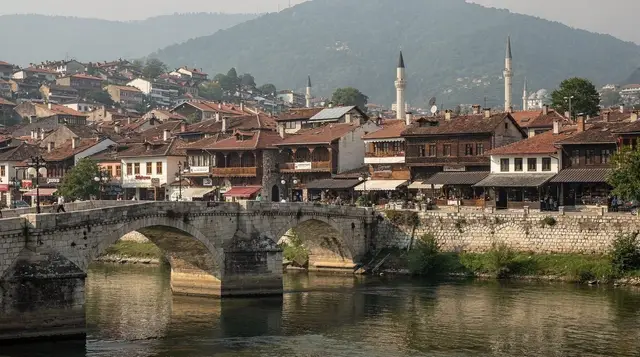
Late afternoon — the Latin Bridge. A short walk along the Miljacka brings you to the Latin Bridge, where Gavrilo Princip shot Archduke Franz Ferdinand on 28 June 1914. The corner building now houses the Sarajevo 1878-1918 museum. It is worth being precise here rather than dramatic: the assassination triggered the chain of alliances that led to the First World War, it did not “start” it single-handedly, and the museum’s small exhibition sets out that chain clearly.
Evening. Baščaršija fills up after dark with grills doing cevapi ten to a portion in warm somun bread, 8-12 KM with onion and kajmak — our cevapi guide has a short list of the ones locals actually queue for rather than the ones nearest the Sebilj. Finish with a bosanska kafa in a džezva, served with a sugar cube on the side rather than stirred in.
Day two: the Tunnel of Hope and a view over the city
Morning — Butmir. The Tunnel of Hope sits under what was Sarajevo’s airport runway, in the Butmir district about 20-25 minutes from the centre by taxi (around 20-25 KM on the meter) or by a combination of tram and bus. Dug by hand in 1993, the 800-metre tunnel was the only route in or out of the besieged city and, for four years, the only way food, fuel, weapons and people crossed the front line. About 20 metres are open to walk through today, alongside a small museum built into the house that hid the original entrance. Entry runs 10-15 KM. Our visiting guide has the current opening hours, since they shift by season.
If you would rather not manage the taxi logistics yourself, a guided siege tour typically bundles the Tunnel of Hope with a drive along what was Sniper Alley and a stop to see one of the city’s “roses” — mortar scars in the pavement filled with red resin where people were killed, never something to stand on for a photograph.
a guided siege walking tour that includes the Tunnel of Hope removes the transport question entirely and gives context a self-guided visit can miss, particularly around Sniper Alley and the airport perimeter.
For a version that adds cycling between sites, a guided bike tour with Tunnel of Hope entry included covers similar ground at a faster pace, useful if the afternoon’s viewpoint is also on the agenda.
Afternoon — choose a viewpoint. Sarajevo sits in a narrow valley ringed by hills on three sides, and seeing that shape from above is the fastest way to understand both the city’s charm and, in winter, its trapped air. Two honest options:
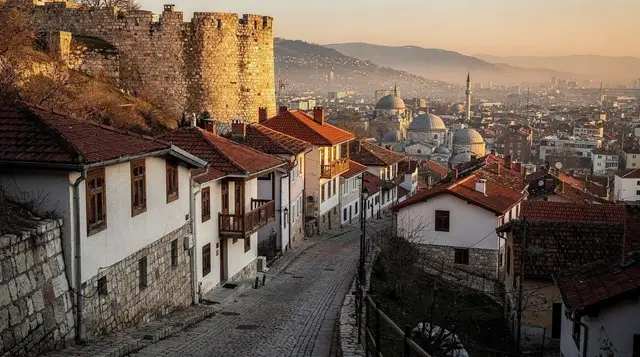
- Žuta tabija (the Yellow Fortress) is free, reached by a fifteen-minute uphill walk from the edge of Baščaršija, and best in the hour before sunset when the call to prayer echoes up from several mosques at once. During Ramadan a cannon is still fired from here to mark the breaking of the fast.
- The Trebević cable car, reopened in April 2018, covers the same idea faster: about nine minutes from Bistrik up to 1,164 m, 20 KM return. At the top, a ten-minute walk reaches the abandoned 1984 Olympic bobsleigh track, now covered in graffiti and one of the most photographed spots in the city.
Either fits after a Tunnel of Hope morning; the cable car needs a bit more of the afternoon once queueing and the walk to the bobsleigh track are counted in.
Evening. Come back down into the centre for dinner somewhere with a view of the river rather than the bazaar — a change of register after a day that started at a wartime tunnel. If the siege and the Yugoslav era both interest you and a second day of context feels worthwhile on a future trip, a Rise and Fall of Yugoslavia tour covers the twentieth-century story in more depth than two days allows.
Why Mostar doesn’t fit here
Mostar is 130 km from Sarajevo, 2h15 to 2h30 each way by road (about 2h40 by the scenic but slower train). Bolted onto a two-day Sarajevo trip as a third-day dash, it becomes four to five hours in a car or minivan for perhaps two hours actually standing on the Stari Most — not a good trade for either city. It is not treated as a stop in this itinerary for that reason. If Mostar matters to you, the honest options are a proper third day (see our Mostar day trip guide and the three-day itinerary above) or an overnight in Mostar itself as a separate leg of the trip, which also opens up Blagaj, Počitelj and Kravice without the round-trip fatigue.
How two days compares to one day or three
| Itinerary | Old town | Siege sites | Viewpoint | Day trip |
|---|---|---|---|---|
| One day | Condensed, Baščaršija and Vijećnica only | Latin Bridge, brief | Optional, if time allows | None |
| Two days (this guide) | Full — Baščaršija, Ferhadija, Vijećnica, Latin Bridge | Tunnel of Hope, Sniper Alley context | Žuta tabija or Trebević cable car | None |
| Three days | Full, unhurried | Tunnel of Hope plus a war museum | Trebević, with time to spare | Mostar or Konjic |
Logistics at a glance
| Day one | Day two | |
|---|---|---|
| Focus | Old town and Austro-Hungarian centre | Siege memory and a hilltop view |
| Main costs | Mosque 5 KM, Vijećnica 10 KM, meals 20-30 KM | Tunnel of Hope 10-15 KM, cable car or none 0-20 KM, taxi to Butmir ~20-25 KM |
| Walking | Mostly flat, under 5 km total | Flat at Butmir, uphill at the viewpoint |
| Best avoided | Midday heat in July-August | Rushing the tunnel to fit both viewpoints |
Getting around and staying nearby
The tram network — the oldest continuously operating urban tram system in Europe, running since 1885 and electrified in 1895 — covers most of this itinerary along the valley floor; a ticket is about 1.80 KM at a kiosk, slightly more bought on board. Full details, including which lines reach Baščaršija and which reach Ilidža, are in the public transport guide.
For arrival logistics from the airport, see getting to Sarajevo. If you haven’t booked yet, the where to stay guide points toward the old town for exactly this kind of two-day, mostly-on-foot visit — anywhere within walking distance of Baščaršija cuts the tram and taxi costs above close to zero.
Cash matters more than cards for this itinerary: mosque and museum entries, tram tickets and the Tunnel of Hope are all cash transactions, and KM is the currency to carry — the euro is sometimes accepted around the old town but at a worse rate than simply paying in KM.
Two days in Sarajevo: questions before you go
Is two days enough for Sarajevo?
It is enough for the old town, the Austro-Hungarian centre and the core of the siege story, including the Tunnel of Hope. It is not enough for the mountains, the four faiths in depth, or any day trip — those need a third day.
Should the Tunnel of Hope go on day one or day two?
Day two. It sits out at Butmir near the airport, a taxi ride from the centre, and pairs naturally with a hilltop view afterwards rather than being squeezed between old-town sights.
Can I fit Mostar into a two-day Sarajevo trip?
Not honestly. Mostar is 130 km and 2h15 to 2h30 each way by road, so a day trip from a two-day base eats most of one day and leaves little energy for either city. Add a third day, or treat Mostar as its own overnight stop.
Žuta tabija or the Trebević cable car — which is better on day two?
Žuta tabija is free, a short uphill walk from Baščaršija, and best near sunset. The Trebević cable car costs around 20 KM return, takes about nine minutes, and reaches the abandoned 1984 Olympic bobsleigh track. Either works after the Tunnel of Hope; the cable car needs more of the afternoon.
Do I need to book the Tunnel of Hope in advance?
Independent entry rarely needs booking, but the museum room is small and coach groups can fill it. A guided siege tour that includes the tunnel is the simpler option if the date matters, since it also covers transport out to Butmir.
Is two days too short to understand the siege?
Two days covers the facts and the physical sites responsibly — Sniper Alley, the Tunnel of Hope, the roses in the pavement. Understanding it properly is a longer process than any visit; the aim here is to see the sites accurately, not to claim the subject is finished in an afternoon.
City sightseeing tours on GetYourGuide
Verified deep-linked GetYourGuide tours. Book through these links and we earn a small commission at no cost to you.
GetYourGuide does not provide a product photo for this activity — the image shows the meeting point, photographed by us.