The Latin Bridge and the assassination of 28 June 1914
Where exactly did the assassination of Archduke Franz Ferdinand happen?
At the corner of Obala Kulina bana and Zelenih beretki, on the Sarajevo bank of the Miljacka right beside the Latin Bridge, on 28 June 1914. The corner building now houses the Museum Sarajevo 1878–1918, a short walk from the Vijećnica.
A street corner that reordered the century
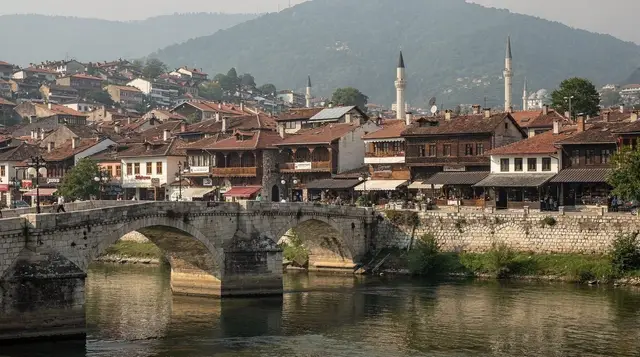
Most of Sarajevo’s landmarks ask for your time before they explain themselves: a mosque, a market, a library. The Latin Bridge asks almost nothing. It is a low stone footbridge over the Miljacka, plain enough that visitors sometimes walk past without noticing they have crossed it. What matters is not the bridge but the pavement at its northern end, where Obala Kulina bana meets Zelenih beretki. On the morning of 28 June 1914, that corner is where Gavrilo Princip, a 19-year-old member of the nationalist group Mlada Bosna, shot Archduke Franz Ferdinand of Austria-Hungary and his wife, Sophie, Duchess of Hohenberg, at close range. Both died within the hour.
The visit itself takes fifteen minutes: the corner, a short look across the river, and the small museum in the building where it happened. Getting the history right takes a little longer, and it is worth doing properly, because this is one of the handful of places on earth where a single quarter of an hour of one morning is genuinely traceable, event by event, to a war that killed millions.
What actually happened that morning
The Archduke’s visit to Sarajevo was already a provocation to some in the city: 28 June is Vidovdan, the Serbian national day commemorating the 1389 Battle of Kosovo, and his presence as heir to the empire that had annexed Bosnia and Herzegovina in 1908 was read locally as a deliberate insult. Six members of Mlada Bosna, armed and positioned along the planned motorcade route on the Appel Quay (today’s Obala Kulina bana), had the same target.
The first attempt failed. Nedeljko Čabrinović threw a bomb at the Archduke’s car; it bounced off the folded convertible roof and detonated under the following vehicle, wounding around twenty people. Čabrinović swallowed a cyanide pill that turned out to be too old to work and jumped into the Miljacka, which in late June is barely knee-deep; he was pulled out and arrested within minutes.
The Archduke insisted on continuing the day’s programme, visiting the wounded at the garrison hospital. His driver, following the original route, turned right onto Franz Josef Street (now Zelenih beretki) by mistake. General Oskar Potiorek, riding in the car, corrected him, and the driver began reversing the car back onto the Appel Quay — directly in front of Moritz Schiller’s delicatessen, on the corner where Princip happened to be standing, having assumed the day’s plot had already failed.
The car stalled. Princip stepped forward and fired twice from less than two metres away. Franz Ferdinand was hit in the neck, Sophie in the abdomen; both were dead within the half hour. Princip tried to turn the gun on himself and was overpowered by bystanders before he could.
The nuance that gets flattened: triggered, not begun
It is common shorthand, in English-language guidebooks and on quiz shows, to say the First World War “started” or “began” in Sarajevo. That is not quite right, and it is worth being precise about why, standing on the corner where it happened.
Nothing military happened here. No shots were exchanged between armies, no border was crossed, no mobilisation order was issued on 28 June. What happened on this corner was an assassination — a targeted political killing of an heir to a throne, one of several in Europe that century, most of which did not lead to continental war.
What turned this one into a war was the month that followed: Austria-Hungary’s ultimatum to Serbia on 23 July, deliberately drafted to be unacceptable; Serbia’s near-total but incomplete compliance; Austria-Hungary’s declaration of war on Serbia on 28 July, exactly a month after the assassination; and then, within days, the interlocking alliance system pulling in Russia, Germany, France, Belgium and Britain in a matter of a week.
The more accurate description, and the one used through this site, is that the war was triggered or set in motion in Sarajevo, not that it began or was fought here. The distinction matters for the same reason precision matters anywhere in this city: it is easy to let a place become a slogan, and this corner deserves the extra sentence.
The museum on the corner: Museum Sarajevo 1878–1918
The building at the corner — the same one that housed Moritz Schiller’s delicatessen in 1914 — now holds the Museum Sarajevo 1878–1918, a small municipal museum covering the forty years of Austro-Hungarian rule in Bosnia and Herzegovina, from the 1878 occupation (formal annexation followed in 1908) through to the assassination that ended the period.
Two rooms, not more, but well used: period photographs of the motorcade and the crowd, newspaper front pages from across Europe reporting the killing, weapons and objects connected to the conspirators, and material on the wider transformation of Sarajevo under Austro-Hungarian administration — the railways, the tramway, the Austro-Hungarian public buildings along Ferhadija that still define the city centre today.
| Museum Sarajevo 1878–1918 | |
|---|---|
| Location | Corner building at the Latin Bridge, Zelenih beretki / Obala Kulina bana |
| Typical hours | Tue–Sun, roughly 10:00–18:00 (summer), 10:00–16:00 (winter); closed Mondays |
| Entry | Around 4–6 KM (about €2–3) |
| Time needed | 15–20 minutes |
| Language | Bosnian and English labelling |
Treat these hours and the price as an order of magnitude rather than a fixed timetable — small municipal museums in Sarajevo shift their hours with the season and occasionally close for short renovations, so it is worth a quick check on the day rather than building a schedule around it months in advance.
What you’re actually looking at outside
Stand on the Sarajevo bank, facing the corner building, and the geography does more explaining than any plaque. The Miljacka is narrow here, and the Latin Bridge — a stone footbridge of Ottoman origin, rebuilt after flood damage more than once, most recently in the late 18th century — crosses it in a few short steps. The Appel Quay the Archduke’s car was travelling along is today’s Obala Kulina bana, the riverside road that runs the length of the old town. The street the driver mistakenly turned into, where the car stalled, is Zelenih beretki. A modest plaque on the corner building marks the spot; it is not a shrine and was not designed as one, and that plainness is arguably the most honest thing about it.
The bridge itself is not the reason to come. On its own, without the museum and the history attached to the corner, it is one of several small stone bridges over the Miljacka, less distinguished architecturally than the Ottoman bridges at Mostar or Konjic. What earns this stop its place on a Sarajevo itinerary is the fifteen minutes of history, not the masonry.
Right next door: the Vijećnica
Walk five minutes east along the riverbank and the pseudo-Moorish facade of the Vijećnica, Sarajevo’s former city hall and national library, comes into view — the same building visible in some of the 1914 photographs of the Archduke’s motorcade, since the route passed directly in front of it. The Vijećnica’s own story belongs to a different, later chapter of the city’s history: opened in 1896, gutted by fire during the shelling of 25–26 August 1992 with the loss of roughly two million books and manuscripts, and reopened as a museum and cultural space on 9 May 2014.
It is worth visiting on the same walk, but as a separate stop with its own separate story — the full details, including its own hours and entry price, are in the Vijećnica visiting guide. Keeping the two visits mentally separate — one about 1914, one about 1896 through 2014 — makes both make more sense.
Fitting it into a day in the old town
The Latin Bridge sits on the natural walking line between Baščaršija, the Ottoman old town, and the Austro-Hungarian quarter along Ferhadija, which makes it easy to include without a detour. A reasonable order, on foot, starting from the Sebilj fountain in the heart of Baščaršija:
- Baščaršija and the Sebilj, ten to fifteen minutes to get your bearings
- Gazi Husrev-bey Mosque, five minutes off the main bazaar street
- South to the riverbank and the Latin Bridge corner, the Museum Sarajevo 1878–1918
- East along Obala Kulina bana to the Vijećnica
- Continue along Ferhadija into the Austro-Hungarian quarter proper
That sequence, unhurried, takes half a day and covers Ottoman and Austro-Hungarian Sarajevo in one continuous walk without backtracking. It also pairs naturally with the city’s harder history: several guided walks that cover the siege of 1992–96 start or finish near this corner, since it sits on the same riverside road as Sniper Alley, a few hundred metres further west.
The two histories, 1914 and 1992, are not the same story and shouldn’t be blurred together, but they share this stretch of riverbank, and a single well-planned walk can honestly cover both without treating either one as a footnote to the other. For that fuller context on the later war, see the siege walking tour guide.
If your time in the city is limited to a single day, this corner fits comfortably into the Sarajevo in one day itinerary; with two days to work with, it sits well on the second day alongside the Vijećnica and the Austro-Hungarian quarter, or you can follow the fixed two-day itinerary if you’d rather not plan the order yourself.
Guided or on your own
Visiting the corner and the museum independently costs nothing beyond the entry ticket and needs no booking — it is a five-minute stop on a public street. A guide adds value here mainly through context: connecting the assassination to the wider Austro-Hungarian period, to the Mlada Bosna group’s motives, and to the July Crisis that followed, which is more than a museum plaque can carry on its own.
Several general city walking tours build this corner into a longer route through Sarajevo’s layered history. The Beyond the Headlines guided walking tour takes a broader run through the city’s modern history, including this stretch of riverbank, for visitors who want the 1914 story set alongside the 20th century that followed it.
For a walk that leans more on the Ottoman and Austro-Hungarian old town, with this corner as one stop among several, the general walking tour of Sarajevo’s old town covers similar ground at an easier pace. If you’d rather see the corner as part of a walk through the older residential mahala neighbourhoods above the centre, the mahala neighbourhoods city hike works the riverbank into a longer, hillier route.
What not to expect
The corner is small, and there is no reconstruction, no wax figures, no dramatic staging — a plaque, a modest two-room museum, and the ordinary traffic of a working city street. Visitors expecting a monument on the scale of the event itself are sometimes disappointed by how quiet and unassuming it is; that plainness is, if anything, the more honest response to a killing rather than a battle.
If you want a fuller museum experience of the same period and the decades either side of it, the National Museum of Bosnia and Herzegovina has a substantially larger collection, including archaeology and the Sarajevo Haggadah on its limited viewing schedule — details in the National Museum visiting guide and the Sarajevo Haggadah guide — and the city’s museums are compared as a set here if you’re deciding which to prioritise with limited time.
For a broader first-time orientation to the city before you set out, see the Sarajevo first-time guide, and for the handful of overpriced or overhyped stops worth skipping elsewhere in town, the Sarajevo tourist traps guide is a useful companion.
The Latin Bridge and the assassination: questions answered
Where exactly did the assassination of Archduke Franz Ferdinand happen?
At the street corner beside the Latin Bridge, on the north bank of the Miljacka, where Zelenih beretki meets Obala Kulina bana. Franz Ferdinand’s car had taken a wrong turn onto that corner and stalled while reversing, and Gavrilo Princip shot him and his wife Sophie at close range from the pavement.
Did the First World War start at the Latin Bridge?
No. The assassination triggered a chain of ultimatums and alliance obligations across July 1914 that led to declarations of war roughly a month later. Sarajevo is accurately described as the place the war was triggered or set in motion, not the place it began or was fought.
What is the Museum Sarajevo 1878–1918 and what is inside?
It occupies the corner building where the assassination took place, with period photographs, newspaper front pages, weapons of the period, and material on the Austro-Hungarian administration of Bosnia between 1878 and 1918, ending with the events of 28 June.
What are the museum’s opening hours and entry price?
Typically open Tuesday to Sunday, roughly 10:00 to 18:00 in the warmer months and 10:00 to 16:00 in winter, closed Mondays. Entry runs around 4–6 KM, about €2–3. Hours shift with the season, so check the day you plan to go.
Is the Latin Bridge itself worth stopping for?
As a bridge on its own, briefly. It is a modest Ottoman-era stone footbridge over the Miljacka, rebuilt more than once. What makes the stop worthwhile is the corner and the museum, not the masonry.
How far is the Latin Bridge from the Vijećnica?
About 300 metres, five minutes on foot along the riverbank. The two sights sit close together but cover different periods: this corner is about 1914, the Vijećnica is about the 1896 building, the 1992 fire, and the 2014 reopening.
Can I visit the Latin Bridge and museum as part of a walking tour?
Yes, most general history walking tours of Sarajevo include this corner as a stop, since it sits directly on the route between Baščaršija and the Austro-Hungarian quarter along Ferhadija.
City sightseeing tours on GetYourGuide
Verified deep-linked GetYourGuide tours. Book through these links and we earn a small commission at no cost to you.
GetYourGuide does not provide a product photo for this activity — the image shows the meeting point, photographed by us.