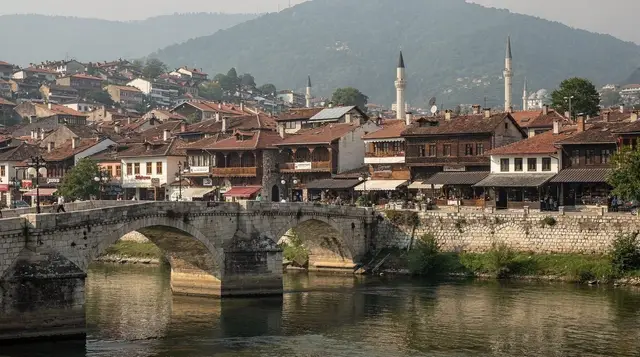
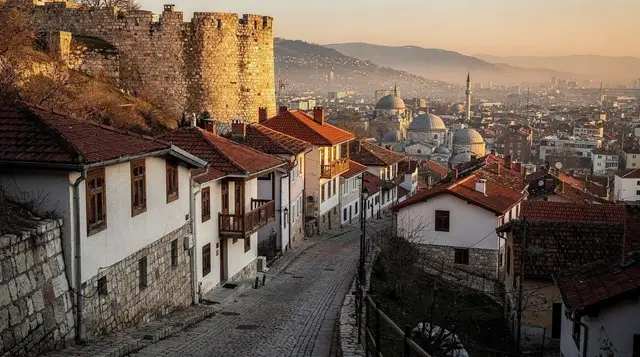
Sarajevo in one day: an hour-by-hour itinerary
How can I see Sarajevo in one day?
Spend the morning in Baščaršija and at the Gazi Husrev-beg Mosque, then Vijećnica and the Latin Bridge before lunch, and ride the Trebević cable car in the afternoon for the view over the city. Skip the Tunnel of Hope and any Mostar day trip — there isn't time for both without rushing the old town.
What one day actually covers
A single day in Sarajevo is enough to walk the old town properly, stand in the mosque courtyard, see Vijećnica rebuilt and the corner where the First World War was triggered, and ride a cable car up to a view that explains the whole city in nine minutes. It is not enough for the Tunnel of Hope, a serious war museum, or a trip to Mostar. Every version of this itinerary that tries to fit all of it in ends the same way — a rushed half-hour at each stop and a missed cable car slot. This one assumes you have one day, names what gets cut, and times the rest so you actually enjoy it.
If you have a second day, read the Sarajevo in two days guide and put the Tunnel of Hope there. If you have three, add Sarajevo in three days and a day trip. For the fixed one-day version, here’s the schedule.
The day at a glance
| Time | Stop | Duration |
|---|---|---|
| 8:30–10:00 | Baščaršija and the Sebilj | 1h30 |
| 10:00–11:00 | Gazi Husrev-beg Mosque and Ferhadija | 1h |
| 11:15–12:30 | Vijećnica and the Latin Bridge | 1h15 |
| 12:30–13:30 | Lunch: ćevapi | 1h |
| 13:45–16:30 | Trebević cable car and the bobsleigh track | 2h45 |
| 16:30–18:00 | Back down, free time or a coffee in Baščaršija | flexible |
Times assume a mid-May to September day with long light. In winter, start the same time but plan to be down from Trebević by 4:30pm before dusk.
8:30–10:00: Baščaršija and the Sebilj
Start at the Sebilj, the wooden Ottoman fountain built in 1891 that is the de facto meeting point for the entire city. From here, Baščaršija — the bazaar quarter founded around 1462 by Isa-beg Ishaković — spreads out in narrow lanes still organised by trade. The Kazandžiluk street is where the kazandžije, the coppersmiths, still hammer sheet copper into coffee pots and trays; walk it slowly, since this is one of the few crafts in the old town that hasn’t been replaced by souvenir stalls selling the same magnets.
Budget 45 minutes to an hour here before the mosque opens properly for visitors, longer if you want a Bosnian coffee — a small cup of thick, unfiltered coffee served in a copper džezva with a cube of sugar and often a piece of rahat lokum, around 2 to 3 KM (roughly 1 to 1.50 EUR). This is also the easiest place in the city to book a guided walk if you’d rather have context than a map: the Grand Walking Tour covers Baščaršija and the Austro-Hungarian quarter on Ferhadija in around two and a half hours, which is close to the pace of this itinerary’s morning if you’d rather not navigate it yourself.
By 9:30am, head toward the mosque — this is also roughly when the morning cool starts to lift in summer, so earlier is better between June and August.
10:00–11:00: Gazi Husrev-beg Mosque and Ferhadija
The Gazi Husrev-beg Mosque, completed in 1531, is the largest historical mosque in the country and still an active place of worship. It’s open to visitors outside prayer times; entry runs around 5 KM (roughly 2.50 EUR). Shoulders and knees need to be covered, and a headscarf is provided free at the entrance for women who need one — there’s no need to bring your own. Give the courtyard and interior 20 to 30 minutes.
From the mosque, walk west along Ferhadija, the pedestrian street where Baščaršija’s Ottoman lanes give way abruptly to Austro-Hungarian facades — there’s a line embedded in the pavement marking exactly where one era stops and the other starts. It’s a five-minute walk that says more about the city’s layered history than most museum panels do. If this transition interests you, the Ferhadija Austro-Hungarian walk guide covers it building by building for a future visit.
11:15–12:30: Vijećnica and the Latin Bridge
Vijećnica, the pseudo-Moorish city hall completed in 1896, is the most photographed building in Sarajevo and one of the most quietly devastating. It burned on the nights of 25 and 26 August 1992, during the siege, taking an estimated two million books and manuscripts with it — a deliberate loss, not collateral damage. It reopened, restored, on 9 May 2014, and now houses the National and University Library’s reading rooms and rotating exhibitions. Entry is around 10 KM (roughly 5 EUR); give it 45 minutes, including the stained-glass atrium, which is worth the ticket price on its own.
From Vijećnica, it’s a seven or eight-minute walk along the river to the Latin Bridge, where Gavrilo Princip shot Archduke Franz Ferdinand on 28 June 1914. The corner building now houses the Sarajevo 1878–1918 museum. It’s worth being precise here: the assassination triggered the First World War’s chain of alliances — it didn’t simply “start” the war in isolation, and the small museum explains that chain better than the bridge itself does. Fifteen minutes at the bridge is enough unless you go into the museum, which adds 30 to 45.
That’s the morning: old town, mosque, city hall, and 1914, done by half past twelve without feeling rushed.
12:30–13:30: Lunch
Sarajevo’s ćevapi are served by the ten, tucked into a somun flatbread with raw onion and a spoon of kajmak — order “deset ćevapa” and you’ll get the standard portion without needing much Bosnian. Expect 8 to 12 KM (roughly 4 to 6 EUR) at an old-town spot near Baščaršija; a burek — here the word specifically means the meat-filled version, with sirnica, krompiruša and zeljanica covering cheese, potato and spinach — runs 3 to 5 KM. A pressed beer alongside is 3 to 5 KM. An hour is enough, including the walk back toward Baščaršija for a taxi or the short walk to catch a tram toward Bistrik.
13:45–16:30: the Trebević cable car and the bobsleigh track
This is the single best-value afternoon in the city. The Trebević cable car reopened on 6 April 2018 after 26 years out of service — the original line, opened for the 1959 Youth Games, was destroyed during the siege — and now carries visitors from Bistrik, just above the old town, to 1,164 metres in around nine minutes. A return ticket is roughly 20 KM (about 10 EUR). This is the view that makes sense of everything you’ve walked through so far: Sarajevo sitting in a narrow valley along the Miljacka, hemmed in by mountains on three sides, with Baščaršija’s rooftops and minarets laid out below.
At the top, the abandoned 1984 Winter Olympics bobsleigh track is a 15 to 20-minute walk from the upper cable car station, well signposted. Concrete, cracked, entirely covered in graffiti, and completely unguarded — you can walk its full length. It’s one of the most photographed spots in the city for good reason, but it’s also a direct, physical reminder of how fast the city’s fortunes turned: an Olympic venue in 1984, a front line eight years later. Give the track itself 45 minutes to an hour if you want to walk a meaningful stretch of it.
Two and a half to three hours for the round trip, the view, and the bobsleigh track is realistic. If you’d rather have a guide explain the Olympic and siege history on the way up, the Siege Walking Tour covers Trebević alongside sites in the city centre, though it runs on its own schedule rather than slotting neatly into this one.
Stay off marked trails anywhere in the hills around Sarajevo. Trebević itself is cleared and safe on the paths visitors actually use, but Bosnia and Herzegovina still has suspected minefields in rural and forested areas, and the rule that matters everywhere in the country is the same: stick to marked paths and frequented ground, and don’t wander off them out of curiosity.
16:30–18:00: back down
Ride the cable car back to Bistrik and you’re a five-minute walk from Baščaršija again. This is genuinely free time — an early dinner, a second coffee, a slower pass through the Sebilj square as the evening crowd builds, or, if you have energy left, a look at the Old Orthodox Church or the Sacred Heart Cathedral, both a short walk from the square and both open into the evening. There’s no fixed plan for this slot on purpose — it’s the buffer that keeps the rest of the day from feeling like a checklist.
What this itinerary cuts, and why
Two things get left out on purpose, and both are worth doing on a future visit rather than squeezed into this one.
The Tunnel of Hope — the 800-metre hand-dug tunnel under the airport runway that was the city’s only link to free territory during the siege — sits in Butmir, near the airport, roughly 25 to 30 minutes each way by taxi from the centre. A proper visit, including the small museum and the surviving stretch of tunnel, runs to an hour on site. Once you add the return trip, that’s the best part of three hours — more than this itinerary has spare.
It deserves its own morning rather than a rushed detour, and the Tunnel of Hope visiting guide covers it properly. If the siege history matters more to you than the mountain view, swap the afternoon: skip Trebević and book the guided bike tour with entry to the Tunnel of Hope instead, which covers the tunnel and Sniper Alley in around three hours.
Mostar is roughly 130 kilometres away, two hours 15 to two hours 30 by car each way. Even a lean version of a Mostar visit — the Stari Most, Kujundžiluk, an hour to look around — needs five hours round trip once you add the road. That’s not a plausible add-on to a day that already includes the old town and Trebević; it’s a separate day. If Mostar is non-negotiable for your trip, the honest options are to give Sarajevo two days and Mostar a third, or to trade this entire itinerary for a single long day built around Mostar instead — see the Mostar day trip from Sarajevo guide for that version.
Getting around during the day
Everything in the morning and lunch sections is walkable — Baščaršija, the mosque, Ferhadija, Vijećnica and the Latin Bridge sit within a compact 15 to 20-minute walking loop, and none of it needs transport. For Bistrik and the cable car, it’s a 10 to 15-minute walk uphill from Baščaršija, or a short taxi ride if you’d rather save the legs for Trebević itself.
Sarajevo’s tram network — Europe’s oldest continuously operating urban tram system, running since 1885 — is useful mainly if you’re staying outside the old town; a ticket is around 1.80 KM (about 0.90 EUR) from a kiosk, slightly more bought on board, and needs to be validated once you’re on. None of the day’s stops require it if your accommodation is anywhere near Baščaršija, which is where most first-time visitors base themselves.
Practical notes for the day
Carry cash. Cards are accepted at restaurants and the cable car, but the mosque donation box, small kiosks, and some Baščaršija stalls are cash-only, and the currency is the convertible mark (KM, code BAM), fixed at 1 EUR to 1.95583 KM — near enough 2 KM to the euro to convert in your head. Euros are occasionally accepted around the old town but at a poor rate; pay in KM.
Dress for the mosque before you arrive at it rather than scrambling at the door — shoulders and knees covered, and remember shoes come off inside. Summer afternoons in the valley run to 30–35°C, so the Trebević ride is also a reasonable way to escape the heat for an hour. In winter, check the day’s air quality before committing to a full day outdoors: the temperature inversion that settles over the valley regularly pushes Sarajevo into the world’s worst-air-quality rankings in December and January, and the hills around Trebević are usually well above the haze that sits over the centre.
If you’d rather have someone else handle the morning’s navigation and history entirely, the neighbourhood-focused City Hike Through the Traditional Mahala Neighborhoods is a slower alternative to a straight Baščaršija walk, threading through residential lanes above the bazaar that most one-day visitors never see — worth considering if you’ve done Sarajevo’s old town before and want a different angle on the same morning slot.
Sarajevo in one day: frequently asked questions
Is one day enough to see Sarajevo?
It’s enough to see the old town properly and understand the shape of the city, not to cover everything. A single day gets you Baščaršija, the Gazi Husrev-beg Mosque, Vijećnica, the Latin Bridge and the Trebević cable car. It doesn’t get you the Tunnel of Hope, the war museums in any depth, or a day trip to Mostar.
What should I skip if I only have one day in Sarajevo?
Skip the Tunnel of Hope in Butmir and any Mostar excursion. Both are worthwhile, but each needs the best part of half a day on its own once you count travel time, and squeezing either in means rushing the old town instead of walking it properly.
What time should I start a one-day Sarajevo itinerary?
Start at Baščaršija by 8:30am, before the tour groups and the heat in summer. Starting later than 9:30am usually pushes the cable car ride past the best light and risks a queue at Bistrik station in July and August.
Can I fit the Tunnel of Hope into a one-day visit?
Not alongside everything else in this itinerary. The tunnel museum sits in Butmir, near the airport, and a proper visit with travel time runs to three hours. Come back for a second day, or read the Tunnel of Hope visiting guide and swap it in for the cable car if the siege history matters more to you than the view.
Is the Trebević cable car worth it on a short visit?
Yes. Nine minutes from Bistrik to 1,164 metres gives you the one view that makes sense of Sarajevo — a city in a narrow valley, ringed by mountains on three sides. It’s also the fastest way to reach the abandoned Olympic bobsleigh track, which is worth the short walk once you’re up.
Do I need to book anything in advance for a one-day trip?
Not usually. The mosque, Vijećnica and the cable car all sell tickets on site, and queues are short outside July and August. A guided walking tour is worth booking a day ahead in high season, mainly to fix your start time rather than to guarantee a place.
Can I do Sarajevo and Mostar in one day?
Not this itinerary’s version of Sarajevo. Mostar is around 130 kilometres and two hours fifteen minutes each way by car, so combining it with a proper morning and afternoon in Sarajevo means rushing both. If Mostar matters to you, give Sarajevo two days and Mostar its own day, or read the Mostar day trip from Sarajevo guide.
City sightseeing tours on GetYourGuide
Verified deep-linked GetYourGuide tours. Book through these links and we earn a small commission at no cost to you.
GetYourGuide does not provide a product photo for this activity — the image shows the meeting point, photographed by us.