Getting around Sarajevo by public transport
How does public transport work in Sarajevo?
Sarajevo runs one integrated network of trams, trolleybuses and buses along the Miljacka valley. A single ticket costs around 1.80 KM (about 0.90 EUR) from a kiosk, slightly more if bought on board, and must be validated in the machine as soon as you get on. Services run from early morning to around 11pm-midnight, with reduced frequency on Sundays.
One network, one ticket, one valley
Sarajevo’s public transport looks more complicated than it is because three different kinds of vehicle share the same corridor: trams on rails, trolleybuses drawing power from overhead wires, and diesel buses filling in everywhere else. All three run on the same ticket, the same validating machines and, broadly, the same operating hours. Once that clicks, the network stops being a puzzle and becomes what it actually is: a single east-west line with a few branches, built to move people along a valley that is barely two kilometres wide in places.
This page is the practical overview: what the network covers, what a ticket costs, where to buy one, and why services line up the way they do. For the tram network’s own history, route numbers and the vintage rolling stock still running on line 3, see our tram guide. For taxis, including fair fares and apps, see the taxi guide.
Why everything runs east-west
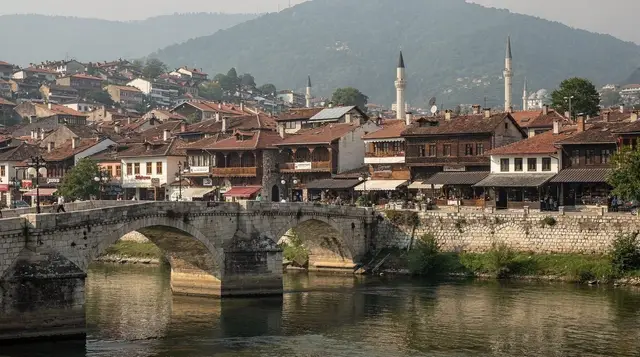
Sarajevo sits at roughly 500 metres of altitude, squeezed into the narrow valley of the Miljacka, with hills climbing steeply on three sides. There is, practically speaking, only one flat corridor through the city, and it runs from the old town at Bascarsija in the east, through the Austro-Hungarian centre, past Marijin Dvor and the newer district of Novo Sarajevo, out to Ilidza and the Vrelo Bosne park in the west. Trams and trolleybuses follow that same corridor for most of their length, which is why a first-time visitor can get to a surprising number of sights just by riding one line end to end.
Everything that isn’t on that flat line has to climb, and that’s where buses take over. The hill neighbourhoods above the centre, the road up towards Trebevic, and the residential districts on higher ground are served by bus routes that branch off the valley floor and switchback upward. There’s no equivalent of a funicular for most of these; the exception is the Sarajevo cable car, which is a separate, paid attraction rather than part of the everyday transport ticket, and which we cover on its own page.
Trams: the spine of the city
The tram line running through central Sarajevo dates back to 1885, originally horse-drawn and electrified in 1895, which makes it one of the oldest continuously operating urban tram networks in Europe. Six numbered lines share overlapping sections of the same central corridor, splitting off toward different endpoints at either end. For a visitor, the useful fact is simpler than the full route map: any tram heading toward Bascarsija will take you into the old town, and any tram heading the other way will eventually reach Ilidza, on the western edge of the city, near Vrelo Bosne.
Trams are the easiest way to get a first sense of the city’s layout. A ride from one end of the line to the other, with no stops, takes well under an hour and passes the Vijecnica, the Latin Bridge, Marijin Dvor and the old Austro-Hungarian streets. We’ve written a longer piece on riding the historic line 3 specifically, if the tram itself is part of the interest rather than just the transport.
Trolleybuses and buses: filling the gaps
Trolleybuses run on rubber tyres but draw power from overhead cables, the way trams do, and they cover routes that branch slightly off the main tram corridor, often reaching a bit further into side streets before rejoining it. To a passenger they behave exactly like a bus: same doors, same validating machine, same ticket.
Ordinary diesel buses cover the rest: the hill neighbourhoods, the outer suburbs, and crucially the areas the tram and trolleybus lines don’t reach at all, including the road out towards Ilidza on some routings, and connections up toward the lower slopes of Trebevic. If you’re staying somewhere above the centre, in one of the hillside neighbourhoods, a bus is very likely your daily option rather than a tram.
Buying a ticket
A single ticket costs around 1.80 KM, a little under 1 EUR, bought from one of the small street kiosks that sit near tram stops and major bus stops across the city. Buying on board, from the driver or conductor, is possible on buses and trolleybuses but costs more, typically 2 to 2.50 KM, and isn’t always an option on trams, where kiosk tickets are the norm.
There is, as of now, no citywide ticketing app that visitors can rely on. Don’t plan around finding one on your phone; instead, note the location of a kiosk near your accommodation on your first day, and buy two or three tickets at once so you’re not searching for one every time you want to move.
a lounge stop after landing at Sarajevo airport is one option if you’d rather sit down with a coffee and work out the ticket system calmly before heading into town, especially after a long flight.
Validating your ticket
Every ticket, whether bought at a kiosk or on board, has to be validated the moment you get on. Small yellow or grey machines are mounted near the doors; you insert the ticket and it stamps the time. This step trips up a lot of visitors who assume a kiosk ticket is already “activated” — it isn’t. Inspectors do board and check, particularly on trams through the centre, and an unvalidated ticket counts as travelling without one, with a fine to match. It takes two seconds and is worth doing on reflex every single time.
Timetables and frequency
Trams and trolleybuses generally start running around 5 to 6am and continue until roughly 11pm to midnight, depending on the line, with the busiest central routes running every few minutes during the day. Frequency drops noticeably in the evening and drops again, significantly, on Sundays, when some routes run on a reduced schedule with considerably longer gaps between vehicles. If you’re relying on public transport for a Sunday evening dinner reservation or an early Monday departure, build in extra waiting time rather than assuming weekday frequency.
There’s no posted app-based live tracking that visitors can count on, so the practical approach is the old one: check the timetable posted at the stop, or simply allow a bit of slack, since a tram or bus along the main corridor rarely takes more than 10 to 15 minutes to appear even outside peak times.
Where public transport won’t take you
The network is genuinely useful for the flat central corridor and reasonably useful for the nearer hill neighbourhoods, but it has real limits worth knowing before you build a day around it.
| Trip | Public transport | Better option |
|---|---|---|
| Bascarsija to Ilidza | Tram, direct, easy | Tram is fine |
| Centre to airport | Bus/tram plus a change | Taxi, 20-25 KM |
| Centre to Trebevic cable car base | Bus to Bistrik area, short walk | Taxi if short on time |
| Centre to Lukomir or Bjelasnica | Not covered | Organised tour or car |
| Centre to Mostar | Not covered by city tickets | Train or bus |
For the airport specifically, a taxi at 20 to 25 KM on the meter, roughly a 20 to 25 minute ride, is usually the sensible choice on arrival with luggage, even though a bus and tram combination exists. Our airport transfer guide sets out both options in detail.
For anything up in the mountains, whether that’s a hike toward Trebevic or a full day out to Lukomir, city tickets stop being relevant and you’re into the territory of an organised trip or a rented car. If walking the city’s older neighbourhoods on foot rather than by wheel sounds more appealing than working out bus branches, a guided walk through Sarajevo’s traditional mahala neighbourhoods covers exactly the hillside streets the buses only skirt.
For the tunnel that kept wartime Sarajevo connected to the outside world, out near the airport, a guided bike tour that includes entry to the Tunnel of Hope is a more direct way to reach it than working out the bus route on your own. And if the appeal is getting properly up into the hills above the city, a guided hike along the highlands path with lunch included starts from where the buses stop being useful.
Two bus stations, one common mistake
Sarajevo has two separate long-distance bus stations, and mixing them up is one of the most common planning mistakes visitors make. The main station, on the Federation side of the city, handles departures to Mostar, Zagreb, Split and Vienna. A second station, at Istocno Sarajevo (Lukavica), on the Republika Srpska side, handles Belgrade, Trebinje and destinations to the east. Neither the city tram nor trolleybus network connects the two directly in a single hop, so always check which station your ticket departs from before you book, and allow time to get there. We go through this split in more detail, including which local buses connect each station to the centre, in a separate piece on the two stations.
Trains, for the routes they actually cover
Sarajevo’s rail network is limited but worth knowing about for two specific routes: Sarajevo to Mostar and on to Capljina runs twice a day, and is considered one of the more scenic train rides in Europe, while a single daily service connects Sarajevo to Banja Luka. Trains don’t use city transport tickets and don’t cover commuting within Sarajevo itself, so for getting around town day to day they’re not part of this picture, but they’re a genuinely pleasant option for the Mostar leg of a longer trip. Our Bosnia train guide has current timings.
Driving instead
Some visitors decide the tram-trolleybus-bus system is more effort than it’s worth and rent a car instead, particularly if day trips further afield are part of the plan. It’s a reasonable call for trips to Konjic, Jajce or Travnik, though parking and one-way streets in the historic centre make a car a liability for sightseeing within Sarajevo itself. If that’s the direction you’re leaning, our guides to driving in Bosnia and car rental in Sarajevo cover what to expect, including the paperwork for crossing into Republika Srpska or Croatia.
Putting it together for a first visit
For most first-time visitors, the practical approach is: buy several tickets from a kiosk on day one, keep a couple spare in your pocket, validate every single ride without exception, and default to the tram or trolleybus for anything along the Bascarsija-to-Ilidza corridor. Switch to a bus once you’re heading into the hills, and switch to a taxi for the airport, for anything after midnight, or for a Sunday evening when frequencies thin out. That combination covers the overwhelming majority of what a visitor needs, and it costs a fraction of what taxis alone would.
If you’re still mapping out the shape of a first visit before worrying about how to move between sights, our one-day and trip-planning guides are the better starting point, and our budget breakdown shows where a 1.80 KM ticket fits against the rest of a day’s spending.
Sarajevo public transport: questions worth checking before you travel
How much does a Sarajevo public transport ticket cost?
Around 1.80 KM (roughly 0.90 EUR) from a street kiosk, and a little more, usually 2-2.50 KM, if you buy it from the driver or conductor on board. There is no discount for buying several tickets at once, and no day pass sold to visitors at kiosks.
Do I need to validate my ticket?
Yes. Every ticket has to be stamped in the small validating machine near the doors as soon as you board, even if you bought it minutes earlier at a kiosk. Inspectors do check, especially on the tram, and an unvalidated ticket is treated as no ticket at all.
Is there an app to buy tickets in Sarajevo?
Not a reliable one for visitors. Ticketing in Sarajevo is still mostly analogue: paper tickets from kiosks or from the driver. Do not plan a trip around a phone app working; instead, note a couple of kiosks near where you are staying before you need one.
What is the difference between the tram, the trolleybus and the bus in Sarajevo?
They all use the same ticket and the same validating machines. Trams run on rails along the valley floor between Bascarsija and Ilidza. Trolleybuses run on the same general corridor but reach a little further up some side streets, drawing power from overhead wires. Buses cover everywhere neither of those go, including the hill neighbourhoods and the airport area.
How late do trams and buses run in Sarajevo?
Most lines start around 5-6am and the last departures are around 11pm to midnight, depending on the line. Sunday services run on a reduced timetable with longer gaps between vehicles, so build in extra waiting time if you are travelling on a Sunday evening.
Can I get from Sarajevo Airport to the centre by public transport?
Yes, but it takes a bus or tram connection rather than one direct line, and a taxi at 20-25 KM on the meter is often the more practical choice for a first arrival with luggage. See our dedicated airport transfer guide for the current route.
Which bus station do I need for onward travel from Sarajevo?
Check carefully: Sarajevo has two separate bus stations. The main station on the Federation side handles Mostar, Zagreb, Split and Vienna; the station at Istocno Sarajevo (Lukavica), on the Republika Srpska side, handles Belgrade, Trebinje and points east. Buying a ticket at the wrong one is a common and avoidable mistake.
Sarajevo nightlife on GetYourGuide
Verified deep-linked GetYourGuide tours. Book through these links and we earn a small commission at no cost to you.
GetYourGuide does not provide a product photo for this activity — the image shows the meeting point, photographed by us.