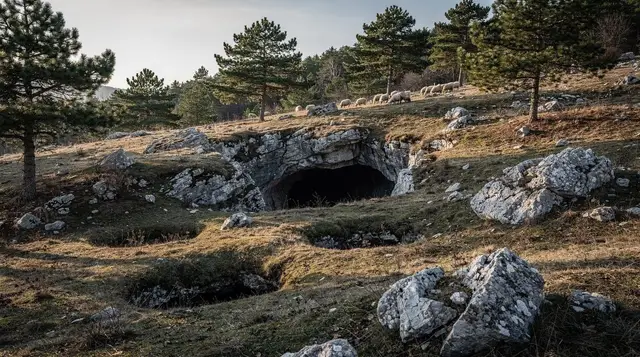
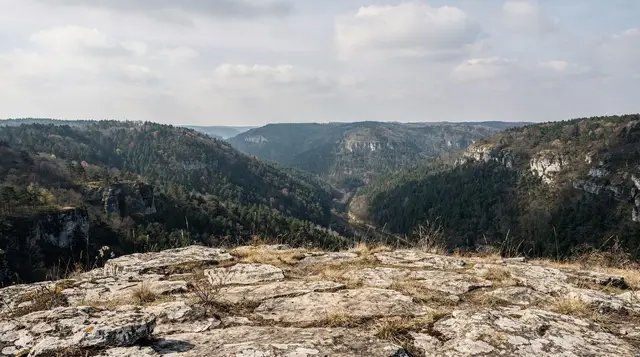
The bobsleigh track today
I went up to Trebević for the view, the first time. Everyone does. You buy a return ticket for around 20 KM, queue for the cable car, and nine minutes later the whole basin opens up below you — the tower blocks of Novo Sarajevo, the minarets of Baščaršija catching the light, the ridge of mountains closing the valley on every side. I hadn’t planned to walk any further than the viewing platform. Then I saw a couple of people heading off along a path into the trees with the unmistakable look of people who knew exactly where they were going, and I followed.
Twenty minutes later I was standing in a concrete chute wide enough for two people to lie side by side, curling away downhill through the pines, every surface of it painted. That’s the Olympic bobsleigh and luge track, and it’s one of the more unusual things you can walk into in this city without a ticket, a fence, or anyone telling you where to stand.
What actually happened here in 1984
Sarajevo hosted the XIV Winter Olympic Games from 8 to 19 February 1984, the first Winter Games held in a socialist country and, at the time, a genuine point of civic pride for the city. The alpine skiing went to Bjelašnica for the men’s events and Jahorina for the women’s, cross-country and biathlon were spread around Igman, and the bob and luge track was cut into the northern slope of Trebević, close enough to the city that spectators could ride up and watch.
It’s easy to forget, walking the track today, that this was a fully engineered piece of Olympic infrastructure: a refrigerated concrete run built to hold ice through a competition, with a start house, timing points and a finish area lower down the slope. I found photographs of it afterwards, athletes crouched into sleds in national colours, and it’s a strange thing to match those images to the ruin I’d just walked through.
The Games themselves ran well and the city was, by most accounts, proud of how it pulled them off. What came eight years later — the siege that began in April 1992 — is a different subject, and one this site covers properly elsewhere rather than folding it into a walk up a mountain. If you want that history in full with someone talking you through it, a walking tour of the siege years in the city centre is one route, and the siege walking tour and the wider 1984 Olympics legacy guide go into it with the space it needs. I’d rather describe what’s actually in front of you on Trebević today, which is a piece of sports infrastructure that stopped being maintained and has spent three decades weathering, decaying and being repainted.
a guided walk that traces the arc from the 1984 Games through Yugoslavia’s collapse covers that fuller context if you’d rather have someone explain it as you go, but you don’t need a guide for the track itself — the path is obvious and the walk is short.
The walk from the cable car
The route starts at the upper Trebević cable car station. From there a signed path runs along the ridge, mostly flat with a short climb, through pine forest that keeps you in shade most of the year. It’s an easy walk in trainers; I wouldn’t do it in the rain in anything with no grip, since the concrete of the track itself gets slick. If you’d rather have the ride and the walk arranged in one go, there is a combined cable car and bobsleigh track outing on Trebević, though the independent version is just as easy. After about twenty minutes the path meets the top of the run, marked by a low retaining wall covered floor to ceiling in spray paint, and from there you can walk the track itself for a good stretch downhill — inside the chute, along the top edge, whichever you prefer.
What struck me most was the shape of the thing. A bobsleigh track is built for speed and containment, so it curves and banks in ways that feel deliberate even now, decades past any use. Trees have pushed roots under sections of the concrete and cracked it in places. Water pools in the lower curves. And everywhere, layered over years, is graffiti — political slogans, memorial pieces, straightforward tags, the occasional genuinely good mural. It’s not maintained as a tourist site and it’s not managed as one either: no signage explaining the sport, no barrier, no ticket booth. You just arrive at it.
That combination — Olympic engineering, total abandonment, and a wall of colour running the length of a forest slope — is exactly why it turns up on so many phones. It photographs well from almost any angle: standing inside the curve looking down the chute, framed through the trees from above, close on individual pieces of art. I’d guess it’s the most photographed single spot in the city that isn’t in Baščaršija or on one of the official viewpoints. It earns that partly on the history and partly, honestly, on how it looks right now — not as a shrine to 1984, just as an interesting, faintly eerie place to be standing.
A practical note, not a sentimental one
I want to be straightforward about a couple of things rather than romanticise the site. First, it is genuinely abandoned — no lighting, no phone signal in patches, no one checking on you — so go with a friend or at a sensible time of day and tell someone your plan if you’re heading up solo. Second, and more importantly: stay on the track and the marked path. Trebević was fought over during the 1990s war and parts of the mountain away from established trails have never been fully cleared. That’s not a reason to skip the walk, it’s a reason to stay on the concrete and the path everyone else uses, exactly as you would on any of the hikes around Sarajevo.
If you’d rather build a proper day out of the mountain, Trebević also has a dedicated hiking guide covering routes beyond the bobsleigh track, and in winter the story shifts entirely to the ski areas near Sarajevo, including Jahorina, which hosted the women’s alpine events in the same Games.
For most visitors, though, this is a half-day add-on: ride the cable car up, walk the track, ride back down, and you’ve fitted it comfortably into a two-day Sarajevo itinerary alongside everything else on the best day trips list. I came down the mountain the same way I’d gone up, on the tram back into the centre — the same tram network I wrote about separately after riding line three — thinking mostly about how odd it is that a competition venue can outlive its sport by forty years and end up as something closer to an open-air gallery than a ruin.
The bobsleigh track: what visitors ask
Can you still visit the Sarajevo Olympic bobsleigh track on Trebević?
Yes. The concrete run is abandoned, unfenced and free to enter. It sits on the ridge above the top cable car station and there’s no ticket or opening hours to work around.
How do you get to the bobsleigh track?
Take the cable car from Bistrik up to the top station on Trebević, then follow the marked path for roughly 20 minutes to reach the start of the track.
How much does the cable car cost?
A return ticket is around 20 KM, about 10 EUR at the fixed rate. The ride itself takes roughly nine minutes each way on the line rebuilt for its 2018 reopening.
Is it safe to walk on the track?
The concrete is uneven and shaded stretches stay damp, so wear shoes with grip. Stay on the track and the marked path — parts of Trebević away from established trails were mined during the 1990s war and are not fully cleared.
What events were held there in 1984?
Trebević hosted the bobsleigh and luge competitions of the XIV Winter Olympic Games, held in Sarajevo from 8 to 19 February 1984.
Is the track covered in graffiti?
Most of it. Artists have painted the walls for years, and it’s the mix of Olympic-era concrete and modern colour that makes the site so widely photographed.
Do I need a guide to see it?
No — it’s a straightforward independent walk from the cable car station. A guide adds most value if you want the full 1984 Games and Yugoslavia story explained alongside it.
Mountain excursions on GetYourGuide
Verified deep-linked GetYourGuide tours. Book through these links and we earn a small commission at no cost to you.
GetYourGuide does not provide a product photo for this activity — the image shows the meeting point, photographed by us.