The Livanjsko polje: home to the wild horses
Livno sits at the edge of the Livanjsko polje, the largest karst field in the Dinaric Alps, a flat limestone basin roughly 65 km long that stretches toward the Croatian border. On it live several hundred free-roaming horses, descendants of animals that farming families once turned loose to graze rather than stable through the summer. Nobody owns them individually, nobody feeds them, and nobody times their movements for visitors. That is the point, and it is also the honest caveat: this is not an organised attraction with a ticket booth and a viewing platform. It is a herd of wild animals on a very large, very flat plain, and some days they are close to the road and some days they are not.
The best odds come in spring and summer, from around April to September, when grass is available across the polje and the animals spread out to graze it, often visible from the roads that cross the plain or from a short walk off them. Early morning and the couple of hours before sunset tend to produce more sightings than the middle of a hot day, when horses, like most grazing animals, tend to rest in whatever shade the plain offers. In winter the plateau is frequently flooded or frozen and the horses move to drier, higher ground away from the main routes, so a winter visit built around seeing them is a poor bet.
Two practical ways to improve your chances without gambling on a random drive-through: a jeep excursion that heads out across the plateau tracks with a driver who follows where the herd has been grazing that week, or, for a faster and more exposed way to cover the same ground, a guided quad ride out onto the Livanjsko polje. Both get you further from the asphalt than a rental car safely can, and both come with someone who has a rough sense of where the animals have been in recent days. Neither can promise an encounter, and any operator who does is overselling it.
The horses are unfenced and unpredictable. Keep a sensible distance, do not approach foals, and do not try to feed or touch them. A few hundred metres with binoculars or a long lens gives a better result than pushing closer and scattering the herd before you have seen anything at all.
A modest old town below the fortress
Livno’s town centre will not detain anyone for long, and it is worth saying so plainly rather than dressing it up. A hilltop fortress, largely a ruin with sections rebuilt for access, gives a clear view over the rooftops and out across the start of the polje; it is a reasonable orientation stop rather than a destination in itself. Below it, the source of the Bistrica river rises from the karst and runs a short, clean course through the town before it disappears again into the limestone downstream, one small, visible example of the plumbing that shapes this entire landscape. A scatter of cafes along the main street serves the same bosanska kafa and cakes found across the country, at prices noticeably lower than Sarajevo.
Realistically, the fortress, the Bistrica spring and a coffee in the centre add up to under an hour of walking. That is fine: it is not a reason to skip Livno, it is a reason to plan the visit around the polje and treat the town as a short, pleasant add-on rather than the main event. Anyone arriving expecting an old town on the scale of Baščaršija or Mostar’s Old Bridge district will be disappointed for the wrong reason.
The plateau that becomes a lake
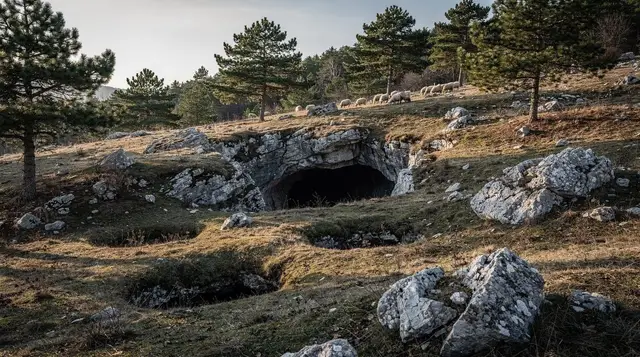
The Livanjsko polje is a classic karst field, a flat basin cut into limestone with no surface river draining it out. Instead, water leaves through ponors, natural sinkholes and underground channels that swallow the flow and carry it away beneath the rock. In an average winter and spring, snowmelt from the surrounding mountains and heavy rain arrive faster than the ponors can drain them, and large stretches of the polje flood into a shallow, temporary lake, sometimes only centimetres deep, sometimes enough to reflect the sky for kilometres. Locals fish and skate on it in a hard winter; farmers work around it the rest of the year.
By late spring the balance usually tips the other way: snowmelt slows, the ponors keep working, and the water recedes, leaving grassland that dries out through summer and becomes exactly the grazing the horses depend on. This is worth explaining rather than marketing, because the two things visitors most want to see, water and horses, are largely mutually exclusive: come for the flooded plateau in winter or early spring, and the odds of horses are low; come for the horses in summer, and the lake will most likely be gone. There is no single visit that reliably delivers both, and any itinerary that promises otherwise is guessing.
Getting to Livno from Sarajevo
The drive from Sarajevo is around 170 km and takes about 2 h 45 in normal conditions, mostly via Kupres on the mountain road that also serves as one of the more scenic routes toward Herzegovina and the coast. It is a real mountain drive, not a motorway hop: expect two-lane roads, some altitude, and slower going if snow is falling on the Kupres plateau in winter. A rental car gives the most flexibility for detouring across the polje itself once you arrive; details on documents and road conditions are covered in the guide to driving in Bosnia and the Sarajevo car rental guide.
Public transport is thin. There is no direct train, and bus options from Sarajevo to Livno typically involve a change and a longer overall journey than driving. For visitors without a car, an organised tour that includes transfers, such as the jeep or quad excursions above, or a private transfer arranged in advance, is the more realistic option than trying to piece together a bus route.
Livno on the way to the coast, not as a day trip
Livno’s real position on a Bosnian itinerary is as a waypoint rather than a destination in its own right. It sits on one of the natural routes between Sarajevo and the Dalmatian coast, and travellers already heading toward Split add relatively little driving time by routing through Livno and the polje compared with the more direct roads through Mostar. Given that a dedicated there-and-back trip from Sarajevo eats close to five and a half hours of driving for a town that offers under an hour of sightseeing plus an uncertain wildlife encounter, it is far better value as a stop on a longer journey than as its own excursion.
For travellers building a longer loop, the practicalities of the onward leg toward the coast are covered in the Sarajevo to Dubrovnik transport guide, and the wider question of how to structure a multi-stop trip is addressed in the seven-day Bosnia road trip itinerary and the Bosnia nature week itinerary, both of which can be adapted to route through Livno rather than the more direct Mostar corridor.
If the coast is not on the agenda, Livno pairs more sensibly with a broader look at day trips from Sarajevo, most of which sit closer to the capital and cost less driving time for a comparable payoff.
Livno also sits reasonably near other stops in Bosnia’s the North-West, for travellers extending in that direction rather than toward the coast: the karst river systems and waterfalls of Una National Park and its Štrbački buk falls share the same limestone geology on a larger scale, covered in the Una National Park guide. Further east, Jajce’s in-town waterfall and Travnik’s Ottoman old town are combinable in a single day and are covered together in the Jajce and Travnik day trip guide.
When to go, and what to budget
| Season | Horses | Lake | Notes |
|---|---|---|---|
| Late April - September | Best chance | Usually dry | Peak grazing season on the polje |
| November - March | Unlikely near roads | Often present | Cold, sometimes fog or snow on Kupres |
| Late March - April | Mixed | Receding | Transition period, unpredictable either way |
Livno is inexpensive by any standard, and cheaper again than the Croatian coast most travellers are heading toward. A coffee runs 2-3 KM, a simple lunch in town 10-18 KM, and a tank top-up on the way through costs the same as anywhere else in the country. A half-day jeep or quad excursion out onto the polje is the main line item for most visitors and is worth booking rather than trying to replicate with a rental car, since local drivers know the current tracks and grazing areas far better than a map does. Paying in KM rather than euros gets the fairer rate; euros are occasionally accepted at fuel stations and cafes along the main routes but at a worse exchange than the fixed 1.95583 peg.
As with any open, rural stretch of karst terrain in Bosnia and Herzegovina, the same caution applies here as elsewhere in the countryside: stick to roads and tracks that are visibly in regular use by locals or tour vehicles, and do not wander off them onto unmarked ground to get closer to the horses or a better photo angle. Parts of the country still carry suspected landmine contamination from the 1990s war in areas away from marked paths and maintained farmland, and the plateau’s flat, open appearance can be misleading about which ground has actually been checked. More detail on where this matters and how to travel accordingly is in the landmine safety guide for hiking in Bosnia.
For travellers weighing Livno against other nature-focused stops in the region, the nature and hiking category and the wider list of day trips from Sarajevo put it in context, and a route planner is useful for judging how it fits alongside other stops on the interactive map. Anyone still deciding when to travel at all should check the general best time to visit guide, since Livno’s own calendar, driven mostly by snow on Kupres and water on the polje, runs on a different rhythm from the capital’s.
Two more tours worth knowing about if Livno is one stop among several: a broader look at Bosnia’s karst and geological curiosities continues with the Visoko hills, reachable on the nature-focused week-long itinerary, or, for travellers combining history with the drive out of Sarajevo, the history and memory category covers the sites most worth pairing with a longer day on the road, such as the half-day excursion to the Visoko hills for those curious about the site even knowing the mainstream scientific view rejects the pyramid claim, or a wider Sarajevo-based day trip roundup for structuring the rest of the week.
Visiting Livno and the wild horses: your questions answered
Are the wild horses of Livno guaranteed to be there?
No. They are free-ranging animals that graze the Livanjsko polje on their own schedule, not a managed attraction with fixed viewing points. Spring and summer mornings and early evenings give the best odds, but a visit can still turn up nothing.
How far is Livno from Sarajevo, and how long does it take?
It is around 170 km by road, mostly via Kupres, and takes about 2 h 45 by car in normal conditions. There is no direct train, and bus connections are limited, so this is a drive best done with a rental car or an organised tour.
Can I visit Livno as a day trip from Sarajevo?
You can, but it is a long day for what the town itself offers. Livno makes more sense as a stop on the way to or from the Dalmatian coast, where the detour costs little extra driving, rather than as a dedicated there-and-back excursion.
What is the seasonal lake on the Livanjsko polje?
In wetter months, usually late autumn through spring, snowmelt and rain collect faster than the karst plateau’s underground drains, called ponors, can carry the water away, and parts of the polje flood into a shallow lake. It typically dries out again by mid to late summer.
Is there anything to see in Livno’s old town?
The old town is small: a hilltop fortress with views over the plateau, the source of the Bistrica river, and a handful of streets and cafes. Most visitors cover it in under an hour before heading out onto the polje.
Do I need a guide or a jeep to see the horses?
Not strictly, since the horses graze on open, publicly accessible land, but a local guide or a jeep and quad tour improves the odds because they know current grazing areas and can cover more of the plain than a rental car on the main road.
Is it safe to walk out onto the polje?
Stay on tracks and roads used by locals and tour operators. Bosnia and Herzegovina still has land suspected to hold landmines from the 1990s war in rural areas away from marked paths, and the Livno plateau is no exception.