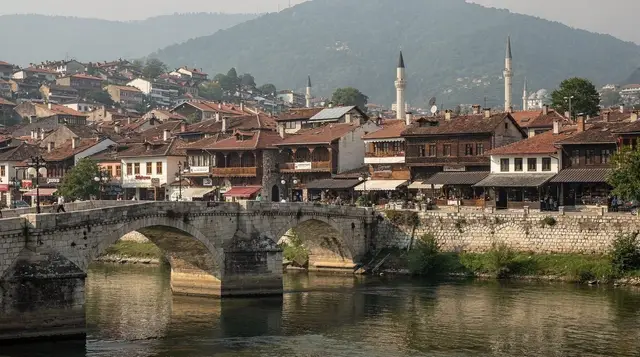
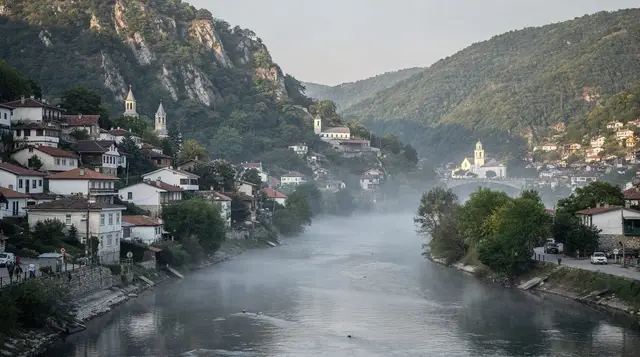
Sarajevo's four faiths walk: mosque, church, cathedral and synagogue
What is the four faiths walk in Sarajevo?
It is a roughly 15-minute walking loop around Baščaršija linking Gazi Husrev-bey mosque (1531), the Old Orthodox Church (16th century), Sacred Heart Cathedral (1889) and the 1902 Ashkenazi synagogue building, now home to the Jewish Museum. All four sit within about 500 metres of each other.
Four faiths, one quarter-hour of walking
Sarajevo earned the nickname “the Jerusalem of Europe” honestly. Within about 500 metres of the Sebilj fountain in Baščaršija stand a working Ottoman mosque, an Orthodox church going back to Ottoman times, an Austro-Hungarian Catholic cathedral, and the building that once served the city’s Ashkenazi Jewish community and today holds its Jewish Museum. No other European capital packs four faiths this tightly, and the walk between them takes less time than a coffee.
This page is a route, not four separate guides. It tells you what order to visit the sites in, when each one is actually open, what it costs, and what to expect at the door. For the detail on each building — history, architecture, what’s inside — the dedicated pages linked throughout are the ones to read before or after the walk.
The route at a glance
| Stop | Faith | Built | Typical entry | Walking time to next stop |
|---|---|---|---|---|
| Gazi Husrev-bey mosque | Islam | 1531 | ~5 KM (2.50 EUR) | 4–5 minutes |
| Old Orthodox Church | Serbian Orthodox | 16th century | Free, donation | 3–4 minutes |
| Sacred Heart Cathedral | Roman Catholic | 1889 | Free, donation | 6–7 minutes |
| Ashkenazi synagogue / Jewish Museum | Judaism | 1902 | ~5 KM (2.50 EUR) | — |
Walked without stopping, the full loop is around 15 minutes. Realistically, allow half a day if you want to step inside all four and read the panels at the museum.
Why this order
Start at the Gazi Husrev-bey mosque because it sits at the physical and historical centre of Baščaršija, the Ottoman bazaar founded around 1462. From there, a short walk south brings you to the Old Orthodox Church, tucked below street level in a courtyard that is easy to miss if you’re not looking for it. Heading back through the old town towards Ferhadija — Sarajevo’s Austro-Hungarian shopping street — puts Sacred Heart Cathedral on your way. The walk finishes at the former synagogue building on the bank of the Miljacka, which also makes a natural point to continue towards Vijećnica or the river itself.
Doing it in reverse works just as well; the point is that all four stops sit close enough together that no version of the route involves backtracking across town.
Stop 1: Gazi Husrev-bey mosque
Built in 1531 by the Ottoman governor Gazi Husrev-bey, this is the largest historic mosque in Bosnia and Herzegovina and still an active place of worship. Visitors are welcome outside prayer times, and this is the one stop on the route where opening hours genuinely vary through the day: the mosque closes to visitors around each of the five daily prayers, so the window shrinks and shifts depending on the season. In practice, mid-morning and mid-afternoon are usually safe; arriving right before midday prayer on a Friday is not.
Shoulders and knees need to be covered, and a headscarf is provided free at the entrance for women who don’t have one. Entry is a modest fee, typically around 5 KM. The courtyard, with its ablution fountain and the tomb of Gazi Husrev-bey himself, is worth a slow look before you go in. For the building’s history and etiquette in full, see the mosque visiting guide and the general guide to mosque etiquette in Sarajevo, which also covers the smaller mosques you’ll pass elsewhere in the old town.
Stop 2: the Old Orthodox Church
A few minutes’ walk south of the mosque, set below the current street level in a walled courtyard, is Sarajevo’s Old Orthodox Church, dating to the 16th century and dedicated to the Nativity of the Virgin. It’s easy to walk straight past the entrance, which is set back from the main pedestrian flow — look for the low gate and the small museum sign.
Inside, an iconostasis and a small church museum hold icons and manuscripts that trace the Serbian Orthodox community’s presence in the city back through Ottoman rule. Entry is free, with a donation box near the door; a modest contribution is expected if you spend time inside or take photographs. It’s a quieter stop than the mosque or cathedral, usually with just a handful of visitors at any given time.
Stop 3: Sacred Heart Cathedral
From the Old Orthodox Church, the walk to Sacred Heart Cathedral takes you back through the old town and onto Ferhadija, Sarajevo’s main Austro-Hungarian-era street. Completed in 1889, this neo-Gothic cathedral is the seat of the Catholic Archdiocese of Vrhbosna and the largest Catholic church in Bosnia and Herzegovina — a very different architectural register from the Ottoman mosque you started at, built barely three decades after Austro-Hungary took over administration of the city.
The cathedral is generally open to visitors outside Mass times, and entry is free. If a service is underway, wait outside or come back later rather than walking through; Mass times are usually posted by the main door. The square in front, with its statue of Pope John Paul II, is also a common meeting point and a good spot to see the transition from Ottoman Baščaršija to Austro-Hungarian Ferhadija in a single glance — a contrast covered in more depth in the Ferhadija walking guide.
Stop 4: the Ashkenazi synagogue and the Jewish Museum
The walk ends at the riverbank, at the building constructed in 1902 to serve Sarajevo’s Ashkenazi Jewish community — a later arrival than the city’s older Sephardic Jewish population, which had been established in Baščaršija since the 16th century. Today the building houses the Jewish Museum of Bosnia and Herzegovina, telling the story of both Jewish communities in the city: centuries of Sephardic life in Baščaršija, the arrival of Ashkenazi Jews under Austro-Hungarian rule, the near-destruction of the community during the Second World War, and what remains of Jewish Sarajevo today.
Entry is a small fee, typically around 5 KM. The museum is closed on Saturdays for the Jewish Sabbath, which is the one closure day worth planning around if this is the stop you care about most. The guide to Jewish Sarajevo covers the wider story, including the Sarajevo Haggadah — the city’s most famous Jewish artefact, held at the National Museum rather than here, and worth checking for its own limited viewing hours before making a special trip; see the Haggadah guide for that detail.
Timing it right
The one variable that can derail this walk is the mosque’s prayer schedule, since it’s the only stop with a hard closure window that moves through the year. If seeing inside the mosque matters to you, check the day’s prayer times before you set out rather than assuming a fixed opening hour. The other three stops are more forgiving: the church and cathedral are open through most of the day with no fixed break, and the museum keeps standard daytime hours except on Saturdays.
Ramadan changes the rhythm of the whole neighbourhood, not just the mosque. Baščaršija empties out in the late afternoon and fills again after the cannon at the Yellow Fortress marks the breaking of the fast — worth timing a visit around if you’re here during that period. The guide to Ramadan in Sarajevo has the detail.
What this walk doesn’t cover
None of the four buildings gets a deep visit on this route — that’s the point of it being a 15-minute walk rather than a half-day itinerary. If any one faith or building interests you more than the others, treat this page as the map and read the dedicated page before you go back:
- The mosque itself: Gazi Husrev-bey mosque visiting guide
- Mosque etiquette generally: Sarajevo mosque etiquette
- Sarajevo’s churches in more depth: Sarajevo churches guide
- The Jewish community’s full story: Jewish Sarajevo guide
- The Sarajevo Haggadah specifically: Sarajevo Haggadah guide
Extending the walk
Because all four stops sit inside Baščaršija’s core, it’s easy to fold this route into a longer morning in the old town rather than treating it as a separate outing. Combine it with the Baščaršija walking guide for the bazaar itself, or with the Ferhadija walk to see the Ottoman-to-Austro-Hungarian transition that runs right past Sacred Heart Cathedral. If it’s your first morning in the city, the Sarajevo in one day itinerary already builds this walk into a fuller day that also takes in Vijećnica and the Latin Bridge.
Walking it alone or joining a tour
Walking the four faiths route by yourself works well for the exteriors and a quick look inside each building, and nothing here requires a guide. What a self-guided walk won’t give you is the connective explanation of how these four communities actually lived alongside — and at times through hardship, for — each other across Ottoman, Austro-Hungarian, Yugoslav and modern Bosnian rule.
A dedicated guided Jewish heritage tour of Sarajevo spends real time on the synagogue building and the wider story of the city’s Sephardic and Ashkenazi communities that a quick museum visit only sketches. For a broader walk that places these four stops inside Sarajevo’s traditional neighbourhood fabric, a guided hike through Sarajevo’s traditional mahala neighbourhoods covers ground well beyond Baščaršija.
If your interest leans more towards the twentieth century than the Ottoman or Austro-Hungarian periods, a tour tracing the rise and fall of Yugoslavia explains how the multi-faith city held together, and fractured, under socialist Yugoslavia and the war that followed. For a more active alternative that still passes through the old town, a guided bike tour that includes entry to the Tunnel of Hope covers a different side of the city’s twentieth-century history entirely.
The four faiths walk: frequently asked questions
How long does the four faiths walk take?
The walking distance itself is about 15 minutes at an easy pace. Add 20 to 40 minutes at each stop if you go inside, so budget half a day if you want to see the interiors properly rather than just the exteriors.
What order should I visit the four sites in?
Start at the Gazi Husrev-bey mosque since it sits at the centre of Baščaršija, then walk to the Old Orthodox Church a few streets south, continue to Sacred Heart Cathedral on Ferhadija, and finish at the former synagogue on the riverbank. This order follows the natural flow of the old town without doubling back.
Can I visit all four buildings on the same day?
Yes, but check the mosque’s prayer times first, since it closes to visitors five times a day, and note that the synagogue building is closed on Saturdays for the Jewish Sabbath. Weekday mornings work best for seeing all four.
Do I need to cover my head or shoulders?
Only at the mosque. Shoulders and knees should be covered and a headscarf is provided free at the entrance for women who need one. The church, cathedral and former synagogue have no dress requirement, though modest clothing is polite in any of them.
Is there an entry fee for each building?
The mosque and the former synagogue both charge a small entry fee, typically around 5 KM (about 2.50 EUR). The Old Orthodox Church and Sacred Heart Cathedral are usually free to enter, with a donation box for upkeep.
Why is Sarajevo called the Jerusalem of Europe?
Because a mosque, an Orthodox church, a Catholic cathedral and a synagogue have stood within a quarter-hour of each other for well over a century, and the city’s Muslim, Orthodox, Catholic and Jewish communities have lived side by side through Ottoman, Austro-Hungarian, Yugoslav and modern Bosnian rule.
Should I book a guided tour instead of walking it alone?
Walking it alone works fine for the exteriors and a quick look inside each building. A guided city hike or a dedicated Jewish heritage tour adds context on how the four communities actually interacted, which a self-guided walk cannot give you on its own.
Religious heritage & sacred sites tours on GetYourGuide
Verified deep-linked GetYourGuide tours. Book through these links and we earn a small commission at no cost to you.
GetYourGuide does not provide a product photo for this activity — the image shows the meeting point, photographed by us.