Jewish Sarajevo: synagogues, museum and community history
What are the main Jewish heritage sites in Sarajevo?
The Ashkenazi Synagogue (1902), still in use, and the Jewish Museum of Bosnia and Herzegovina, housed in the older Sephardic synagogue near Baščaršija. The Sarajevo Haggadah itself is not at either site; it is kept at the National Museum and shown only at limited times.
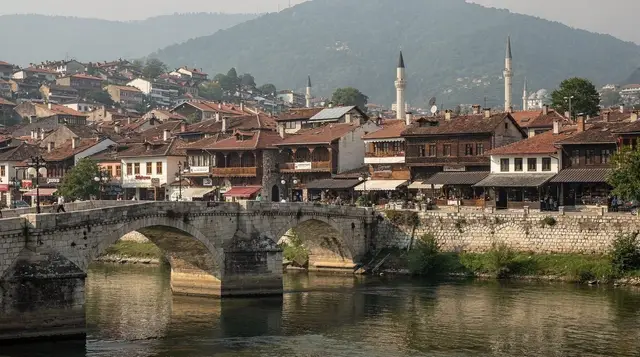
Sarajevo is sometimes called the Jerusalem of Europe because a mosque, an Orthodox church, a Catholic cathedral and a synagogue all sit within a fifteen-minute walk of each other. The Jewish half of that story is easy to see in an afternoon but harder to understand quickly: two separate synagogue buildings, a manuscript that isn’t where visitors expect it, and a community history that runs from the Spanish expulsion of 1492 through the Holocaust to the 1990s siege. This guide covers where things actually are and what they mean.
From Sepharad to the Miljacka valley
Sephardic Jews expelled from Spain in 1492 settled across the Ottoman Empire in the following decades, and Sarajevo, growing fast under Ottoman rule around the same period Baščaršija was founded, became one of their communities in the Balkans. Ladino, the Sephardic Jewish language derived from Old Spanish, was spoken in the city’s Jewish quarter for centuries and left words in the local Bosnian vocabulary.
By the late nineteenth century, a second wave, this time Ashkenazi Jews from the Austro-Hungarian lands, arrived after Vienna took over the province in 1878 and built its own institutions alongside the older Sephardic ones. The two communities worshipped separately, which is why Sarajevo ended up with two synagogues rather than one.
Before the Second World War, an estimated 10,000 to 14,000 Jews lived in Sarajevo, close to a fifth of the city’s population at the time, making it one of the more significant Jewish centres in south-eastern Europe. That history is now told mainly through two buildings and one museum collection, none of which is large, all of which reward a slow visit rather than a rushed one.
The Ashkenazi Synagogue (1902)
The Ashkenazi Synagogue, completed in 1902 on the right bank of the Miljacka near the Cathedral of the Sacred Heart, is still an active place of worship for what remains of Sarajevo’s Jewish community. It is built in a Moorish Revival style similar in spirit, though not in scale, to the Vijećnica across the river.
Because it is a working synagogue rather than a museum, opening hours for casual visitors are more restricted than at the city’s other religious sites, and it closes to the public during services. It is also occasionally used as a concert venue, since its acoustics are well regarded by Sarajevo’s classical music scene, so checking the local events listings before a visit can turn up a way in beyond the daytime hours.
The building sits a short walk from Ferhadija and the Sacred Heart Cathedral, making it easy to fold into a walk that also covers the Old Orthodox Church, completing the four-faiths circuit that gives Sarajevo its Jerusalem-of-Europe nickname. Our guided walk that links all four places of worship in one route below covers the logistics of doing this on foot in a single morning.
The Old Synagogue and the Jewish Museum
The second, older synagogue building sits on the edge of Baščaršija, closer to the old Jewish mahala than to the riverside institutions of the Austro-Hungarian era. Built for Sarajevo’s Sephardic congregation and known locally as the Old Synagogue or Il Kal Vježu, it no longer holds regular services; instead it houses the Jewish Museum of Bosnia and Herzegovina, which tells the community’s history from the Ottoman era through to the twentieth century using photographs, ritual objects, and documents recovered after the Second World War and after the siege.
The exhibits move roughly chronologically: Ottoman-era Sephardic life and the Ladino language, the arrival of Ashkenazi Jews after 1878, the interwar period when Sarajevo’s Jewish community was at its largest, and then the Holocaust years, treated with the same restraint the museum extends to the rest of the collection. Entry is inexpensive, typically a few convertible marks, in line with Sarajevo’s other small museums, and a visit takes forty-five minutes to an hour for anyone reading the panels properly rather than walking through.
The surrounding streets, a short stretch between the museum and Baščaršija proper, formed the old Jewish quarter. Little of it reads as a distinct district today; most of what survives is the synagogue building itself and a scattering of street names, since the community that once filled these lanes was reduced first by the Holocaust and then by decades of emigration.
The Holocaust in Bosnia: what to know before you go
Sarajevo’s occupation during the Second World War followed the same pattern as much of the region: Bosnia was absorbed into the Nazi-aligned Independent State of Croatia, whose Ustaša regime deported Jews, along with Roma and Serbs, to concentration camps, principally Jasenovac, alongside deportations to German-run camps elsewhere. Of a pre-war Bosnian Jewish population estimated at around 14,000, the great majority did not survive the war. The Ashkenazi Synagogue itself was used by the Ustaša as a warehouse during the occupation, one of the reasons its interior today feels more restored than original.
None of this is presented at the sites themselves as spectacle, and this guide follows the same approach: dates and figures, not commentary. Visitors who want the fuller regional context, including the later genocide at Srebrenica in 1995, are better served by reading our note on the historical context before visiting and, separately, how to visit the Srebrenica memorial itself, which is a different period of history and a different journey from Sarajevo.
La Benevolencija and the siege
La Benevolencija, Sarajevo’s Jewish humanitarian society founded in the nineteenth century and reactivated in 1990 as war approached, became one of the more quietly remarkable institutions of the 1992-1996 siege. It ran a pharmacy that supplied medicine across ethnic and religious lines at a time when almost nothing else moved reliably through the besieged city, and it organised evacuation convoys that helped residents leave, again without regard to their faith.
Because Sarajevo’s Jewish population was by then small, and because the society’s aid reached far beyond that population, La Benevolencija is remembered in the city with a warmth that outweighs the size of the community it represented. It is one of the reasons locals often mention Jewish Sarajevo in the same breath as the city’s broader identity as a place where communities looked out for each other under siege, alongside stories covered in our guide to the siege itself and the museums that document it.
Where the Sarajevo Haggadah actually is
The Sarajevo Haggadah is the object most visitors ask about first, and the one most likely to cause a wasted trip if you don’t check ahead. It is a Sephardic Passover manuscript from the fourteenth century, illuminated and believed to have travelled from Spain with Jewish exiles, and it survived both the Second World War and the 1990s siege thanks to Bosnian librarians and museum staff who hid it on each occasion. It is not held at either synagogue or at the Jewish Museum.
It belongs to the National Museum of Bosnia and Herzegovina, where it is shown only at limited times, sometimes only a few hours a week, because of its fragility and value. If seeing the Haggadah itself is the point of your visit, check the National Museum’s current display schedule before you go rather than assuming it will be on view; our dedicated guide to visiting the Haggadah and the National Museum’s full visiting guide both cover current practice in more detail than is safe to fix in print.
The old Jewish cemetery
On the lower slopes of Trebević, overlooking the city, lies one of Europe’s oldest and largest Sephardic Jewish cemeteries, in use from the sixteenth century onward. During the 1992-1996 siege its elevated position made it a contested military position, and many of its stone slabs, most laid flat rather than upright in the Sephardic tradition, still show damage from that period. It is not developed as a visitor site and has no set opening hours or entry fee, which means visiting takes some initiative; anyone planning to go should treat it as a quiet, respectful stop rather than a photo destination, in the same spirit recommended throughout this site’s coverage of Sarajevo’s roses and other war-marked places.
Practical visiting information
| Site | Location | Typical entry | Notes |
|---|---|---|---|
| Ashkenazi Synagogue (1902) | Right bank, near Sacred Heart Cathedral | Free to modest donation | Active synagogue; closed during services; occasional concerts |
| Jewish Museum (Old Synagogue) | Edge of Baščaršija | Around 3-5 KM | 45-60 minutes; closed Sundays at some times of year, confirm locally |
| Sarajevo Haggadah | National Museum of Bosnia and Herzegovina | Included in museum entry | Displayed at very limited times only; confirm before travelling for it specifically |
| Old Jewish cemetery | Lower slopes of Trebević | No fee, no set hours | Undeveloped site; go for quiet visiting, not photography |
Modest dress is appreciated at both synagogue buildings, though neither enforces the head-and-shoulder covering rules of Sarajevo’s mosques and churches as strictly. Photography inside the Jewish Museum is generally fine for personal use; ask at the desk before photographing inside the active Ashkenazi Synagogue, since rules there can depend on whether a service or private event is scheduled that day.
Fitting this into a wider walk
Because the Old Synagogue sits at the edge of Baščaršija, most visitors combine the Jewish Museum with a walk through the bazaar itself, taking in the Sebilj and the Gazi Husrev-bey Mosque before or after. Our walking guide to Baščaršija lays out a sensible order for a half-day loop that includes the Old Synagogue without feeling rushed.
Travellers who prefer a guide to thread the sites together, rather than working from a map, can join a walking tour that sets Sarajevo’s religious and wartime history in context across several neighbourhoods in one outing, or a guided hike through the old residential mahalas that surround the synagogues and mosques, which covers streets most visitors on their own would walk straight past.
For a first Sarajevo visit that wants Jewish heritage as one thread among several, rather than the whole itinerary, see our one-day Sarajevo plan or the longer two-day guide, both of which allow room for the Ashkenazi Synagogue, the Old Synagogue, and a stretch of Baščaršija without cutting the rest of the city short.
Anyone building a trip around Sarajevo’s religious diversity specifically should read the four-faiths walk in full and, for context on how to visit any of the city’s harder history respectfully, this note on visiting Sarajevo thoughtfully. Broader museum planning sits in our guide to Sarajevo’s museums, and general safety questions, unrelated to this specific history, are answered in is Sarajevo safe.
Jewish Sarajevo: frequently asked questions
Is the Sarajevo Haggadah kept at the synagogue?
No. The Haggadah, a fourteenth-century Sephardic manuscript, is held at the National Museum of Bosnia and Herzegovina, not at either synagogue or the Jewish Museum. It is displayed only at limited times, so check the National Museum’s current hours before making a special trip to see it.
Which building holds the Jewish Museum, the Ashkenazi or the Sephardic synagogue?
The Jewish Museum of Bosnia and Herzegovina occupies the older Sephardic synagogue building near Baščaršija, sometimes called the Old Synagogue or Il Kal Vježu. The 1902 Ashkenazi Synagogue, across the river, is a separate, still-active building rather than the museum.
Can I visit the Ashkenazi Synagogue?
It functions as a working synagogue for Sarajevo’s small remaining Jewish community, so visiting hours are more limited than a museum’s and it is not open during services. It is also used occasionally for concerts, since the acoustics are well regarded locally.
What happened to Sarajevo’s Jewish community in the Holocaust?
Most of Bosnia’s Jews, a pre-war population estimated at around 14,000, were deported to Ustaša-run camps, chiefly Jasenovac, or to German camps, and did not survive. The community that remained after 1945 was a small fraction of its pre-war size, and it shrank further during the 1992-1996 siege.
Do I need to book ahead for the Jewish Museum?
Not usually for individual visitors; it keeps set opening hours like Sarajevo’s other small museums. Groups, and anyone hoping to combine a visit with a guided walk of the wider Jewish quarter, should confirm times in advance since hours can be shorter outside the summer season.
Is there still a Jewish quarter in Baščaršija?
The old Jewish mahala around the Old Synagogue survives as a small pocket of streets rather than a distinct district today, since most of Sarajevo’s Jewish community left, was killed, or dispersed over the twentieth century. The synagogue building and a handful of nearby streets are what remain to walk.
What did La Benevolencija do during the siege of Sarajevo?
La Benevolencija, the city’s Jewish humanitarian society, ran a pharmacy and organised evacuation convoys during the 1992-1996 siege that helped residents of the city regardless of their faith, not only its Jewish members. It is one of the reasons Sarajevo’s Jewish community is remembered locally with particular warmth.
Religious heritage & sacred sites tours on GetYourGuide
Verified deep-linked GetYourGuide tours. Book through these links and we earn a small commission at no cost to you.
GetYourGuide does not provide a product photo for this activity — the image shows the meeting point, photographed by us.