Baščaršija walking guide: the Ottoman bazaar street by street
How do you walk Baščaršija properly?
Start at the Sebilj fountain, work through the Kazandžiluk coppersmiths' street, visit the Gazi Husrev-beg mosque (around 5 KM), then finish at the Svrzo or Despić house if you have time. The core loop takes 45 minutes to an hour without stops, closer to two or three hours with coffee and lunch.
What Baščaršija actually is
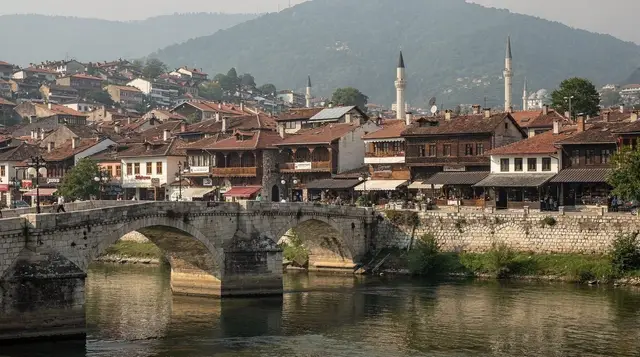
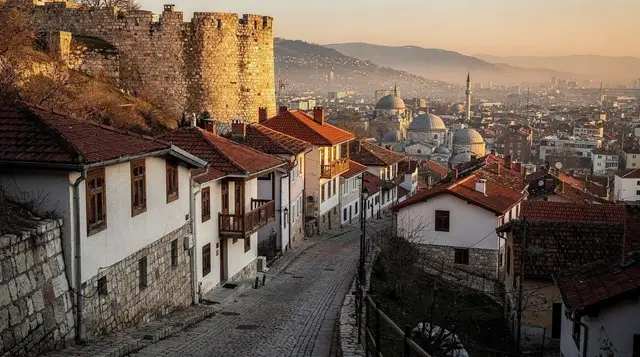
Baščaršija is not a single square or a single street. It is the whole Ottoman-era commercial quarter that Isa-beg Ishaković founded around 1462, when Sarajevo was laid out as a bazaar town around a river crossing. What survives today is a tight grid of cobbled lanes, low stone-and-timber shopfronts, and one working mosque, squeezed between the Miljacka and the hillside. Most visitors see only the square around the Sebilj fountain and assume that is Baščaršija. It is the entrance, not the whole thing.
This guide keeps to that Ottoman core: the Sebilj, the coppersmiths of Kazandžiluk, the Gazi Husrev-beg mosque, and the merchant houses of Svrzo and Despić. It stops where the Ottoman bazaar stops. The moment the cobbles turn flat and the shopfronts turn Habsburg, you have crossed into Ferhadija, and that street has its own walk rather than an extension of this one.
The Sebilj: where everyone starts
The wooden fountain in the middle of the main square is the Sebilj, built in 1891 in a pseudo-Ottoman style that is actually Austro-Hungarian in date, though it reads as older. It is the default meeting point for the entire city; Sarajevans use “at the Sebilj” the way Londoners say “under the clock.” Pigeons cluster around it in numbers that surprise first-time visitors, and the square around it is the single most photographed spot in Sarajevo.
It is also the most expensive square metre of coffee in the city. Cafés directly facing the Sebilj charge visitor prices, not local ones. Treat it as a landmark and a photo stop, not a place to sit down, and the rest of this walk gets noticeably cheaper.
Kazandžiluk: the coppersmiths’ street
Heading south-east from the Sebilj, Kazandžiluk is the street that gives Baščaršija its working-craft character rather than its souvenir-shop one. The name comes from kazandžije, coppersmiths, and a working line of them still hammers, engraves and solders here, much as they have for centuries. You’ll hear the street before you see it: a metallic tapping from workshop doorways where trays, coffee sets (džezva and fildžan) and artillery-shell casings turned into decorative pieces are still made and repaired by hand.
Not every shop on Kazandžiluk is a working workshop; some have become straightforward souvenir stalls selling imported copies. Look for the ones with an actual anvil, a scorched workbench and an older craftsman at it — those are the real thing, and they’re usually happy to have you watch for a minute without buying. A hand-hammered coffee set here, bought directly from a coppersmith, typically runs somewhat higher than a machine-made one from a general souvenir stand, but it’s a genuinely different object. For more on separating the two, see the guide to Baščaršija shopping and the profile of the Kazandžiluk coppersmiths.
Gazi Husrev-beg mosque: the heart of the bazaar
A short walk from Kazandžiluk, set back behind its own courtyard and ablution fountain, is the Gazi Husrev-beg mosque, built in 1531 and still the largest historical mosque in Bosnia and Herzegovina. It is a working mosque, not a museum, and it is open to visitors outside the five daily prayer times for an entry fee of around 5 KM.
Dress rules are enforced, not suggested: shoulders and knees covered, shoes off before the prayer hall, and a headscarf for women, provided free at the entrance for anyone who doesn’t have one. Inside, the proportions are worth the fee on their own — a single large square prayer hall under a shallow central dome, painted in restrained reds and golds rather than the heavy gilding of later Ottoman mosques. For the etiquette in more detail before you go, see the guide to mosque etiquette in Sarajevo.
The mosque complex also includes Gazi Husrev-beg’s tomb (türbe), a clock tower keeping lunar time, and the adjoining madrasa, all part of the same 16th-century foundation and worth the extra ten minutes to walk around rather than just through.
Sarači and the merchant houses: Svrzo and Despić
West of the mosque, the street called Sarači (saddlers) runs through what was once the leatherworking district and is now a mix of restaurants, jewellers and a few surviving craft shops. It’s a useful spine for getting between the mosque and the two Ottoman-era houses that round out this walk.
Svrzo House (Svrzina kuća) is a preserved 18th-century residence that shows how a wealthy Muslim merchant family actually lived: a walled courtyard, separate men’s and women’s quarters, low sofas built into the walls, and a garden that functioned as private outdoor space in a dense city. Despić House, a few minutes away, is its Christian counterpart — an Orthodox merchant family’s home from a similar period, with noticeably different furniture and religious objects but the same basic Ottoman-era urban layout.
Seeing both in the same visit, rather than just one, is what actually explains the “different communities, same city” character that Sarajevo is known for. Neither takes more than 20 to 30 minutes, and both are covered together in the guide to Sarajevo’s Ottoman houses.
A realistic walking order, stop by stop
| Stop | What it is | Time to allow |
|---|---|---|
| Sebilj | Wooden fountain, main meeting point | 5–10 min (photo, no sitting) |
| Kazandžiluk | Coppersmiths’ street, working workshops | 20–30 min |
| Gazi Husrev-beg mosque | 1531 mosque, ~5 KM entry | 20–30 min |
| Sarači | Former saddlers’ street, connecting spine | 10 min walking |
| Svrzo House | 18th-century Muslim merchant house | 20–30 min |
| Despić House | 18th/19th-century Orthodox merchant house | 20–30 min |
Walked start to finish without any stop, this route is under a kilometre and takes well under an hour. With the mosque, both houses and a proper coffee break worked in, budget a relaxed two to three hours. It pairs naturally with an early start, since Kazandžiluk is at its best — quiet, workshops just opening — before 9am, well ahead of the tour groups that build up around the Sebilj from mid-morning.
If you’d rather have the history explained as you go rather than reading it off a plaque, a guided option covers the same ground with context on each stop.
a guided walk through Baščaršija and central Sarajevo adds the layers of Ottoman, Austro-Hungarian and wartime history that are easy to miss walking alone, and generally takes in the Sebilj, the mosque exterior and Kazandžiluk in a couple of hours.
What to eat along the way, and what it costs
Baščaršija is also where most visitors eat their first cevapi, and it’s worth knowing the going rate before you sit down anywhere near the Sebilj.
| Item | Typical price | In euros |
|---|---|---|
| Bosnian coffee (bosanska kafa) | 2–3 KM | ~1–1.50 EUR |
| Espresso | 2–2.50 KM | ~1–1.30 EUR |
| Burek (meat), by weight | 3–5 KM | ~1.50–2.50 EUR |
| Ten cevapi with somun, onion, kajmak | 8–12 KM | ~4–6 EUR |
| Half-litre draught beer | 3–5 KM | ~1.50–2.50 EUR |
Two things to know before ordering. First, in Bosnia “burek” specifically means the meat-filled pastry; the potato, cheese or spinach versions are called krompiruša, sirnica and zeljanica respectively, and asking for “burek” when you want the cheese one will get you the wrong pastry. Second, cevapi in Sarajevo are served by count, usually in tens, tucked into a split somun flatbread with raw onion and kajmak (a clotted cream) on the side — a different serving style from cevapi elsewhere in the region. The guide to the best cevapi in Sarajevo, the burek guide and the Bosnian coffee ritual go into each in more depth.
For a bazaar visit combined with lunch and a trip out to the Bosna springs on the same day, there’s also a packaged option:
a combined Vrelo Bosne and Baščaršija tour with lunch included works well if you’d rather have the meal arranged for you between the two stops.
Where the prices turn touristy
The honest pattern in Baščaršija is that price scales with distance from the Sebilj. Cafés with a direct line of sight to the fountain routinely charge double the price of an identical coffee two streets away. The same applies to souvenirs: a hammered copper tray or a “traditional” fridge magnet costs noticeably more at the stalls ringing the square than at a shop on Kazandžiluk actually run by the person making the goods.
The fix is simple and doesn’t cost any extra walking: treat the Sebilj square as the photo stop, then move one or two streets in any direction — towards Kazandžiluk, towards Sarači, or towards the mosque — before sitting down or buying anything. Prices drop to normal Sarajevo levels almost immediately. More on spotting this pattern generally in the Sarajevo tourist traps guide.
Baščaršija versus Ferhadija: where one street ends
The change from Ottoman to Austro-Hungarian Sarajevo isn’t a gradual fade, it’s a hard edge you can feel underfoot. Baščaršija’s lanes are cobbled, narrow and irregular, lined with low stone-and-timber shopfronts built to Ottoman scale. Within a few steps — usually marked by a bronze line set into the pavement near the Sebilj, with a “Sarajevo Meeting of Cultures” inscription — the paving turns flat and formal, the buildings grow taller and acquire columns and cornices, and you’re on Ferhadija, the Austro-Hungarian high street built after 1878.
This guide deliberately stops at that line. Ferhadija has its own character, its own shops, and its own walk, covered separately in the Ferhadija Austro-Hungarian walk — worth doing as a second, contrasting walk on the same day rather than folding it into this one.
How to pace the walk
The most common mistake in Baščaršija is treating it as a checklist. The stops on this route are close together, so the walk rewards slowing down rather than ticking items off. Let the Sebilj be a short opening, give Kazandžiluk the time it deserves, and keep your energy for the mosque and the two houses, which are the parts that explain the quarter rather than just decorate it.
If you are short on time, drop Despić House before you drop the mosque, and drop the coffee at the square before you drop either. If you have a whole morning, sit down once, in a side street rather than on the square, and simply watch the lane for a while. The bazaar makes most sense when you see people using it: shopkeepers opening up, delivery carts squeezing through, locals stopping for a quick coffee on their way to work. For a longer stay in the city, the Sarajevo first-time guide and the two-day Sarajevo plan show where this walk fits.
Reading the quarter as you walk
Baščaršija was built as a working market, and its layout still follows that logic. Streets were once grouped by trade, which is why the names (Kazandžiluk for the coppersmiths, Sarači for the saddlers) read like a directory of crafts. Looking at the street names and at what is actually sold behind them is a quiet way to see how much has changed and how much has stayed.
Look up as well as ahead. The upper floors and the roof lines are where the Ottoman timber-and-stone construction is easiest to read, and they are usually free of the souvenir clutter at street level. Notice the small fountains and the courtyards glimpsed through open gates; these are reminders that the bazaar was a place where people lived and prayed as well as traded. The Ottoman houses guide explains what those courtyards were for, and the guide to the Gazi Husrev-beg mosque visit covers the building at the centre of it all.
Photography is easiest in the early hours, when the lanes are empty and the light is soft. Ask before photographing a craftsman at work; most are glad to be asked and many will show you what they are making. If you want to understand what you are seeing in more depth, a longer walking tour of the city places the bazaar within the wider story of Sarajevo, from Ottoman trading town to Habsburg showcase to the modern capital.
Combining the walk with the rest of the day
Baščaršija sits at the centre of the old town, so it connects easily with the other sights nearby. The Latin Bridge and the City Hall (Vijećnica) are a short stroll along the river, and the Sarajevo four faiths walk continues the theme of mosques, churches and the synagogue sitting close together. For a food-focused afternoon, the Sarajevo food guide and the bakery and sweets suggestions give you places to continue once the walking is done.
Evenings are a good time to return. The crowds thin, the lanes light up, and the Sarajevo nightlife guide and the bars by neighbourhood point to where the old town goes after dark. Walking the same streets twice, once in the morning and once at night, shows two quite different faces of the bazaar.
Practical notes before you set off
Baščaršija is compact, flat and entirely walkable — no transport needed once you’re there, though the Sarajevo tram drops you within a few minutes’ walk if you’re coming from elsewhere in the city. Cards are accepted in most sit-down restaurants around the bazaar, but the small food stalls, coppersmith workshops and the mosque entry desk are cash-only in KM — carry small notes and coins rather than relying on a card for everything.
Friday midday draws the largest crowd to Gazi Husrev-beg for jumu’ah prayer, and the mosque pauses to visitors around that time; plan the interior visit for the morning or mid-to-late afternoon instead. During Ramadan, the atmosphere in Baščaršija changes noticeably after sunset, when the fast-breaking cannon fires from the Žuta tabija above the city and the square around the Sebilj fills with people — a good time to be there, covered in the guide to Ramadan in Sarajevo.
If you’re combining the bazaar with the rest of central Sarajevo in a single day, the one-day Sarajevo itinerary sequences Baščaršija alongside the Sebilj, the Latin Bridge and the cable car up Trebević. For visitors who’d rather not plan the route themselves at all, a walking tour that starts from Baščaršija is a reasonable shortcut:
a guided walking tour that starts near Baščaršija and the Bentbaša gorge is worth comparing against the general city walking tour if your interest leans more towards the river and the older residential lanes above the bazaar; the comparison of Sarajevo’s walking tour options sets out how the different routes differ.
City sightseeing tours on GetYourGuide
Verified deep-linked GetYourGuide tours. Book through these links and we earn a small commission at no cost to you.
GetYourGuide does not provide a product photo for this activity — the image shows the meeting point, photographed by us.