Tito's bunker (D-0 ARK): visiting Konjic's Cold War hideout
Can you just turn up and visit Tito's bunker in Konjic?
No. D-0 ARK can only be seen on a guided tour at fixed times, and it is roughly an hour's drive from Sarajevo, so booking ahead is strongly advised rather than optional. Most visitors combine it with Konjic's Ottoman bridge or with Mostar on the same day.
Why a mountain outside Konjic hides 6,500 square metres of concrete
The bunker known as D-0 ARK - Domicile 0, Atomska Ratna Komanda, or Atomic War Command - was built between 1953 and 1979 into a hillside outside Konjic, about an hour’s drive south of Sarajevo. It covers roughly 6,500 square metres across two levels, designed to shelter Yugoslavia’s top political and military leadership, President Josip Broz Tito among them, in the event of nuclear war.
The project consumed a large share of the Yugoslav defence budget across a quarter of a century and was kept secret even from most senior officials - only a small circle knew the full scale of what was under the mountain. Its existence became public only after the country broke apart in the 1990s, and the Bosnian army opened part of it to organised visits in 2011.
That combination - genuine Cold War infrastructure, still largely as it was left, now partly repurposed as an art space - is what makes it worth the drive from Sarajevo. It is not a battlefield or a memorial; it is a piece of engineering and secrecy, and the guided tour treats it that way.
Getting to Konjic from Sarajevo
Konjic sits about 60 km from Sarajevo, a drive of roughly an hour on the M17 road that follows the Neretva valley south towards Mostar. Driving yourself is straightforward and the road is one of the more scenic short drives in the country, cutting through the Neretva canyon. Details on hiring a car and driving conditions are covered in a separate guide to driving in Bosnia and in the car rental guide for Sarajevo.
Without a car, the practical option is a guided day tour that includes transport, since the bunker itself is outside town and only opens for scheduled groups rather than passing trade. A local bus service connects Sarajevo and Konjic, but it drops passengers in town, some distance from the bunker entrance, and does not align with tour departure times - workable if you already have a bunker tour booked with its own onward transfer, awkward otherwise.
| From Sarajevo | Distance | Typical time |
|---|---|---|
| Konjic town | 60 km | About 1 hour |
| Continuing on to Mostar | 130 km | 2 h 15 - 2 h 30 |
| Continuing on to Boračko Lake | ~70 km | About 1 h 15 |
Visiting the bunker: how access actually works
D-0 ARK cannot be visited independently. Entry is by guided tour only, at fixed times set by the operator managing access, and walking up without a booking risks being turned away or facing a long wait for the next available slot. Reservation is strongly advised rather than a formality - this is a working military-heritage site with restricted capacity, not a museum with a ticket desk and rolling entry.
The straightforward way to see it from Sarajevo is a day tour that bundles transport, the guided visit inside the bunker, and usually one or two other stops nearby. A few of the combinations available:
a day trip from Sarajevo that pairs the bunker tour with the Neretva canyon scenery along the way, which keeps the day focused on Konjic and the drive itself.
a tour that adds a stop at Boračko Lake after the bunker, useful if you want some time outdoors rather than a straight there-and-back.
a longer tour that combines the bunker with Mostar’s highlights in a single day, for travellers who want both without a separate Mostar trip.
a fuller circuit that also takes in the Tunnel of Hope museum, for a single day that covers both the Cold War bunker and the siege-era tunnel - a long day, but a logical pairing of two underground sites with very different histories.
Whichever tour you book, confirm the departure point in Sarajevo and the expected return time before you commit, since some of these run as full-day itineraries rather than half-day trips.
Inside the bunker: what the guided tour covers
The visit moves through a section of the complex’s two levels and roughly 100 metres of the original tunnel network open to visitors - a fraction of the full 6,500 square metres, much of which remains closed or unrestored. Guides walk groups through blast doors built to withstand a nuclear strike, decontamination chambers, dormitories, offices, and Tito’s own reserved suite, kept furnished in period style. The scale is the point: corridors run for hundreds of metres through solid rock, air filtration and independent power systems were designed to sustain the leadership for months, and the whole structure was built without the knowledge of the wider Yugoslav public or, for long stretches, most of the government it was meant to protect.
The tour is conducted at a fixed pace with a guide rather than freely, partly for logistics and partly because unmarked sections of the complex are not open to the public. Expect concrete corridors, cool temperatures year-round regardless of the season outside, and limited natural light - comfortable shoes and a layer are worth having even in summer.
Ars Aevi and the art inside the tunnels
Since 2011, part of the bunker has doubled as exhibition space for the Ars Aevi collection of contemporary art, shown periodically through the Ars Aevi Biennial. Installations sit directly in the original tunnels and chambers, set against unfinished concrete and Cold War fittings rather than in a conventional white-walled gallery. It is an unusual pairing - military secrecy repurposed as an art venue - and it is one of the reasons D-0 ARK reads less like a static museum and more like a site still being used, just for a different purpose than the one it was built for. What is on display varies with the exhibition calendar, so a fixed list of works is not reliable guidance; ask your guide what is currently installed.
Konjic itself: more than a stop on the way to the bunker
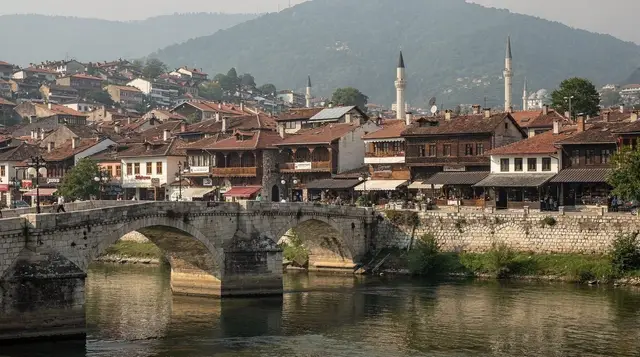
Most visitors treat Konjic as a gateway to the bunker, but the town has its own history worth half an hour. The Ottoman stone bridge across the Neretva dates to 1682 and was reconstructed after wartime damage; it anchors a compact old town with a handful of woodcarving workshops - Konjic has long been known for carved furniture and boxes, a craft still practised locally. Combining the bunker tour with a walk around the bridge and old town is the natural way to spend a day here, and several of the tours above already include it.
For travellers building their own itinerary rather than booking a packaged tour, the Konjic day trip guide covers the town in more depth, including the bridge and old town beyond the bunker visit.
Where this fits alongside Sarajevo’s other Cold War and 1984 history
D-0 ARK sits in a different register from most of what draws visitors to Sarajevo. It predates and is unrelated to the 1992-1996 siege; it belongs to the earlier story of Yugoslavia’s Cold War posture and Tito’s non-aligned but heavily defended state. Readers interested in that wider thread - including the 1984 Winter Olympics venues around Sarajevo, another product of the same Yugoslav era - may want the guide to Yugoslav heritage around Sarajevo and the piece on the legacy of the 1984 Olympics, both of which sit alongside this one without overlapping it.
For a broader menu of day trips from the capital, the best day trips from Sarajevo guide places Konjic and D-0 ARK against other options such as Mostar, and travellers planning several days outside the city may prefer the structured Bosnia history week itinerary, which sequences sites like this one across multiple days rather than as single add-ons.
Practical tips for the visit
- Book ahead. Entry is guided-only at fixed times, and Konjic is an hour from Sarajevo - arriving without a reservation risks a wasted trip.
- Bring a layer. The tunnels stay cool year-round regardless of the season above ground.
- Wear comfortable, flat shoes - the visit involves a fair amount of walking on concrete floors and some uneven surfaces.
- Photography rules can vary by tour operator and by what is currently on display through Ars Aevi; ask your guide before shooting inside the chambers.
- Pair it with Konjic’s Ottoman bridge and old town rather than driving straight back to Sarajevo - it adds under an hour to the day.
- If you also want Boračko Lake or a stop in Mostar, check which combination tour covers it before booking, since not all of them include the same extra stops.
Choosing between a tour and doing it yourself
The bunker forces the decision for you, because access is guided and scheduled whichever way you arrive. What you can still choose is how much of the day around it you control. A packaged tour removes the logistics of the drive and the timing, while a self-driven day lets you linger in Konjic or skip a stop you do not care about. The guide to guided tours versus independent travel in Bosnia weighs that trade-off in general terms, and day trips without a car is the better starting point if you are not hiring one. If you are leaning towards public transport for part of the trip, the overview of buses in Bosnia explains why a bus alone rarely fits a site like this.
Who will get the most from the visit
The bunker rewards people who enjoy the mechanics of a place: how air was filtered, how a command structure was meant to function underground, why a state would pour so much into a structure it hoped never to use. If you prefer sites with a strong human story, you may find it quieter than the siege-era sights in the capital, and the Tunnel of Hope visiting guide or the comparison of Sarajevo’s war museums will suit that taste better. Many visitors do both, and the contrast is part of the appeal: one site is about a war that was planned for and never came, the other about a war that arrived without warning.
Families should read the answer on children below and then judge for themselves. The Sarajevo with kids guide and the notes on Bosnia with teenagers give a sense of which sights tend to hold younger attention, and older children who like engineering or history often take more from the corridors than adults expect.
Making the day work around the bunker
Because the tour times are fixed, plan the rest of the day backwards from your slot rather than forwards from your hotel. Arrive in Konjic with a little margin, leave the old town and any meal for after the tour, and keep the later stops flexible. If your tour continues to the lake or to Mostar, ask the operator how much slack the schedule has, since a late start at the bunker pushes everything after it.
The Boračko Lake guide is useful if you want an unhurried afternoon after the concrete, and the Mostar day trip guide explains what a Mostar add-on really involves before you commit to a long itinerary. For the transport side of that, the Sarajevo to Mostar transport guide lays out the options.
If your plans stretch beyond a single day, the same corridor of the Neretva valley holds other worthwhile stops, including Jablanica, and the Bosnia road trip itinerary strings several of them together.
Context that helps before you go
A little background makes the tour land better. The bunker is a product of the Yugoslav state’s particular position between the two Cold War blocs, and the Yugoslav heritage guide fills in that setting. For the later history, which is a very different subject, the guide to Bosnian war context for visitors is written for people arriving without prior knowledge, and the destination page for the bunker gathers the essentials in one place.
Decide on the season too. The tunnels stay cool whatever the weather outside, so the bunker is a useful card on a hot day or a wet one, and the rainy day indoor guide lists other options for bad weather. For the best time to travel in general, see the guide to when to visit Sarajevo, and the packing list is worth a glance if you are travelling in the colder months.
Fitting the bunker into your wider Sarajevo plans
Most people give the bunker a half day or a full day, and that cost has to come from somewhere. On a short stay, it competes with the old town and the central museums, so check the two days in Sarajevo guide and the wider trip planning guide before you decide. With more time, the bunker is an easy and rewarding addition, and the Sarajevo museums guide helps you balance it against what you can see without leaving the city.
Frequently asked questions about visiting Tito’s bunker
What does D-0 ARK stand for?
D-0 ARK is short for Domicile 0, Atomska Ratna Komanda - Yugoslavia’s Atomic War Command. It was the codename for the bunker complex built to shelter the country’s political and military leadership, including President Tito, in the event of nuclear war.
How far is the bunker from Sarajevo, and how long does the visit take?
Konjic is about 60 km from Sarajevo, roughly an hour by road. The guided tour inside the bunker itself typically runs 60 to 90 minutes; with travel time and Konjic’s old town, plan on half a day at minimum.
Can you visit the bunker without a car?
Independent access on public transport is impractical, since the bunker sits outside Konjic and only opens for scheduled guided groups. A day tour from Sarajevo that includes transport is the straightforward option for visitors without their own vehicle.
Is Tito’s bunker linked to the Ars Aevi museum in any way?
Yes. Since 2011 part of the bunker’s tunnels has hosted work from the Ars Aevi collection of contemporary art, shown through the Ars Aevi Biennial. The art installations sit inside the original Cold War infrastructure rather than in a separate gallery space.
Is the bunker suitable for children?
It can be, though the corridors are long, dimly lit and cool year-round, and the subject matter - nuclear war planning - is aimed at an adult audience even if it is presented factually rather than graphically. Younger children may find the length and the concrete tunnels tiring rather than frightening.
What else should you see in Konjic on the same day?
Konjic’s own Ottoman bridge, built in 1682 and reconstructed after wartime damage, sits in the town centre a short walk or drive from the bunker turn-off, and most half-day and full-day tours stop there as well.
War history & remembrance tours on GetYourGuide
Verified deep-linked GetYourGuide tours. Book through these links and we earn a small commission at no cost to you.
GetYourGuide does not provide a product photo for this activity — the image shows the meeting point, photographed by us.