Bosnia and Herzegovina with teenagers
What can teenagers actually do in Bosnia and Herzegovina besides museums?
Teenagers aged 13 to 18 tend to respond better to white-water rafting on the Neretva or the Tara, the abandoned 1984 Olympic bobsleigh track on Trebević, and the Tunnel of Hope than to another gallery. Mostar's cliff divers, the Tito Bunker's contemporary art collection, and the War Childhood Museum add physical activity and content mature enough to hold their attention without being staged as a spectacle.
Why the usual museum pace falls flat with this age group
Sarajevo has an unusually dense concentration of serious history, and the standard advice for visiting families is to walk it slowly, room by room. That works for adults and for younger children who need short bursts and clear narration. It works badly for a 15-year-old who has already sat through a school unit on the twentieth century and is not interested in a fifth glass case of shell fragments. The sites that actually land with teenagers here are the ones that combine something physical — cycling, rafting, a scramble over concrete — with content that is not simplified for them.
Bosnia and Herzegovina happens to have both in quantity: a capital ringed by mountains that held an Olympics, a river gorge built for white water, and a recent history that a 13-to-18-year-old is old enough to be told about straight, without a euphemism. This guide sequences those sites rather than the standard sightseeing list. For a gentler pace with younger children, see family day trips from Sarajevo instead — this one assumes teenagers who can walk for hours and sit through an honest conversation about the 1990s.
Mostar’s cliff divers: the jump that isn’t a show
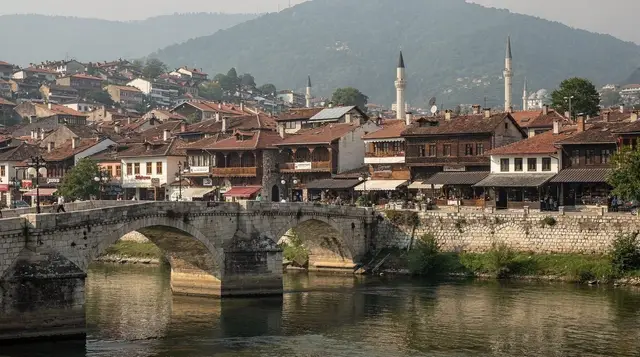
The Stari Most is the single most photographed structure in Bosnia and Herzegovina, rebuilt to its 1566 design after Croat forces destroyed it on 9 November 1993 and reopened on 23 July 2004. Teenagers usually clock the bridge itself in about ninety seconds and then ask about the divers. The Mostari diving club is real and its members do jump from the parapet, a drop of roughly 21 metres into the Neretva, but it is not a scheduled attraction.
Divers jump when the crowd on the bridge has put enough money into the collection to make it worth their while — sometimes that takes ten minutes, sometimes it does not happen at all during a given visit. Telling teenagers this in advance avoids the flat disappointment of standing around waiting for a show that was never promised. The town around the bridge — the Kujundžiluk copper market, the mosque courtyards with river views, the Old Bridge Museum — fills the rest of a half-day easily. Full details, including how the train to Mostar compares with the road, are in the Mostar day trip guide.
a full-day guided run from Sarajevo to Mostar that also stops at the Tunnel of Hope museum on the way covers the transport logistics in one booking, which matters on a day when nobody wants to be managing bus timetables.
Rafting the Neretva and the Tara: white water, not a boat float
Two rivers within reach of Sarajevo carry real white water rather than a gentle drift, and both run a proper rafting season from May to September. The Neretva is run from Konjic, roughly an hour from Sarajevo, with rapids graded for a first-timer but genuinely physically demanding — paddling matters, not just holding on. The Tara, across the border in Montenegro but reached from Foča on the Bosnian side, runs through Europe’s deepest gorge and is a longer, more committed day.
Both need proper footwear, a willingness to get properly wet, and a guide briefing that teenagers should actually listen to rather than treat as filler before the fun starts. Minimum ages and difficulty vary by water level and by operator, so confirm specifics rather than assuming; the rafting season and safety guide covers what changes month to month, and the river-specific write-ups — rafting the Neretva and rafting the Tara from Sarajevo — go into put-in points and what a day actually involves.
a day trip from Sarajevo that includes the Neretva rafting run itself plus meals is the simplest way to book this without arranging transport to Konjic separately.
Trebević’s abandoned bobsleigh track: the site teenagers photograph the most
The Trebević bobsleigh and luge track was built for the 1984 Winter Olympics and has sat unused and unmaintained since the siege, when it was used as a Bosnian Serb artillery position overlooking the city. What is left is a long concrete chute, now covered floor to ceiling in graffiti, freely walkable with no ticket, no barrier and no supervision. It reads as abandoned infrastructure rather than a memorial, which is precisely why it photographs well and why teenagers tend to spend longer here than at almost anything else in the city.
The Trebević cable car, reopened in April 2018, is the easiest way up — about nine minutes from Bistrik to 1,164 metres, with the track a short walk from the top station. Footing on the old chute is genuinely uneven, so this is not a stop for anyone in sandals. The Trebević bobsleigh visiting guide and the cable car guide cover timing and what else is up on the mountain, including hiking trails back down for anyone who wants more than a viewpoint.
The Tito Bunker at Konjic: six kilometres of Cold War tunnel turned into art
Also near Konjic, and easily combined with a rafting day, is the Tito Bunker — officially D-0 ARK — 6,500 square metres of tunnels dug into the mountainside between 1953 and 1979 as a nuclear-proof command post for Yugoslavia’s leadership in case of war. It never saw the use it was built for. Since 2011 it has operated as a contemporary art space, with rotating installations set inside the original blast doors, ventilation shafts and command rooms.
That combination — Cold War military architecture used as a gallery — is an easier sell to a sceptical teenager than a conventional museum, and the physical scale of the tunnels does most of the work. Book ahead: visits run on a schedule rather than drop-in access. The Tito Bunker visiting guide has the booking details, and the Konjic day trip guide covers pairing it with the town’s 1682 Ottoman bridge or with a rafting run on the same day.
The Tunnel of Hope: the one history site that consistently works
Most of Sarajevo’s siege-related sites are built for an adult audience thinking carefully about the 1990s. The Tunnel of Hope, at Butmir near the airport, is the exception. The original 800-metre tunnel, hand-dug in 1993 under the airport runway as the only route between the besieged city and free territory, cannot all be walked, but around 20 metres of it can, alongside a small museum built into the house that concealed the original entrance.
The physical scale — a tunnel roughly 1.5 metres high and less than a metre wide, dug by hand under active fire — communicates the siege more directly to a 14-year-old than a timeline on a wall ever will. Entry runs around 10 to 15 KM (about €5 to €8). The Tunnel of Hope visiting guide and the destination page cover getting out to Butmir; most guided city tours of the siege stop here as a matter of course.
a guided bike route through the city that finishes with entry to the Tunnel of Hope turns the visit into an active half-day rather than a single indoor stop, which tends to suit this age group better than a walking tour on its own.
The War Childhood Museum: objects, not a lecture
The War Childhood Museum sits in the Old Town and works from a simple premise: adults who were children during the siege donated one object each, with a short caption in their own words explaining what it meant to them. A toy, a diary, a pair of skates. There is no narration track and no attempt to summarise the war as a whole — the effect comes from reading twenty or thirty short, specific accounts written by people who were, at the time, roughly the same age as the teenager reading them.
It won the Council of Europe Museum Prize in 2018 and it is, by a clear margin, the siege-related museum that teenagers engage with most on their own terms rather than because an adult told them to look. The War Childhood Museum guide has practical details; it pairs naturally with a stop at the Tunnel of Hope on the same day, since both are told through individual experience rather than institutional history.
A four-to-five-day structure that mixes effort with content
| Day | Focus | Physical load |
|---|---|---|
| 1 | Baščaršija on foot, Sebilj, Gazi Husrev-bey Mosque, War Childhood Museum | Low |
| 2 | Tunnel of Hope, cable car up Trebević, the bobsleigh track | Moderate |
| 3 | Day trip to Konjic: Tito Bunker plus Neretva rafting | High |
| 4 | Day trip to Mostar: Stari Most, cliff divers, Old Bridge Museum | Moderate |
| 5 | Optional: hiking around Sarajevo or a second river day on the Tara | High |
This is deliberately front-loaded with the lower-effort day first, since arrival day rarely suits a rafting trip. Days 2 and 3 are the ones built around this guide’s angle; day 4 shifts the theme to Mostar without repeating it. Anyone with a full week can extend this with the seven-day Bosnia road trip framework and add a mountain night near Jahorina or Bjelašnica.
a guided hike through the highlands above the city with lunch included is a reasonable way to fill a fifth day that doesn’t involve another transfer to Mostar or Konjic, and it keeps the group on a marked, guided route.
Practical details before you book anything
Landmines remain the one serious safety issue in the Bosnian countryside, with tens of square kilometres still suspected outside marked and frequented areas. None of the sites in this guide sit in flagged zones, and none of them require leaving a marked path, but it is worth saying plainly to a teenager who wants to wander off a trail on Trebević or in the hills above Konjic: don’t. The landmine safety guide sets out the actual rule — stay on marked paths and frequented ground, and take a guide for anything off them.
Footwear matters more on this itinerary than on a standard sightseeing trip. Trainers or walking shoes for the bobsleigh track and the Tunnel of Hope, water shoes or old trainers that can get wet for rafting, and something with grip for the Tito Bunker’s uneven floors. Bring cash in KM — none of these sites take cards reliably, and rafting operators in particular expect payment in cash on the day.
Book rafting and the Tito Bunker ahead rather than turning up. Rafting operators run to group sizes and daylight hours; the Tito Bunker runs scheduled visits rather than open access. The Tunnel of Hope, the War Childhood Museum and the Trebević track can all be done on the day without advance booking.
FAQ: taking teenagers to Bosnia and Herzegovina
How old do you need to be to raft the Neretva or the Tara?
Most operators set their own minimum age, commonly around 12 to 14, and it can shift with water levels — high spring flow rules out younger teenagers even where the listed minimum would allow them. Ask the specific operator when you book, not a general rule, and expect the answer to change between May and September.
Can teenagers watch the Mostar bridge divers jump?
Yes, and it costs nothing to watch from the Stari Most or the riverbank. There is no schedule: the Mostari club’s divers jump the roughly 21-metre drop only once enough money has been collected from the crowd, so a visit can mean a ten-minute wait or an hour with no jump at all.
Is the Trebević bobsleigh track safe to visit?
The track itself is structurally sound concrete, covered in graffiti and open to anyone on foot, with no barrier or ticket. Footing is uneven and there is no lighting or rail, so it suits daylight visits in decent shoes rather than a quick stop in sandals.
Is the Tunnel of Hope too intense for younger teenagers?
No — the visitable stretch is around 20 metres of the original 800-metre tunnel plus a small museum, and the facts are presented plainly rather than dramatised. It is one of the few sites in Sarajevo built for a general audience rather than specialists, and it works for teenagers from about 13 upwards.
What age is the War Childhood Museum appropriate for?
The museum presents real objects donated by people who were children during the siege, with short first-person captions rather than graphic imagery. It suits teenagers well — the format is closer to a series of personal stories than a conventional war exhibition, which is part of why it won the Council of Europe Museum Prize in 2018.
Do we need a guide for hiking near Sarajevo with teenagers?
For marked, frequented routes such as the path up Trebević or the walk along the Velika aleja to Vrelo Bosne, no. For anything off the marked trail — including parts of the Rakitnica canyon or routes around Lukomir — take a guide, because unexploded landmines are still suspected in parts of the surrounding countryside.
How many days do we need for this itinerary?
Four to five days covers Sarajevo’s teenager-focused sites plus one full day trip to Mostar or Konjic with time to decompress in between. Trying to combine rafting, the bobsleigh track, the Tito Bunker and Mostar in under four days turns every stop into a rushed transfer.
Is Bosnia and Herzegovina safe for teenagers to travel in?
Sarajevo and Mostar are safe cities with low rates of crime against visitors. The one serious risk in the country is landmines in unmarked rural and former front-line areas, which is a reason to stay on marked paths and frequented routes, not a reason to avoid the country.
Family-friendly tours on GetYourGuide
Verified deep-linked GetYourGuide tours. Book through these links and we earn a small commission at no cost to you.
GetYourGuide does not provide a product photo for this activity — the image shows the meeting point, photographed by us.