Seven days in Sarajevo: a full week from one base
Seven days from a single hotel in Sarajevo covers more of Bosnia and Herzegovina than most visitors expect, without ever packing a bag twice. That is the point of this itinerary and what separates it from a road-trip loop: the base never moves. Two days go to the city itself, four go out and back by tour, train, bus or hire car, and the last day stays close, in the mountains above town. The two long days — Kravice and the Jajce-and-Travnik combination — are worth planning around rather than around each other; doing them back to back is tiring in a way that a rest day in between is not.
Day 1: Baščaršija and the old town
Start in Baščaršija, the Ottoman bazaar founded around 1462, and let the first day be walking rather than driving. The Sebilj fountain is the obvious meeting point; from there, the Kazandžiluk lane still has coppersmiths at work, the Gazi Husrev-bey Mosque is open to visitors outside prayer times for around 5 KM, and the Vijećnica — Sarajevo’s pseudo-Moorish town hall, burned in the 1992 fire that destroyed close to two million books and manuscripts, reopened in 2014 — is worth the roughly 10 KM entry. Within about fifteen minutes on foot sit an Orthodox church, a Catholic cathedral and a synagogue, which is where Sarajevo’s old “Jerusalem of Europe” description comes from.
Finish the day with coffee served the Bosnian way, in a džezva with a piece of rahat lokum, and a first plate of ćevapi — Sarajevo serves them ten to a somun, with raw onion and kajmak, for around 8 to 12 KM. A guided walk through the old town on the first morning is a fast way to get the layout of the city — including where the Federation and Republika Srpska sides of town split — before exploring alone for the rest of the week. For a slower first pass, follow the route in Sarajevo in one day.
Day 2: The siege and the Tunnel of Hope
The second day belongs to the more recent history, and it deserves care rather than pace. Sniper Alley, the roses in the pavement where mortar impacts have been filled with red resin, and the War Childhood Museum all sit within the city centre. The Tunnel of Hope — 800 metres dug by hand in 1993 under the airport runway, the only link the besieged city had to free territory — is out at Butmir, near the airport, and around twenty metres of the original tunnel are open to visitors alongside a small museum, for roughly 10 to 15 KM entry.
The siege lasted 1,425 days, from 5 April 1992 to 29 February 1996, the longest siege of a capital city in modern warfare, and around 11,000 people died, including close to 1,600 children. A guided version of this day — a walking tour that covers the siege sites and the tunnel
— tends to explain what is otherwise easy to miss, particularly around Sniper Alley, where very little is signposted. This is not a day for photo stops; it is a day for reading the plaques.
Day 3: Mostar and Blagaj
Mostar is around 130 km and 2 hours 15 to 2 hours 30 by road, or about 2 hours 40 on one of Europe’s more scenic train lines, with two departures a day for roughly 12 KM. The Stari Most, built in 1566, destroyed on 9 November 1993 during the war and rebuilt by 2004, is the reason most people come; the divers of Mostari jump from around 21 metres, but only once they have collected enough from the crowd, not on a schedule.
Pair Mostar with Blagaj in the same day: a sixteenth-century dervish tekke sits directly against a 200-metre cliff face at the source of the Buna, one of the more powerful springs in Europe, about 12 km outside Mostar. A private guide through Mostar’s old town covers the bridge, the bazaar and the post-war rebuilding in a couple of hours, leaving the afternoon free for Blagaj. See Mostar as a day trip from Sarajevo for the transport options in more detail.
Day 4: Kravice Waterfalls
Kravice is the longer of the two full-day excursions: around 180 km each way, close to 3 hours in the car, so this is a day best started early. The Kravice Waterfalls on the Trebižat river drop about 25 metres over an arc roughly 120 metres wide, and entry runs around 20 KM in high season. Swimming is allowed and popular from late spring through summer; outside those months the falls are quieter and colder but no less worth seeing.
Because Kravice sits close to Mostar and Blagaj, some visitors combine all three in one long day rather than splitting them across Day 3 and Day 4 as suggested here — that works, but it turns two full days into one very full one. If time is short, an organised loop that covers Kravice, Blagaj and Počitelj in a single guided day is the more efficient version of Days 3 and 4 together, at the cost of less time at each stop.
Day 5: Jajce and Travnik in one day
This is the hardest day of the week, and it should be treated as such. Jajce is around 165 km and 2 hours 30 from Sarajevo, and the town’s defining feature — a roughly 20-metre waterfall on the Pliva, dropping right in the town centre — needs no detour to reach. Travnik is closer, around 90 km and 1 hour 30, and is best known as the birthplace of Ivo Andrić, the 1961 Nobel laureate, alongside a hilltop fortress and a brightly patterned mosque.
Doing both towns in one day from Sarajevo means roughly 255 km of driving before the day is done, so leave before 8am and expect to arrive back after dark. This single day covers most of what is realistically reachable in the country’s the North-West without sleeping outside Sarajevo — beyond Jajce and Travnik, towns like Banja Luka or Bihać stop being day-trip distance and start needing a night away. See Jajce and Travnik as a day trip for a route that fits both towns into daylight hours.
Day 6: Konjic and Tito’s bunker
Konjic is the easiest of the week’s excursions, about an hour from Sarajevo, which makes it a good day to recover pace after Day 5. The town’s Ottoman bridge, built in 1682 and reconstructed in 2009, is worth a look, but the main draw is Tito’s bunker — D-0 ARK, 6,500 square metres carved into the mountainside between 1953 and 1979, kept secret through the Yugoslav era and opened to the public in 2011, now doubling as a contemporary art space. Reservations are worth making ahead, since tour groups can fill the timed entry slots.
Konjic is also the starting point for rafting on the Neretva through the summer season, and it works well as a half-day if the bunker tour is booked for the morning, leaving the afternoon free back in Sarajevo. For the history of the site itself, the Tito bunker visiting guide covers what the tour includes and what it does not.
Day 7: Bjelašnica to close the week
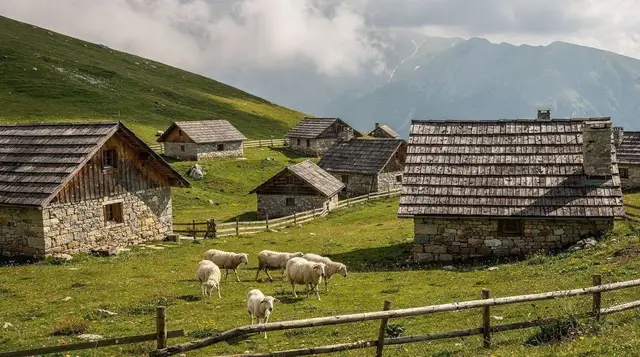
The last day stays close and slows down. Bjelašnica hosted the men’s alpine skiing at the 1984 Winter Olympics and is about 30 km, roughly 45 minutes, from central Sarajevo. In summer it is hiking country, with the stone-roofed village of Lukomir — the country’s highest inhabited village, at around 1,469 metres — reachable from the plateau for those with more time and a guide for the unmarked stretches; away from marked trails and known routes, Bosnia and Herzegovina still has areas of suspected landmines, and that rule holds on Bjelašnica as everywhere else in the hills.
A gentler version of the same day, for those who have done enough driving by now, is the Vrelo Bosne spring at Ilidža, reached on foot, by bike or by horse-drawn carriage down a 3.5 km avenue of plane trees. Either way, it is a fitting last day: a week that started in the old bazaar ends looking back down at the valley from the mountains that shaped the city’s geography, its 1984 Olympics, and — less happily — the siege that followed eight years later.
Planning this week: distances and rough costs
| Day | Destination | One-way distance | Approx. travel time |
|---|---|---|---|
| 1 | Baščaršija (city) | — | — |
| 2 | Tunnel of Hope, Butmir | ~12 km | 20–25 min |
| 3 | Mostar and Blagaj | ~130 km | 2h15–2h30 |
| 4 | Kravice Waterfalls | ~180 km | ~3h |
| 5 | Jajce, then Travnik | ~165 km / ~90 km | 2h30 / 1h30 |
| 6 | Konjic | ~60 km | ~1h |
| 7 | Bjelašnica | ~30 km | ~45 min |
Budget for the week comes out lower than a comparable week in Croatia: figure 20 to 35 KM for a hostel bed or 60 to 110 KM for a private apartment per night, 12 to 25 KM for a restaurant main, and entry fees rarely above 20 KM. The two long days add up mainly in transport — a private driver or organised tour for Kravice or the Jajce-and-Travnik combination typically costs more than the sights themselves. Where to stay in Sarajevo has more on choosing a base that keeps all seven days reasonably central.
Frequently asked questions about a week in Sarajevo
Do I need a car for a week based in Sarajevo?
No. Every day in this itinerary works by organised tour, train or bus from Sarajevo. A rental car saves time on the Jajce-and-Travnik day and gives more flexibility around Konjic and Bjelašnica, but it is not required.
Is one hotel for seven nights actually the best approach?
For this route, yes. Sarajevo is close enough to Mostar, Konjic and the Bjelašnica plateau that day trips are more efficient than packing and unpacking, and it keeps the two long days as out-and-back trips rather than one-way legs.
Which day is the hardest?
The Jajce and Travnik day. It covers roughly 255 km of driving, needs an early departure to see both towns properly, and gets back to Sarajevo after dark. Kravice, at around 180 km each way, is the other long day.
Can this itinerary be shortened to five or six days?
Yes, by dropping either the Jajce-and-Travnik day or the Kravice day, since they are the two longest. Mostar and Blagaj, the Tunnel of Hope, Konjic and Bjelašnica form a workable five-day core.
Do I need to book tours in advance in August?
For Mostar, Kravice and the siege-focused tours, yes, particularly in July and August when the Sarajevo Film Festival and Baščaršijske noći bring more visitors. Konjic’s Tito bunker also fills up and is worth reserving ahead year-round.
Is the pace realistic with children or older travellers?
The city days and Konjic are easy. Kravice and the Jajce-Travnik day are long in the car regardless of age; consider swapping one of them for a slower day around Ilidža and Vrelo Bosne instead.
tours.7 days
Verified deep-linked GetYourGuide tours. Book through these links and we earn a small commission at no cost to you.
GetYourGuide does not provide a product photo for this activity — the image shows the meeting point, photographed by us.