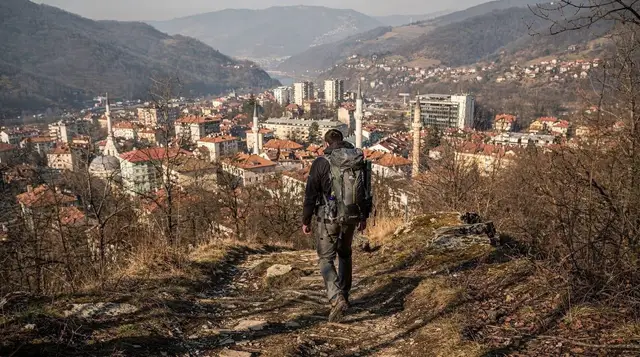
Jablanica sits on the road from Sarajevo to Mostar, about 75 km and a little over an hour by car, where the Neretva narrows into a long reservoir lake below a hydroelectric dam. Almost everyone who stops here does it for two things: the museum of the 1943 Battle of the Neretva, with the wrecked railway bridge still lying where it fell, and a plate of janjetina, spit-roasted lamb, at one of the restaurants strung along the lakeside road. Treat it as an hour-and-a-half stop, not a destination.
What Jablanica is actually good for
Jablanica has no old town, no bazaar and no landmark bridge of its own. The lake is a working reservoir behind a dam, with steep, largely bare slopes on either side and a road running close to the water, not a place for a lazy afternoon swim. What it does have is a genuinely important museum, cheaply and quickly seen, and a stretch of restaurants that specialise in one dish and do it well. Both fit neatly into a stop on the way to or from Mostar, or as a short add-on to a day built around Konjic.
The Battle of the Neretva Museum
In late February and early March 1943, Partisan forces fought their way across the Neretva at Jablanica in one of the largest battles of the war in Yugoslavia, blowing the railway bridge here themselves to slow the pursuing German and Croatian forces before crossing the river regardless, carrying thousands of wounded.
The museum, on the lake shore close to the old bridge site, sets out the battle with period photographs, weapons and maps, and the twisted iron spans of the destroyed railway bridge are still there at the water’s edge, left as they fell rather than rebuilt. It is a small, single-building museum: 30 to 45 minutes is enough to see everything without rushing, and there is no need to budget more. Entry is a few convertible marks; opening hours are shorter outside the summer season, so check ahead if you are passing through in winter.
The battle became one of the founding stories of socialist Yugoslavia and was later restaged, with real tanks and a partly rebuilt bridge, for the 1969 film The Battle of Neretva, one of the most expensive productions of the era. That cinematic scale is worth knowing before you arrive, because the real site is modest by comparison: a lakeside museum and a broken bridge, not a battlefield park.
If you want the fuller Yugoslav-era picture before or after Jablanica, the Rise and fall of Yugoslavia tour from Sarajevo and a stop at Tito’s underground bunker in Konjic cover the same decades from different angles: Jablanica is 1943 and the war itself, the bunker is Cold War paranoia three decades later.
Janjetina: the reason to actually stop
Jablanica’s other claim is culinary. The road along the lake is lined with restaurants built specifically around janjetina, lamb roasted whole on a spit over an open fire, a method associated with this stretch of the Neretva valley more than with Sarajevo itself. A plate of roast lamb with sides runs roughly 15-20 KM, about 8-10 EUR at the fixed rate, and portions are generous. Most places keep the spits turning in view of the road, which is as much advertising as anything, and locals travelling between Sarajevo and the coast routinely time their journey to eat here rather than in Mostar or Konjic.
| What | Typical price (KM) | Approx. EUR |
|---|---|---|
| Janjetina plate (lamb, sides) | 15-20 KM | 8-10 EUR |
| Grilled trout, lake fish | 12-18 KM | 6-9 EUR |
| Soft drink or coffee | 2-4 KM | 1-2 EUR |
| Museum entry | 4-6 KM | 2-3 EUR |
There is no single restaurant to single out over the others; quality along this strip is generally consistent, and the busiest terraces at midday are usually a reasonable guide to which spit has turned over fastest that morning.
The lake itself: brief, not scenic
Jablanica Lake is the result of a hydroelectric dam on the Neretva, and it reads that way: steep, thinly wooded banks, a working shoreline, and a water level that the dam operator controls rather than nature. It is a pleasant enough backdrop for lunch, and a few small operators run short boat trips or fishing excursions from the town, but it is not a swimming lake in the way Boračko Lake, a short drive further towards Konjic, is. If a lake with clean water and a beach setting is what you are after, that comparison matters: Boračko is for an afternoon in the water, Jablanica is for the museum and the lamb.
Whitewater on the Neretva above Jablanica is a separate draw again, run mostly out of Konjic rather than Jablanica town itself; see rafting the Neretva if that is the plan.
How Jablanica compares to its neighbours on this road
The Sarajevo-Mostar road passes three stops within about 15 km of each other that get confused with one another, and each does one thing:
| Stop | Main draw | Time needed | Not the place for |
|---|---|---|---|
| Jablanica | 1943 battle museum, roast lamb | 1-2 hours | Swimming, Cold War history |
| Boračko Lake | Swimming, clean water | Half a day | History, restaurants |
| Tito’s Bunker (Konjic) | Cold War nuclear shelter | 1-1.5 hours (book ahead) | WWII, food, lakes |
If a full day around Konjic and Jablanica appeals, the Konjic day trip guide sequences all three properly rather than trying to force them into one rushed stop.
Getting to Jablanica
Jablanica sits directly on the main road and rail line between Sarajevo and Mostar, which makes it an easy add rather than a detour.
- By car: around 75 km from Sarajevo, a little over an hour on the M17, continuing another 45-55 minutes on to Mostar. Notes on the road itself are in the driving in Bosnia guide.
- By train: Jablanica is a stop on the scenic Sarajevo-Mostar-Čapljina line, which runs twice daily; a fine option if you only want the view and the lamb, without needing a car. Details in the Sarajevo to Mostar transport guide.
- By bus: intercity coaches on the Sarajevo-Mostar route pass through or near Jablanica, though not all stop in the centre; check with the carrier before booking if this is your plan, and see day trips without a car for the wider picture.
- On an organised tour: several Sarajevo-Mostar day tours build in a stop near Jablanica as part of the route south. The Sarajevo Grand Tour with the Tunnel of Hope museum covers the same corridor with a guide handling the stops and timing. For the Cold War side of the same region, the Bosnia Explorer tour taking in Mostar and Tito’s bunker pairs Jablanica’s neighbours in a single day.
Two activity operators run specifically out of Jablanica itself if you want more than the museum and lunch: a kayak and stand-up paddleboard safari on the Neretva at Jablanica, and, for a longer stop, the via ferrata route at Prenjska Vrata above Jablanica, which turns the town into a half-day mountain outing rather than a roadside break.
Making the most of a short stop
An hour or two goes further when the order is right. Most people do the museum first, while attention is fresh, and eat afterwards, since a plate of roast lamb is not a meal that encourages a brisk walk around exhibits. If you are arriving from Sarajevo around midday, the reverse can also work: lunch first, before the busiest terraces fill, then the museum at an easy pace. Either way, park once near the lakeside road and walk; the museum, the broken bridge and the restaurants are close enough that the car can stay where it is.
Bring a layer even in summer. The lake sits in a steep valley and the air by the water can feel cooler than it did in Sarajevo, particularly in the shoulder months. In winter the museum and restaurants remain the point of the stop, and the terraces are replaced by indoor tables, which is perfectly comfortable but a different experience from eating by the water.
Reading the site with some context
The museum makes more sense if you already know a little of what came before and after 1943. The guide to Bosnian war context for visitors covers the later conflict, which is a very different story from the Second World War one told here, and keeping the two apart in your head helps, because the lakeside exhibits speak of the earlier war only. The Yugoslav heritage guide places the Partisan story within the wider socialist-era narrative that the film and the monuments of the period reinforced, and a guided Yugoslavia tour from Sarajevo is a reasonable way to hear that story told in person if you prefer a guide to reading.
If you would rather see the country through its landscapes than its history, the bosnia nature week itinerary strings together the river valleys and mountains that surround this stretch of the Neretva, while the Bosnia history week gives Jablanica a place among the war and heritage sites of the country.
Eating well without overthinking it
Janjetina is a heavy, rich dish, and one plate is often enough for a late lunch; sharing sides is normal. If you are travelling with someone who does not eat lamb, grilled trout is on the table list above, and most kitchens along the strip can put together something simpler. Vegetarians will find the choice narrower here than in the capital, so the vegetarian and vegan guide to Sarajevo is worth reading before you leave, and carrying something to eat is not a bad idea. For a sense of how this meal fits into the wider regional table, see the Sarajevo food guide and the notes on rakija and Herzegovina wine, which are the usual companions to a roast on this side of the country. If you are driving, remember that the wine is better saved for the evening in Mostar.
When Jablanica is the wrong stop
Be honest about what you want from the day. If your time south of Sarajevo is tight and you have to choose, Mostar and the Kravice waterfalls give more for a single day than a lunch break does. Jablanica earns its place when the road itself is part of the plan, or when the Second World War is a reason you are in Bosnia at all. For a comparison of how the whole corridor stacks up, the Sarajevo versus Mostar guide and the notes on where to base yourself will help you decide where the weight of your trip should fall.
Planning the rest of the day around Jablanica
Because Jablanica rarely fills more than two hours, most visitors fold it into a longer day. The two natural pairings are a loop through Konjic and Boračko Lake on the way south, or a straight run through to Mostar with Jablanica as the halfway break. Either fits comfortably inside the Sarajevo-Mostar three-day itinerary or a longer seven-day road trip through Herzegovina.
If history rather than food is the priority for the day, Jablanica sits reasonably on the way to or from Jajce and Travnik as well, though that makes for a long day on the road. For a shorter list of what else is realistic within a day of Sarajevo, see best day trips from Sarajevo and the wider day trips category.
Jablanica: practical questions
How long does the Battle of the Neretva museum take?
Thirty to forty-five minutes covers the exhibits and the section of destroyed railway bridge on the lake shore outside. It is a single small museum, not a site to build a half-day around.
Is Jablanica worth visiting for the lake alone?
No. The lake is a hydroelectric reservoir with a working shoreline, useful as a backdrop for lunch but not a swimming or scenic destination in its own right. Boračko Lake, a short drive away, is the better choice for that.
Where does the lamb tradition come from?
Janjetina, lamb roasted whole on a spit, is associated with this stretch of the Neretva valley in particular, and the restaurants along the Jablanica lakeside built their reputation on it. A plate typically costs 15-20 KM, about 8-10 EUR.
Can I visit Jablanica by train?
Yes. It is a stop on the Sarajevo-Mostar-Čapljina line, which runs twice a day and is considered one of the more scenic rail journeys in the region. It works well if you want the museum and lunch without a car.
Should I combine Jablanica with Tito’s Bunker or Boračko Lake?
They sit close together but cover different ground: Jablanica is the 1943 battle and lunch, Tito’s Bunker in Konjic is Cold War history and needs booking ahead, and Boračko Lake is for swimming. Combining two of the three in one day, rather than all of them, keeps the pace reasonable.
Is Jablanica a full day trip from Sarajevo?
Not really. Most of the value here is seen in an hour or two, so Jablanica works best as a stop on a longer drive to Mostar or as part of a Konjic-focused day, rather than as a standalone day trip from Sarajevo.
What else is there to do around Jablanica?
Beyond the museum and lunch, operators run kayak and paddleboard trips on the Neretva and a via ferrata route above the town at Prenjska Vrata, either of which extends a stop into a half-day of activity for anyone with more time.