The Sarajevo burek guide: what to order, where and when
What is burek in Sarajevo, and how is it different from sirnica or krompiruša?
In Bosnia, burek is strictly the meat-filled version of this rolled filo pastry. The same dough filled with cheese is sirnica, with potato is krompiruša, and with spinach is zeljanica. Calling all four burek is a tourist habit rather than local usage, and it marks you out at the counter.
The word tourists get wrong before they’ve even ordered
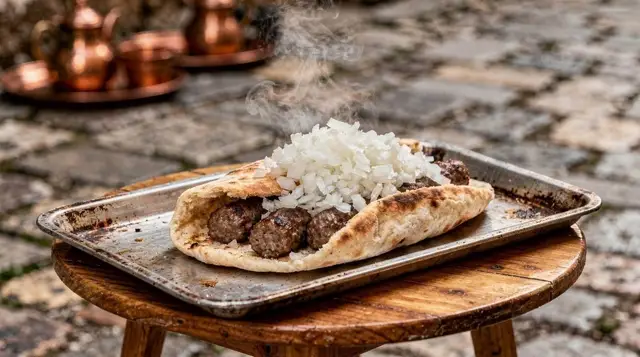
Ask for “burek” in Sarajevo and point at a tray of cheese pastry, and the person behind the counter will usually correct you, politely. In Bosnian usage, burek is one specific thing: a coiled filo pastry filled with minced meat, almost always beef, sometimes mixed with onion and a little fat to keep it moist through baking. The same pastry filled with cheese is sirnica. Filled with potato, it’s krompiruša. Filled with spinach and a soft cheese, it’s zeljanica. All four come out of the same dough, cut into the same spiral, baked in the same trays — but only one of them is burek, and calling the whole family “burek” (as menus aimed at visitors often do) is a tourist habit rather than a Bosnian one.
This matters more than it sounds like it should, because it changes what you’ll actually get. Order “a burek” expecting a mix of fillings on a plate, and you’ll get a slice of meat pastry, full stop. If you want a sampler, you ask for a piece each of burek, sirnica and krompiruša by name — three separate orders, not three flavours of the same dish. Locals do this routinely; it’s not fussy, it’s just how the counter works.
This guide stays on that one subject: what burek and its relatives actually are, where and when to eat them well in Baščaršija, what they cost, and how to tell a bureklinica worth queuing at from a pita counter aimed at foot traffic. For the rest of Sarajevo’s food — cevapi, coffee, sweets — see the Sarajevo food guide.
Bureklinica or pita chain: they are not the same product
Walk through Baščaršija and you’ll pass two different kinds of shop selling what looks, from the street, like the same pastry. Telling them apart is the single most useful thing in this guide.
A traditional bureklinica rolls its own dough, or uses fresh filo bought that morning, and bakes in batches through the day in a proper oven — in the older, smaller shops this is still a wood-fired sač or a stone-floored oven you can sometimes see or smell from the doorway. These places tend to open early, sell through the morning, and often run out of the meat version specifically before they run out of sirnica or krompiruša, because burek is what most locals come in for first. Trays are shallow, round, cut into wedges, and sold by weight or by the piece straight from the tray.
A pita counter or chain — and Sarajevo has plenty, some open until late at night — works from frozen, pre-rolled dough, bakes in an electric oven, and keeps a fairly constant supply all day. The pastry is thinner, the texture more uniform and slightly rubbery once it cools, and the filling tends to be wetter. It isn’t inedible, and it’s a reasonable option at 11pm when the traditional bakeries are long closed. But it’s a different product, and pricing it the same as a bureklinica slice is one of the small ways Baščaršija quietly charges tourists for less.
The giveaway, more than the sign outside, is the queue: a bureklinica with a line of locals holding coins rather than menus, and staff cutting straight from a tray rather than a heated glass case, is doing it the traditional way.
| Traditional bureklinica | Pita chain / fast counter | |
|---|---|---|
| Dough | Fresh, often hand-rolled | Frozen, pre-rolled |
| Oven | Wood-fired or traditional | Electric |
| Hours | Morning to mid-afternoon, often sold out by evening | Open late, sometimes 24 hours |
| Texture | Flaky, drier crust | Softer, slightly rubbery when cool |
| Price | 3–5 KM a portion | Similar price, lower quality |
The vocabulary, laid out plainly
Because getting this right at the counter avoids both confusion and the mild, friendly correction that comes with getting it wrong:
| Bosnian name | Filling | Vegetarian |
|---|---|---|
| Burek | Minced meat (usually beef) | No |
| Sirnica | Cheese | Yes |
| Krompiruša | Potato | Yes |
| Zeljanica | Spinach and cheese | Yes |
If a menu lists all four under the single heading “burek” with sub-names in brackets, it’s written for visitors — not wrong exactly, but a sign the shop is used to explaining rather than being understood on sight. In a bureklinica used mainly by locals, you’ll usually see four separate trays and be expected to know, or ask, which is which.
Where to look in Baščaršija
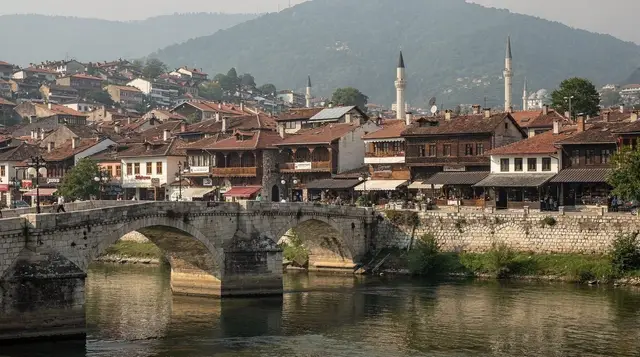
The bazaar founded around 1462 is still the centre of Sarajevo’s burek culture, and the highest concentration of bureklinice sits in its smaller lanes rather than on the widest, most photographed streets. The busiest tourist thoroughfares near the Sebilj tend to have the pita chains and the tourist-menu shops; walk a couple of streets further into the older grid, or towards Ferhadija where the Ottoman old town meets the Austro-Hungarian centre, and you’ll find smaller counters that keep local hours and sell out by early afternoon.
A rough but reliable method: follow the smell of baking bread and look for a queue that isn’t holding a phone up to photograph the pastry. If there’s a wood oven visible, or a chalkboard with just burek, sirnica, krompiruša and zeljanica and no English translation, that’s usually the real thing. For a structured route through the district that takes in these lanes along with the Sebilj, the Kazandžiluk coppersmith street and the mosque courtyards, the Baščaršija walking guide covers the layout in more detail than makes sense to repeat here.
Markale market, a short walk from the bazaar’s edge, is worth a mention for a different reason: it’s where many of the neighbourhood’s bakeries and small producers still buy fresh produce each morning, and the surrounding streets have a handful of no-frills bureklinice that see far more locals on their way to work than tourists.
Timing: morning is not a style preference, it’s practical
The single most common mistake with burek in Sarajevo isn’t the vocabulary, it’s the clock. Traditional bakeries bake in batches, starting early, and the meat filling is usually the first to sell out — often well before midday on a busy morning, sometimes closer to 2pm on a slower one. Arrive at 4pm hoping for fresh burek and you may find only sirnica and krompiruša left, or a tray that’s been reheated rather than pulled straight from the oven. Neither is a disaster, but it isn’t the version worth queuing for.
If burek is the priority, aim for breakfast — before 10am is safest, particularly at smaller, well-regarded bakeries that don’t bake continuously through the day. This also matches how Bosnians actually eat it: burek with kiselo mlijeko is a standard breakfast, not primarily a lunch or dinner dish, even though you can find it at most hours somewhere in the city thanks to the chain counters. For a wider view of what a Sarajevo morning looks like on a plate, see the Sarajevo breakfast guide; for the coffee that often follows it, the Bosnian coffee ritual explains the džezva-and-rahat lokum routine in full.
How to order, and what it costs
Ordering is simple once the vocabulary is settled. You ask for a portion — often quoted as a weight, sometimes as a fixed slice — of burek, sirnica, krompiruša or zeljanica, and it’s cut from the tray in front of you. A typical portion runs 3 to 5 KM (roughly €1.50 to €2.50 at the fixed rate of 1 EUR = 1.95583 KM), whether at a traditional bureklinica or a pita chain, which is exactly why the traditional bakeries are the better value: same price bracket, noticeably better pastry.
Cash is expected at almost all of these counters — they’re small, fast-turnover businesses, and card machines are the exception rather than the rule. Keep coins and small notes on you specifically for this; it also avoids the DCC conversion trap that shows up more often at larger, card-friendly restaurants than at a burek counter, but it’s a habit worth having anyway when eating anywhere small.
If you want to compare prices and quality across a wider set of restaurants rather than just bakery counters, the Sarajevo restaurants by budget guide sets out what 12 to 25 KM buys at a sit-down meal, for context — burek is cheaper than almost anything on that scale, which is part of why it’s eaten so casually and so often.
The proper way to eat it: kiselo mlijeko, not coffee
The standard pairing with burek is kiselo mlijeko, a thin, mildly sour drinking yoghurt sold in small bottles or plastic cups at the same bakeries and at nearby corner shops. It isn’t an optional extra so much as the traditional way the dish is eaten — the yoghurt cuts through the pastry’s fat and the meat’s richness in a way that coffee or water doesn’t. If a bureklinica doesn’t sell it directly, there’s usually a small market or shop within sight that does.
Ayran, a thinner and saltier yoghurt drink more associated with Turkish cuisine, turns up on some menus as a substitute and works reasonably well if kiselo mlijeko isn’t available. What doesn’t really fit, despite how often visitors reach for it, is bosanska kafa — the coffee is excellent, but it’s a separate ritual, usually taken afterwards or at a different time of day, not poured alongside a hot slice of burek.
Vegetarian options, honestly labelled
Because burek is meat by definition, there’s no such thing as “vegetarian burek” in the strict Bosnian sense — asking for one will get you a confused look or a gentle correction rather than a cheese pastry. What you want instead is sirnica (cheese) or zeljanica (spinach and cheese), both sold at the same counters, in the same trays, at the same price. Ordering them by their proper names, rather than as a substitute for burek, gets a faster and more accurate result. For a broader look at eating without meat in Sarajevo beyond the bakery counter, the vegetarian and vegan Sarajevo guide covers restaurants and other dishes.
Learning to make it, not just eat it
For visitors who want to understand why the pastry behaves the way it does — why the dough is stretched paper-thin rather than rolled, why the filling has to be dry enough not to split the layers in the oven — a hands-on class is a more useful way in than reading about it. A burek masterclass where you roll, bake and eat your own tray takes you through the stretching, filling and baking with a local instructor, and it’s the fastest way to actually notice the difference between hand-stretched dough and the frozen sheets used at pita chains, rather than just being told about it.
If burek is one stop on a wider appetite rather than the whole morning, a guided walk through the neighbourhood covering several stops at once saves the guesswork of which lanes to try. A guided walking food tour through Sarajevo’s Grbavica district pairs bakery stops with other local producers away from the most tourist-facing strip.
For a slower half-day that combines the Vrelo Bosne springs with a proper sit-down lunch back in the old town, a Vrelo Bosne and Baščaršija tour that ends with lunch is a reasonable way to bookend a morning of pastry-hunting with something more substantial later in the day.
None of this is necessary to eat well, though. A short walk through the older lanes of the bazaar, arriving before mid-morning, asking for burek or sirnica by name and finishing with a small bottle of kiselo mlijeko, is the whole method — and it costs less than a coffee back home.
Beyond burek: the rest of the city’s food
Burek is one part, admittedly a very good one, of a wider food culture that’s cheaper and more varied than most visitors expect walking in from Croatia. Several guides go deeper into the rest of it: how the city’s coffee ritual works and why it isn’t “Turkish coffee” by another name in the Bosnian coffee ritual guide, what a full day of eating costs across different budgets in Sarajevo restaurants by budget, and the sweeter end of the table in the Bosnian sweets guide, covering tufahija and baklava.
If you’re weighing up a guided food tour against finding your own way around, the Sarajevo food tours compared guide lines up the main options against simply walking in with a short list of names — burek, sirnica, krompiruša, zeljanica, kiselo mlijeko — and ordering with confidence. And for a first-person account of getting the food wrong before getting it right, including a burek-related misstep or two, the blog post the food I got wrong in Sarajevo is a useful, unvarnished companion piece to this guide.
Burek in Sarajevo: your questions answered
What’s the actual difference between burek, sirnica, krompiruša and zeljanica?
They’re the same coiled filo pastry with four different fillings. Burek is meat (usually minced beef), sirnica is cheese, krompiruša is potato, and zeljanica is spinach and cheese. In Bosnian usage, only the meat version is called burek — the others have their own names, and a shop that sells all four as “burek” is aiming at tourists.
What time should I go for burek in Baščaršija?
Morning, ideally before 10am. Traditional bakeries bake in batches through the day and the first trays sell fastest; by mid-afternoon you’re often getting reheated pastry rather than a fresh one, and some places sell out of burek specifically while sirnica or krompiruša remain.
How much does burek cost in Sarajevo?
Expect 3 to 5 KM (roughly €1.50 to €2.50) for a portion at a traditional bureklinica, sold by weight or as a fixed slice. Chain pita counters charge similar prices for a lower-quality product made from frozen dough.
What should I drink with burek?
Kiselo mlijeko, a thin drinking yoghurt, is the standard accompaniment and is sold alongside burek at most bakeries and in small shops nearby. It cuts through the fat of the pastry; ayran, a saltier, thinner yoghurt drink, is a reasonable substitute if kiselo mlijeko isn’t on offer.
What’s the difference between a bureklinica and a pita fast-food chain?
A bureklinica bakes in a wood-fired or traditional oven, rolls the filo by hand or uses fresh dough, and typically sells only through the morning and early afternoon. Chain pita counters use frozen pre-rolled dough, bake in electric ovens, and stay open into the evening — convenient, but a different product.
Can I get vegetarian burek in Sarajevo?
Not burek itself, since by definition it’s meat-filled. Sirnica (cheese) and zeljanica (spinach and cheese) are vegetarian and sold at the same counters, so ask for those by name rather than for a “vegetarian burek”, which isn’t really a thing here.
Is burek eaten for breakfast or lunch in Bosnia?
Breakfast, mainly, alongside kiselo mlijeko or a bosanska kafa. It’s also a common lunch or any-time snack, but the freshest trays and the biggest local queues are in the morning, not around midday.
Where in Baščaršija should I look for good burek?
Head for the smaller bakeries away from the main tourist strip around the Sebilj, rather than the counters directly facing the busiest lanes. A queue of locals rather than tour groups, and a visible oven rather than a glass warming case, are the two most reliable signs.
Sarajevo food & drink tours on GetYourGuide
Verified deep-linked GetYourGuide tours. Book through these links and we earn a small commission at no cost to you.
GetYourGuide does not provide a product photo for this activity — the image shows the meeting point, photographed by us.