Bosnian sweets in Sarajevo: tufahija, baklava and rahat lokum
What are the best Bosnian sweets to try in Sarajevo besides burek?
Tufahija (a whole poached apple filled with walnuts and topped with whipped cream), baklava, hurmašice (syrup-soaked semolina fingers) and rahat lokum served alongside coffee are the core of Bosnian Ottoman-style pastry. Expect to pay roughly 3 to 6 KM (about 1.50 to 3 euros) per piece at a traditional slastičarnica in Baščaršija.
Baščaršija’s other bakery counter
Burek gets most of the attention in Sarajevo, and rightly so — but walk past the bakeries selling filled pastry by the tray and you’ll find a second counter next door, or two doors down, selling something entirely different: slatko, the sweet pastry tradition that arrived with the same Ottoman administration that brought burek, coffee and the bazaar itself. This is a guide to that counter — tufahija, baklava, kadaif, hurmašice and rahat lokum — not to burek, which has its own guide to Sarajevo’s burek, and not to the coffee they’re eaten alongside, covered separately in the Bosnian coffee ritual.
Sarajevans call this category slastice or slatko, and a shop that specialises in it is a slastičarnica. It sits in the same Ottoman-Balkan pastry family as Turkish, Greek and Levantine sweets — walnuts, syrup, filo, rosewater, dried fruit — but the specific combination on a Sarajevo counter, and the emphasis on tufahija in particular, is distinctly local. None of this is invented tradition for visitors: these are the sweets Sarajevans buy for guests, for religious holidays, and for the end of a family meal.
Tufahija: the poached apple that defines Bosnian pastry
If one dessert had to represent Sarajevo, most locals would point to tufahija. It starts as a whole apple — a firm, slightly tart variety — peeled, cored and gently poached in sugar syrup until soft but still holding its shape. The cavity is packed with a paste of ground walnuts, sometimes lightened with a little sugar, and the whole thing is finished with a generous dome of whipped cream, occasionally with a few walnut pieces or a light dusting of sugar on top.
It’s eaten with a spoon, not picked up by hand, and it’s noticeably less sweet than the syrup-soaked pastries around it — the sweetness comes mainly from the poaching syrup and the fruit itself, not from drenching. That makes it a reasonable choice if you find baklava-style pastries cloying. A good tufahija should taste of apple and walnut first, cream second, and sugar a distant third; if it tastes mostly of sugar, the kitchen has cut corners on the poaching stage. At a traditional counter, tufahija sits at the upper end of the price scale — the whole-apple format and the multi-step preparation cost more to make than a cut square of baklava, and it doesn’t keep as well, so it’s usually made and sold within the day.
Baklava and kadaif: the two ends of the syrup-soaked spectrum
Baklava in Sarajevo follows the pattern familiar from anywhere the Ottomans left a pastry tradition: many thin layers of filo, brushed with butter, filled with chopped walnuts, cut into diamonds or squares before baking, then soaked in syrup once it comes out of the oven. Bosnian versions tend to use walnuts rather than pistachio, and the syrup is usually plain sugar syrup rather than heavily spiced or rosewater-scented, which puts it slightly closer to Balkan and Greek versions than to some Turkish or Levantine ones.
Kadaif (sometimes spelled kadayif) is the shredded-pastry cousin — fine strands of dough, rather than sheets, layered around a nut filling and baked until crisp, then soaked in the same style of syrup. It has more texture and a slightly less uniform bite than baklava, and it’s less commonly stocked than baklava or tufahija, so it’s worth asking for by name if a counter’s display case doesn’t make it obvious. Both are sold by the piece rather than by weight in most Baščaršija shops, and both keep for a few days at room temperature, which makes them a more practical souvenir than tufahija if you want to bring something home or back to a hotel room.
Hurmašice: the everyday sweet nobody puts on a postcard
Hurmašice are small, finger-shaped semolina cakes — the name comes from hurma, date, because of their date-like shape rather than any date content — baked until firm, then soaked in syrup until fully saturated. They’re plainer than baklava, cheaper, and far more of an everyday, home-kitchen sweet than a showpiece; you’ll find them at family gatherings and religious holidays as often as in a shop window. Because they’re simple to make and don’t require imported nuts in large quantities, they tend to sit at the lower end of the price range at a slastičarnica, and they’re a reasonable way to try Bosnian syrup-pastry without committing to a full baklava portion.
Texture is the thing to judge them on: a good hurmašica is moist and syrup-soaked all the way through without turning to mush, and holds together when picked up. If it’s dry in the centre, the syrup soak was rushed. They pair well with a short espresso or bosanska kafa exactly the way baklava does, and they show up regularly on the dessert plate at a Bosnian home-cooking meal, including the kind covered by hands-on classes in the city — a hands-on Bosnian cooking class that includes a dessert course is a direct way to see hurmašice and tufahija actually being made, rather than only bought ready-made.
Rahat lokum: the side piece, not the main event
Rahat lokum — the Bosnian name for what’s sold abroad as Turkish delight — is a soft, starch-thickened confection cut into small cubes and dusted with icing sugar or rolled in ground coconut, sometimes studded with walnut pieces. In Sarajevo it isn’t really ordered as a dessert in its own right; it’s the small piece that arrives on the saucer next to bosanska kafa, along with a sugar cube, as part of the coffee ritual rather than the pastry counter. That ritual itself — the dzezva, the small cup, the etiquette of stirring or not stirring — has its own coverage in the Bosnian coffee ritual guide; this page only concerns itself with the lokum as an object, not the coffee it accompanies.
Flavour varies by shop: rosewater is the most traditional, plain sugar is the mildest, and walnut-studded versions add texture. It’s usually the cheapest item on this list, often sold by weight or in small boxed sets aimed at taking home, and it keeps far longer than any of the syrup pastries above — a reasonable souvenir if tufahija clearly isn’t going to survive the trip home.
What a piece actually costs
Prices below are per single piece at a traditional Baščaršija-area slastičarnica, not at a hotel restaurant or an airport kiosk, which both charge more. Euro figures use the fixed peg of 1 EUR = 1.95583 KM, rounded to the nearest half euro.
| Sweet | Typical price | Euro equivalent | Notes |
|---|---|---|---|
| Tufahija | 5–6 KM | ~2.50–3 | Whole poached apple, made fresh; often sells out by afternoon |
| Baklava (piece) | 3–5 KM | ~1.50–2.50 | Walnut filling, plain syrup; sold by the piece or as a small tray |
| Kadaif (piece) | 3–5 KM | ~1.50–2.50 | Less commonly stocked; ask if it’s not on display |
| Hurmašice (piece) | 3–4 KM | ~1.50–2 | The cheapest of the syrup pastries |
| Rahat lokum (small box) | 4–8 KM | ~2–4 | Priced by weight or box, not per piece; keeps well |
Pay in KM. Euros are occasionally accepted at tourist-facing counters in Baščaršija, but always at an informal exchange rate worse than the pegged one, so change from a euro note effectively costs you money — carry small KM notes and coins for pastry counters specifically, since few will break a large bill for a 4 KM item.
Baščaršija’s traditional slastičarnice versus the modern arrivals
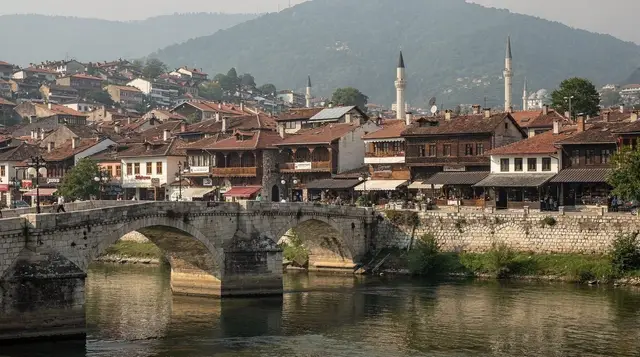
The bazaar around Baščaršija and along Ferhadija has seen a real split over the past decade. On one side are long-running family slastičarnice that have made tufahija and hurmašice the same way for decades, often with a visible kitchen or a counter where pastries are clearly turned over daily rather than kept indefinitely under a heat lamp.
On the other side, a wave of newer shops — some styled as Turkish-import chains, others as western-style patisseries with laminated photo menus in five languages — have opened to catch the same foot traffic, and they don’t always use the same recipes: baklava can arrive pre-made and frozen rather than baked and soaked on site, and tufahija sometimes appears with a shortcut filling that skips the proper walnut paste.
Neither is illegal or dishonest exactly, but they’re not the same product, and the price difference doesn’t always track the quality difference — a mediocre modern-style shop can charge more than an excellent traditional one simply because it’s positioned on a busier corner near the Sebilj fountain. A few practical tells: a traditional slastičarnica usually has a short, Bosnian-only or bilingual menu rather than a laminated multi-language one; the tufahija apples look individually prepared rather than uniform; and staff can tell you what was made that morning.
The Baščaršija walking guide and the Baščaršija shopping guide both cover the wider bazaar layout if you want to combine a pastry stop with browsing the Kazandžiluk coppersmiths or the stalls near Markale Market.
If you’d rather have someone point you to the right counters than guess from a menu, a guided walking food tour through Grbavica and the old town typically includes a pastry stop chosen by someone who eats there regularly, which removes the guesswork on a first visit. For a broader comparison of guided versus independent eating in the city, see Sarajevo’s food tours compared and, for a general framework on where to eat well without overpaying, Sarajevo restaurants by budget.
The Ottoman thread running through all of it
Every sweet on this page traces back to the same period as the bazaar itself: Baščaršija was founded around 1462 by Isa-beg Ishaković, and the Ottoman administration that built the mosques, hans and covered markets also brought the pastry techniques — filo, syrup-soaking, nut fillings, poached fruit — that spread across the empire’s Balkan, Anatolian and Levantine territories alike.
That’s why a Sarajevo baklava, an Istanbul baklava and an Athens baklava are recognisably the same family of dessert with local variations, rather than one being the “real” version and the others copies. Tufahija’s particular form — a whole poached apple rather than a chopped-fruit filling — is one of the more distinctly Bosnian expressions of that shared inheritance, alongside the specific pairing of hurmašice and rahat lokum with bosanska kafa as a fixed hospitality ritual rather than a random dessert menu.
Understanding that lineage is useful mainly so you don’t go looking for a single “authentic origin” that doesn’t exist — the honest answer to “is this Turkish or Bosnian” is usually both, arriving by the same historical route as the mosques and the coffee culture around them. If the Ottoman-era layer of the city interests you beyond the pastry counter, the Sarajevo food guide sets it in the context of the wider local menu, and Sarajevo’s cevapi guide covers the other dish that shares the same historical thread.
Travellers avoiding meat or dairy should note that most of these pastries (baklava, hurmašice, rahat lokum) are naturally vegetarian, though tufahija’s cream topping and some fillings can include dairy — the vegetarian and vegan Sarajevo guide has more detail on substitutions to ask for.
If you want to see the wider Herzegovina food landscape that shares this Ottoman pastry tradition alongside its own wine culture, a culinary and cultural day trip into Herzegovina pairs regional food stops with the rakija and Herzegovina wine guide worth reading beforehand. For a slower, on-foot way to work off a pastry stop or two through the old residential mahalas above the bazaar, a guided hike through the traditional mahala neighbourhoods covers the hillside streets that most day visitors to Baščaršija never see.
Bosnian sweets: your questions answered
What’s the difference between tufahija and baklava?
Tufahija is a whole apple, poached and hollowed out, filled with a walnut paste and topped with whipped cream or a spoon of thick kajmak-style cream — it’s eaten with a spoon, not by hand. Baklava is the layered filo-and-nut pastry soaked in syrup that you’ll recognise from across the former Ottoman world, cut into diamonds and eaten by hand.
How much does a piece of Bosnian pastry cost in Sarajevo?
Budget 3 to 6 KM (roughly 1.50 to 3 euros) per piece at a traditional Baščaršija slastičarnica, with tufahija usually at the top of that range because of the whole apple and the assembly involved. Modern Turkish-style or western-style pastry shops often charge more for less traditional recipes.
Is baklava actually Bosnian or Turkish?
Baklava reached Bosnia through Ottoman rule, the same route it took to Turkey, Greece and the rest of the Balkans, so no single country invented it. What’s specifically Bosnian is the local version and its place alongside tufahija and hurmašice in a shared Ottoman-legacy repertoire, not a claim of sole origin.
What is rahat lokum and is it the same as Turkish delight?
Rahat lokum is the Bosnian name for the same starch-and-sugar confection known abroad as Turkish delight, usually flavoured with rose, walnut or plain sugar and dusted in icing sugar or coconut. In Sarajevo it’s served as a small side piece with bosanska kafa rather than sold as a standalone dessert course.
Where do locals actually buy their sweets in Baščaršija?
Long-running slastičarnice around Baščaršija and Ferhadija that still make tufahija and hurmašice on site are the reliable choice; ask which pastries are made in-house that day, since the good ones sell out. Shops with English-language photo menus, tourist-season pop-up counters and pastries kept under heat lamps are usually aimed at passers-by rather than at Sarajevans.
Are Bosnian sweets very sugary compared to Western desserts?
Yes, in general — the syrup-soaked pastries (baklava, hurmašice, kadaif) are deliberately saturated, and that’s the point of the style rather than a flaw. Tufahija is comparatively gentler, since the sweetness comes mostly from the poached apple and a light walnut filling rather than syrup.
Can I find sugar-free or lower-sugar options?
Not really within the traditional repertoire — these pastries are built around sugar and syrup as preservation and flavour, so a genuinely low-sugar version isn’t really the same dessert. A smaller portion, or tufahija over baklava, is the practical way to have less sugar without asking a shop to change its recipe.
Sarajevo food & drink tours on GetYourGuide
Verified deep-linked GetYourGuide tours. Book through these links and we earn a small commission at no cost to you.
GetYourGuide does not provide a product photo for this activity — the image shows the meeting point, photographed by us.