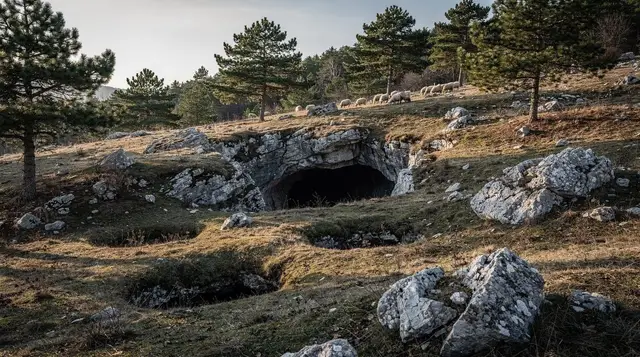
A cave, not a cave system, is what’s actually open
Bijambare Nature Park sits on the Nišići plateau, roughly 30 km north of Sarajevo, and the number that gets thrown around for it is impressive: around twenty caves within the protected area. What that number does not tell you, and what matters if you are planning a half-day out of the city, is that only one of those twenty is developed for visitors. The rest are unlit, unmapped for casual use, and off-limits to anyone without caving equipment and a guide who does this professionally.
The one cave you can actually walk into is Gornja Bijambarska, usually just called the Bijambare cave locally. It has a lit, maintained gallery of around 400 metres, walked as a guided group visit lasting 20 to 30 minutes. That is the entire public offer here, and it is worth being precise about it before you go, because the park’s name and its reputation for “twenty caves” lead a fair number of visitors to expect more than a single show cave with a fixed, short route.
None of this makes Bijambare a lesser trip. It is a straightforward, honest half-day: a short guided walk underground, a cool break from a hot Sarajevo afternoon, and a nature park above ground worth a wander if you have the time. It is just not a caving expedition, and treating it as one is the mistake to avoid.
Getting to Bijambare from Sarajevo
The drive out runs through Semizovac and up onto the Nišići plateau, and takes around 45 minutes by car for roughly 30 km, similar in scale to a run out to Bjelašnica or Skakavac waterfall. There is no direct public transport line to the park entrance, so the practical options are a rental car, a taxi arranged for the return trip, or an organised day tour that packages Bijambare with other stops in the Sarajevo Canton.
If you are without a car and do not want to negotiate a taxi wait, our day trips without a car guide covers which stops around Sarajevo work on public transport and which, like this one, genuinely need wheels. Renting for the day is usually the more relaxed option if you plan to combine Bijambare with Visoko or Vrelo Bosne, and our car rental in Sarajevo guide and driving in Bosnia guide cover what you need before you pick up the keys, including the mountain roads you will meet on the way up to the plateau.
The road inside the park itself is a mix of paved and gravel sections; nothing that needs a 4x4, but slow down for it. There is a car park near the cave entrance, and the nature park’s visitor area is a short walk from there.
Inside Gornja Bijambarska: what the guided visit covers
Visits run in small groups with a staff guide, timed to leave when enough people have gathered or on a rough schedule through the day, depending on the season. Expect to wait a little if you arrive between groups rather than right at opening.
The walk itself covers about 400 metres of the cave’s lit gallery, taking 20 to 30 minutes at an easy pace with stops. The guide points out the usual cave features: stalactites and stalagmites in various stages of formation, chambers that open and narrow as you move through, and the resident bat colony roosting in the upper reaches of the passage. It is not a strenuous walk. The path is maintained and lit, though it is still a cave floor, uneven in places and damp near the entrance, so proper shoes matter more than fitness here.
What you will not get is a long underground trek or a choice of routes. This is a fixed, guided loop through one section of a larger cave, with the rest of the system closed to visitors. If you have done a big show cave elsewhere in Europe and are expecting something on that scale, recalibrate: Bijambare is smaller and shorter, and that is fine as long as you know it going in.
What to wear and bring
The single most useful thing to know before you go is the temperature contrast. Caves in this part of the country hold a fairly constant, cool temperature through the year, which means a July afternoon that is 30 degrees and sticky outside can feel genuinely cold ten minutes into the visit. Bring a light jacket or fleece even if the forecast for Sarajevo that day is warm; you will be glad of it inside and will not miss it once you are back in the sun.
Footwear matters more than most visitors expect. The gallery floor is lit and maintained but not flat throughout, and it can be damp near the mouth of the cave, so trainers or hiking shoes work better than sandals. A phone flashlight is handy for the car park and any waiting area, but you will not need your own light source inside; the gallery is lit for the visit.
Flash photography is not permitted, for a specific reason rather than as a blanket cave-photography rule: the bats roosting in the cave are a protected species, and flash disturbs them. Use natural or low-light settings on a phone or camera, and keep noise down while you are in the chamber where they roost. If you want photos of the formations, expect the low, warm gallery lighting rather than a flash-lit shot, and plan accordingly.
The caves you won’t be taking yourself into
Bijambare Nature Park’s other roughly nineteen caves are the reason the park’s name carries weight among Bosnian cavers, and the reason a casual visitor should not go looking for them alone. These are undeveloped: no lighting, no maintained paths, no staff presence, and in several cases no clear marked entrance from the surface trail network. They are used for organised speleology, meaning caving trips run by clubs or guides with proper equipment, headlamps, ropes where needed, and route knowledge that only comes from repeated visits.
Wandering off from the visitor area to look for one of these on your own is a bad idea for reasons that have nothing to do with rules and everything to do with what a cave actually is: uneven, dark, sometimes wet or unstable rock, with no signal and no easy way to call for help if something goes wrong. If caving itself is what draws you rather than a single short guided walk, look for an organised trip through a caving club or a guide who works this park specifically, and go in with the right kit. Our caving in Bosnia guide covers how to find a legitimate operator for this rather than improvising it.
It is also worth repeating a rule that applies to hiking anywhere off the marked paths and visitor areas in this part of Bosnia and Herzegovina: stick to marked trails and developed sites. Parts of the countryside still carry landmine risk left over from the 1990s war, decades on, and the safe approach is simple and non-negotiable rather than a matter of judgement call. See our full landmine safety while hiking in Bosnia guide before any walk that takes you off a marked path in the wider Sarajevo Canton, Bijambare included.
What’s open and what isn’t, at a glance
| Site | Status | Who can visit |
|---|---|---|
| Gornja Bijambarska (the show cave) | Lit, guided, ~400 m gallery | Anyone, on a scheduled 20-30 minute guided visit |
| The park’s other ~19 caves | Undeveloped, unlit, unmarked | Organised speleology trips with equipment and a qualified guide only |
| Surface trails and picnic areas | Open, marked | Anyone, on the marked paths |
| Off-trail terrain in the wider park | Not developed for visitors | Not recommended; stick to marked routes |
Making a day of it
Bijambare on its own is a half-day: the drive out, the 20 to 30 minute cave visit, some time above ground in the nature park, and the drive back. Most visitors pair it with something else on the Nišići side of Sarajevo rather than treating it as a full day trip by itself.
The most natural pairing is Visoko, roughly on the same side of the city and home to the medieval Bosnian capital and the so-called Bosnian pyramids — a genuinely interesting stop for the medieval history and the tunnels at Ravne, though it is worth knowing going in that the scientific community is unanimous that the hills themselves are natural formations, not pyramids; our Visoko and the pyramids day trip guide lays out what is worth seeing there and what to treat with a raised eyebrow.
Vrelo Bosne, the spring of the Bosna river at Ilidža, is a gentler pairing if you would rather end the day with a flat walk under plane trees than more driving on plateau roads.
If your day has room for a wider overview of Sarajevo’s Olympic mountains and countryside rather than a single stop, an organised tour can save you the logistics of stringing sites together yourself. A general city and countryside overview like the Grand Walking Tour of Sarajevo works well the same day if you base your morning in the city and use the afternoon for Bijambare and Visoko.
For travellers who want the Roman bridge and spring at Vrelo Bosne bundled with a guide rather than arranged independently, the Stojčevac and Vrelo Bosne Roman Bridge tour covers that side of the canton properly. And if the twentieth-century history of the region interests you as much as the caves and springs, the Rise and Fall of Yugoslavia tour is a useful way to spend a different day in Sarajevo, giving context that makes the rest of the trip land better.
Families with a full week in the Sarajevo Canton and an interest in nature over history might slot Bijambare into a broader loop; our nature week itinerary for Bosnia sketches how to combine it with the mountains and waterfalls without doubling back on the same roads. If you are travelling with children specifically, our Sarajevo with kids and best day trips from Sarajevo guides both flag Bijambare as one of the easier half-days to manage with younger travellers, precisely because the cave visit itself is short and guided rather than a long hike.
Prices and the practical numbers
Entry to the show cave runs in the same modest range as most of the region’s smaller sites, typically in the mid-teens to low-twenties of KM per person depending on age and any group rate — worth checking on arrival since posted prices can shift slightly by season. Add fuel or a taxi fare for the round trip from Sarajevo, and a coffee or simple lunch if you stop in Semizovac on the way, and a half-day here comfortably sits in the 15 to 25 KM per person range excluding transport, in line with the day budget most visitors plan for a single-site outing on the Nišići plateau. At the fixed rate of 1 EUR to 1.95583 KM, that is roughly EUR 8 to 13 per person before petrol or a taxi.
Pack for the temperature swing rather than the season on the calendar: a layer for the cave, sturdy shoes for the gallery floor and the surface trails, and a bit of patience for hours that are genuinely seasonal rather than a formality. Our packing list for Sarajevo covers the layering logic in more detail if you are building a wider Bosnia itinerary around trips like this one.
Visiting Bijambare Caves: frequently asked questions
Is Bijambare cave open every day of the year?
No. Hours are seasonal and often reduced or closed entirely outside the May-to-September window, and midweek opening is not guaranteed even in summer. Confirm the current schedule before you drive out, since there is no point standing at a locked gate 30 km from Sarajevo.
Do I need to book a guide in advance?
The visit to Gornja Bijambarska is guided by staff on site rather than arranged as a private booking, but a call ahead is worth it in shoulder season to make sure someone is there and the cave is open that day.
How cold is it inside the cave?
Caves in this part of Bosnia and Herzegovina sit at a fairly constant cool temperature year-round, noticeably colder than the air outside on a summer day. Bring a light layer even if you arrive in a t-shirt.
Can I visit the other caves in Bijambare Nature Park?
Not on your own. The park holds around twenty caves in total, and the rest are undeveloped, unlit, and reserved for organised caving trips with proper equipment and a qualified guide. Walking into one unprepared is a real way to get hurt or lost underground.
Is Bijambare suitable for children?
Generally yes for children old enough to walk a lit, gently uneven path for 20 to 30 minutes and stay calm underground. It is a good half-day outing rather than a long hike, which suits families based in Sarajevo without a car-heavy itinerary.
Is photography allowed inside the cave?
Photography is allowed, but flash is not. The cave shelters a protected bat colony, and flash disturbs them; use available light or a phone camera’s low-light mode instead.
Do I need a car to get to Bijambare?
Effectively yes. There is no direct public transport line running to the park, so most visitors come by rental car, taxi, or an organised day tour that covers this part of the Sarajevo Canton alongside other stops.