Sarajevo bars by neighbourhood
Which Sarajevo neighbourhood is best for a night out?
Baščaršija has ottoman-style courtyard cafés and terraces for coffee and rakija; Ferhadija and the city centre have the more international cocktail and craft-beer bars; the top of the Trebević cable car has one bar with a valley view worth the roughly 20 KM return ride. Few bars post prices on the menu, so check the bill before paying.
Sarajevo does not have one obvious bar street the way some capitals do. It has three distinct pockets, each with its own mood, price level and closing rhythm, and picking the right one matters more than picking the right bar. This page works through them geographically: the ottoman old town, the Austro-Hungarian centre, and the hilltop above the city. It does not cover live music venues or festival programming, which have their own pages linked below — this is a district-by-district plan for where to sit down with a drink.
Three neighbourhoods, three different nights
The short version: Baščaršija is for coffee, rakija and shisha in a courtyard that has looked more or less the same for a century. Ferhadija and the blocks around it are for cocktails, craft beer and a crowd that is more local and more international at once. Trebević is for one drink with the whole valley underneath you, not a night out in itself. Most visitors do some combination of the first two on any given evening and save the third for a clear late afternoon.
For orientation, Baščaršija and Ferhadija sit about ten minutes’ walk apart along the same east-west line through the centre, with the Sebilj fountain marking roughly where one becomes the other. Neither has firm borders — this is a guide to a gradient, not a map with lines drawn on it.
Baščaršija: courtyard cafés, kafanas and rakija by the Sebilj
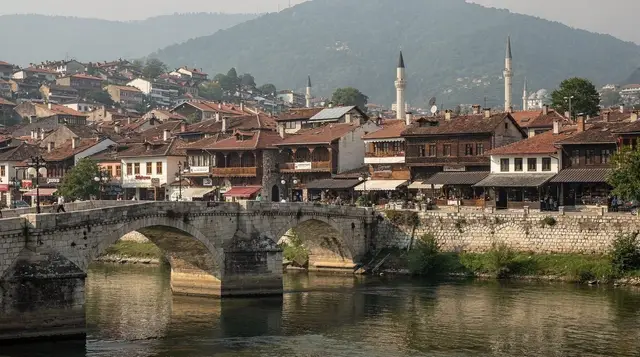
Baščaršija is where Sarajevo drinks coffee rather than alcohol, and that is worth knowing before you go looking for a cocktail here. The bazaar founded around 1462 is built around small courtyards, and most of what passes for a bar in this district is a café that also pours rakija, wine and Sarajevsko beer once the sun goes down. The tables right on the square around the Sebilj are almost entirely for visitors — pleasant, unhurried, and priced accordingly. Walk two or three lanes back, past the coppersmiths still working the metal in the Kazandžiluk, and the same drink costs less and the crowd is mostly local.
The classic order here is a bosanska kafa, served in a copper džezva with a cube of rahat lokum and a lump of sugar to bite rather than stir in — expect to pay 2 to 3 KM for it, a little more on the main square. An espresso runs 2 to 2.50 KM. In the evening the same tables fill with rakija drinkers, usually a plum brandy, and with narghile smokers; a shisha session typically costs more than any individual drink, so ask the price before you sit down if it is not posted.
For background on the coffee ritual itself, and on the difference between it and the Turkish version people often assume it is, the Bosnian coffee guide and the dedicated Baščaršija walking guide go into more detail than fits here.
What Baščaršija does not really offer is a late, loud bar night. Most courtyard cafés wind down by midnight, seating is outdoors or semi-covered so winter changes the picture considerably, and the atmosphere throughout stays closer to a long, unhurried sit than a bar crawl. That is the appeal, not a shortcoming — it is simply a different kind of evening than Ferhadija offers ten minutes’ walk away.
a guided walk through Sarajevo’s older residential mahala neighbourhoods, which is a useful way to see the streets behind Baščaršija before doubling back for a drink once you know the layout.
Ferhadija and the city centre: where locals go for cocktails and craft beer
Where Baščaršija feels ottoman, Ferhadija feels Austro-Hungarian — the buildings change style abruptly at the point locals sometimes point out as where “east meets west,” and the bars along and just off this pedestrian street shift with it. This is where you find cocktail menus, imported spirits, craft beer taps and a crowd that skews younger and more international than Baščaršija’s. It is also, by most accounts, where more Sarajevans actually go for a drink on an ordinary evening.
Expect a wider price range than the old town. A draught Sarajevsko still runs 3 to 5 KM in an ordinary bar, but a proper cocktail in one of the centre’s dedicated cocktail bars is more often 8 to 14 KM, closer to what you would pay in Zagreb or Vienna than to Baščaršija café prices. Craft beer, where it is on tap rather than imported bottled, sits somewhere in between. The Ferhadija Austro-Hungarian walk covers the street’s architecture and shopping side in daylight; after dark it is largely this same stretch and the side streets running off it that carry the bar scene.
The centre is also the more comfortable district for a bar that will still be going past midnight — Baščaršija’s courtyards close earlier, while several bars near Ferhadija and toward Marijin Dvor keep later hours on weekends. If beer specifically is the point of the evening rather than cocktails, the Sarajevo brewery guide covers the Sarajevska pivara’s own history and taproom, a short walk from the centre and one of the few places in the city built around beer rather than coffee or rakija. For rakija and Herzegovinian wine specifically, including where the centre’s bars source theirs from, see the rakija and wine guide.
One practical note that applies across the whole centre: this is also where you are most likely to be handed a menu with no prices at all, particularly on the streets closest to Baščaršija where the two districts blur together. Treat that as a signal to ask before ordering, covered in full below.
Above the city: the one bar worth the cable car ride
The Trebević cable car reopened on 6 April 2018 after a long closure, and the roughly nine-minute ride from Bistrik up to 1,164 metres is now the easiest way to see how Sarajevo actually sits in its valley — hemmed in by mountains on three sides, the reason both for the city’s setting and for the winter smog problem covered elsewhere on this site. A return ticket costs around 20 KM.
At the upper station there is a café-bar with outdoor seating and a direct view down over the city and the Miljacka valley. It is not a destination for a long evening — go up an hour or so before sunset, order one drink, and treat the view as the point rather than the bar list, which is limited compared with anything in the centre. Prices here run a little above city-centre levels, which is normal for a venue reachable only by cable car. The last cabin down runs earlier than a typical bar closing time, so check the current schedule before you go up rather than assuming you can stay as late as you would in Baščaršija.
From the upper station it is a short, mostly flat walk to the abandoned Trebević bobsleigh track from the 1984 Winter Olympics, now covered in graffiti and freely accessible — worth combining with the drink rather than doing as a separate trip. The Sarajevo cable car guide and the Sarajevo viewpoints guide cover the ride and the wider hilltop in more depth, including the Trebević mountain area beyond the café itself and the cable car station details.
Price benchmarks by district
Prices below are typical, not fixed — Baščaršija’s main square and the centre’s dedicated cocktail bars both run above their own district’s baseline.
| Drink | Baščaršija (main square) | Baščaršija (side lanes) | Ferhadija / centre | Trebević summit |
|---|---|---|---|---|
| Bosanska kafa | 3 KM | 2 KM | 2.50 KM | not typically on the menu |
| Espresso | 2.50 KM | 2 KM | 2.50 KM | 3 KM |
| Draught beer | 4–5 KM | 3–4 KM | 4–5 KM | 5–6 KM |
| Cocktail | rarely offered | rarely offered | 8–14 KM | 8–12 KM |
| Shisha (per session) | 12–18 KM | 10–15 KM | less common | not available |
The habit that catches visitors out: check the bill
Across all three districts, a meaningful number of bars do not print prices on the menu, and a smaller number apply a higher rate to tables on the busiest part of a square than to tables a street away — the same practice that shows up around the Sebilj and occasionally near Ferhadija’s most photographed corners. Neither is illegal or even unusual by regional standards, but it means the responsible habit is simple: if a menu has no prices, ask before you order, and read the printed bill line by line before paying rather than after.
This applies more in Baščaršija’s most visited square metres than anywhere else on this list, and it is the same caution covered at more length in the Sarajevo tourist traps guide. Cards are accepted in most bars in the centre and Baščaršija; carry cash as a backup, since a machine being “broken” for a few minutes is a familiar delay tactic in a small number of tourist-facing spots.
Choosing a district for the night you want
If the plan is a slow, low-key evening with coffee or rakija in a historic setting, Baščaršija’s side lanes are the answer, not its main square. If the plan is cocktails, craft beer, and a night that runs later, Ferhadija and the centre are the better fit, with prices to match. If the plan is one memorable drink with a view and an early finish, go up to Trebević before sunset and come back down on the same cable car. Combining Baščaršija and the centre in one evening is easy given the ten-minute walk between them; treating Trebević as a separate outing rather than a late-night stop keeps you on the right side of the last cabin down.
None of this depends on the calendar — Baščaršija fills further and stays open a little later during the Sarajevo Film Festival in mid-August and during Ramadan evenings after the iftar cannon at the Žuta tabija, but the district logic above holds the rest of the year. For a first-timer’s overview of the whole city before narrowing down to bars specifically, the Sarajevo first-time guide and the neighbourhoods guide are useful starting points, and where to stay in Sarajevo is worth reading before booking if being close to one of these districts matters to your evenings.
For restaurants rather than bars specifically, see Sarajevo restaurants by budget, and for the general nightlife picture including live music venues this page deliberately leaves out, see the Sarajevo nightlife guide and the separate live music guide.
a guided walk through the city’s Yugoslav-era history pairs well with an evening in the centre afterwards, since much of the route passes within a few streets of Ferhadija’s bars. For a daytime counterpart that also threads through the old town before an evening in Baščaršija, a guided walk covering the siege years ends close enough to the Sebilj to make the transition straightforward, and a guided tour of Sarajevo’s Jewish heritage sites covers the Alifakovac hillside and streets around Markale market that border both districts covered above.
FAQs about Sarajevo’s bar districts
Which Sarajevo neighbourhood is best for a night out?
It depends what you want. Baščaršija for a low-key evening of coffee, rakija and shisha in an ottoman courtyard. Ferhadija and the streets around it for cocktails, craft beer and a younger, more international crowd. The top of the Trebević cable car for one drink with a view, not a whole evening.
Do Sarajevo bars post their prices?
Not reliably. Menus in tourist-facing parts of Baščaršija sometimes skip prices altogether, and a few venues charge more for a table on the main square than one just off it. Ask the price before you order if a menu has none, and check the printed bill line by line before paying.
How much does a beer or coffee cost in Sarajevo?
A bosanska kafa runs 2 to 3 KM, an espresso 2 to 2.50 KM, and a draught beer 3 to 5 KM in an ordinary bar. Cocktail bars on Ferhadija and in the centre charge more, typically 8 to 14 KM for a mixed drink.
Is it worth going up to Trebević just for a drink?
Yes, once, for the view rather than the drink list. The cable car from Bistrik takes about 9 minutes and a return ticket costs around 20 KM; go an hour before sunset, have one drink at the café by the upper station, and walk to the old bobsleigh track while you are up there.
Is Baščaršija touristy for a drink, or do locals go there too?
Both, depending on where you sit. The tables directly on the Sebilj square are almost entirely visitors; walk two or three streets back into the courtyards and side lanes and you find cafés where the crowd is mostly local, the prices are lower, and nobody rushes you.
Where do younger locals actually go out in Sarajevo?
Mostly Ferhadija and the streets around it, plus a scattering of bars a short walk into the newer part of the centre. This page is about picking a neighbourhood for the mood you want; for venues built around live sets and DJs specifically, see the separate live music guide.
Can I walk between the three areas in one evening?
Baščaršija and Ferhadija are a 10-minute walk apart, so combining them in one night is easy. Trebević is a separate outing: factor in the cable car ride each way and treat it as its own stop rather than something to squeeze in after midnight, since the last cabin down runs earlier than a typical bar close.
Is it safe to walk around Sarajevo at night?
Yes. Sarajevo has low rates of street crime and visitors walking between Baščaršija and the centre late in the evening is routine. The usual city precautions apply, and the only serious hazard in the country concerns unmarked terrain outside town, not the streets covered on this page.
Sarajevo nightlife on GetYourGuide
Verified deep-linked GetYourGuide tours. Book through these links and we earn a small commission at no cost to you.
GetYourGuide does not provide a product photo for this activity — the image shows the meeting point, photographed by us.