A five-day Bosnia itinerary from Sarajevo
Five days is the first format that comfortably covers both Herzegovina and the high mountains around Sarajevo without doubling back on the same road twice. It does not repeat Blagaj or Počitelj, which belong to a separate Herzegovina-focused trip — see the Mostar day trip guide if that is what you are after instead. This plan is built around one overnight outside Sarajevo, in Mostar, with everything else run as day trips from a fixed base.
Why five days works for Sarajevo and Herzegovina together
Two days is enough for the city itself and the Tunnel of Hope; three lets you add Mostar as a rushed day trip. Five days changes the shape of the trip: it allows an overnight in Mostar, a stop at Kravice Waterfalls that a same-day return usually squeezes out, a proper visit to the Tito bunker at Konjic, and a full day at altitude on Bjelašnica and in Lukomir, the highest inhabited village in the country. None of that fits into three days without cutting corners.
This format needs a car, or a run of organised day tours booked in advance — public transport does not reach Kravice, the Konjic bunker turn-off, or Lukomir on a schedule that leaves time to actually see them.
| Day | Focus | Overnight | Approx. driving |
|---|---|---|---|
| 1 | Sarajevo city and Baščaršija | Sarajevo | none |
| 2 | Tunnel of Hope and siege sites | Sarajevo | 25 km round trip |
| 3 | Kravice Waterfalls to Mostar | Mostar | ~200 km |
| 4 | Mostar, then Konjic bunker back to Sarajevo | Sarajevo | ~200 km |
| 5 | Bjelašnica and Lukomir | Sarajevo | ~110 km round trip |
Day 1: Sarajevo city and Baščaršija
Start in Baščaršija, the Ottoman-era bazaar founded around 1462 by Isa-beg Ishaković, and orient yourself at the Sebilj fountain before the streets fill up. The Gazi Husrev-bey Mosque (1531), the largest historic mosque in the country, is open to visitors outside prayer times for around 5 KM, with shoulders and knees covered and a headscarf available at the door for women. Within fifteen minutes’ walk you can also reach the Old Orthodox Church, the Sacred Heart Cathedral and the Ashkenazi synagogue — the cluster that gives Sarajevo its “four faiths” reputation, covered in full in the four faiths walk.
For an oriented first look at the city, a guided walk is a reasonable way to spend the first afternoon:
a half-day walking tour through Baščaršija and the Austro-Hungarian quarterIn the afternoon, cross to Ferhadija to see how abruptly the Ottoman old town gives way to Austro-Hungarian architecture — a single paving line marks the change. Finish at Vijećnica, the pseudo-Moorish city hall of 1896 that became the National Library, was burned on 25–26 August 1992 with roughly two million books and manuscripts lost, and reopened on 9 May 2014. Entry is around 10 KM. For dinner, order ćevapi the Sarajevo way — ten small grilled sausages in a somun flatbread with raw onion and kajmak — for around 8 to 12 KM. Full route detail is in the Sarajevo in one day guide and the Baščaršija walking guide.
Day 2: The siege, the Tunnel of Hope, and the heights
This day covers the subject most visitors come to understand, and it deserves a plain, factual telling rather than a dramatic one. The siege of Sarajevo lasted 1,425 days, from 5 April 1992 to 29 February 1996 — the longest siege of a capital city in modern warfare, with around 11,000 people killed, nearly 1,600 of them children.
Start with the Historical Museum of Bosnia and Herzegovina, which covers the siege itself, then walk or take a taxi out to Butmir, near the airport, for the Tunnel of Hope (Tunel spasa). Around 800 metres were dug by hand in 1993 beneath the airport runway as the only link to free territory; about twenty metres are open today alongside a small museum, with entry around 10 to 15 KM. A guided option covers both in one structured visit:
a guided walk through Sarajevo’s siege-era sites, including the Tunnel of HopeIn the afternoon, ride the Trebević cable car, reopened in April 2018, nine minutes from Bistrik up to 1,164 metres, for around 20 KM return — it is the fastest way to understand how the surrounding mountains shaped both the city’s beauty and the length of the siege. From the upper station it is a short walk to the abandoned 1984 Olympic bobsleigh track, now covered in graffiti and freely accessible. For background before you go, see the siege tour guide and the Tunnel of Hope visiting guide.
Day 3: Kravice Waterfalls and on to Mostar
Leave Sarajevo early for the roughly 180 km, 3-hour drive to Kravice Waterfalls, where the Trebižat river drops around 25 metres over an arc some 120 metres wide. Entry runs around 20 KM in high season, and from June to September the pools below the falls are open for swimming — bring a towel and expect it busy by midday in July and August. Outside summer it is quieter but too cold to swim.
an organised trip to Kravice with a rakija tasting includedFrom Kravice it is a short additional drive to Mostar. Spend the late afternoon at the Stari Most, the Ottoman bridge built in 1566, destroyed on 9 November 1993 during the war and reopened on 23 July 2004; it has been a UNESCO World Heritage Site since 2005. The local diving club only jumps the roughly 21-metre drop once their collection basket is full, so treat a jump as a possibility rather than a scheduled show. Settle into Mostar for the night — the Mostar day trip guide covers the old town layout in more detail, even though this itinerary treats it as an overnight rather than a day trip.
Day 4: Mostar, the Tito bunker at Konjic, and back to Sarajevo
Use the morning in Mostar before the day-trip crowds arrive from Sarajevo and the coast. A local guide is a good way to get context on a town still visibly divided along wartime lines:
a private walking tour of Mostar’s old town with a local guideBy late morning, start back toward Sarajevo and stop at Konjic, about an hour outside the capital, for the Tito bunker — officially D-0 ARK. Some 6,500 square metres were dug into the mountainside between 1953 and 1979 as a Yugoslav-era nuclear shelter for the political and military leadership; it opened to the public in 2011 and now doubles as a contemporary art space. Booking ahead is worth the effort, since tours run on a limited schedule and can sell out on summer weekends. Konjic’s own 1682 Ottoman bridge, rebuilt in 2009, is worth a short stop as well. Full detail is in the Tito bunker visiting guide. Continue on to Sarajevo for the night.
Day 5: Bjelašnica and Lukomir
The final day trades old towns and war history for altitude. Bjelašnica, about 30 km and 45 minutes from Sarajevo, hosted the men’s alpine skiing events at the 1984 Winter Olympics; the abandoned venue infrastructure is still visible alongside a landscape that has mostly reverted to open mountain pasture.
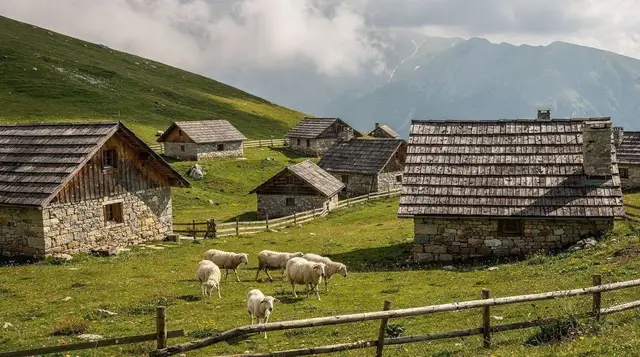
From Bjelašnica, continue on the unpaved track toward Lukomir, at around 1,469 metres the highest inhabited village in the country — stone houses with shingle roofs, cut off by snow for part of the winter, with a handful of families still working the land in summer. Allow about an hour and a half each way from Sarajevo on the piste, and go slowly: this is not a paved road.
Stay on marked tracks throughout — rural stretches of Bosnia and Herzegovina still carry landmine risk from the 1990s war, and wandering off a known path is the one real safety rule worth repeating on this whole trip. See the landmine safety guide and the Lukomir hike guide before you set out. Head back to Sarajevo by early evening.
Costs and logistics for this five-day route
| Item | Approx. cost |
|---|---|
| Tunnel of Hope entry | 10–15 KM (~5–8 EUR) |
| Vijećnica entry | 10 KM (~5 EUR) |
| Trebević cable car return | 20 KM (~10 EUR) |
| Kravice Waterfalls entry (high season) | 20 KM (~10 EUR) |
| Tito bunker tour, Konjic | check current tour price, book ahead |
| Rental car, per day | varies by season and agency |
| Fuel, ~450 km over 5 days | budget generously, mountain roads included |
| Mid-range hotel, Mostar (1 night) | 100–200 KM (~50–100 EUR) |
Prices are in the convertible mark (KM), pegged to the euro at 1 EUR = 1.95583 KM — close enough to 2 KM per euro to convert in your head. Carry cash: card machines are common in Sarajevo and Mostar but rare at waterfall kiosks, mountain guesthouses and small fuel stations along this route.
Getting around: car or organised tours
This itinerary is not built for buses and trams alone. A rental car gives the most flexibility, particularly for the Bjelašnica–Lukomir leg, where the schedule depends on weather and light rather than a bus timetable — see the car rental guide and driving in Bosnia before booking. If you would rather not drive, the Mostar and Kravice leg (Days 3–4) can be replaced with an organised multi-day tour, and Konjic and the mountain day can each be booked as separate half- or full-day trips from Sarajevo. Either approach works; mixing public buses with this specific route generally does not, since Kravice, the Konjic bunker and Lukomir all sit off any useful bus line.
Questions about this five-day Sarajevo and Mostar itinerary
Do I need a car for this five-day route?
Either a rental car or a run of organised day tours. Public transport does not reach Kravice, Konjic’s bunker turn-off or Lukomir on a workable schedule, and stitching buses together would cost most of the five days in waiting.
Is this itinerary the same as a Mostar day trip from Sarajevo?
No. A day trip only reaches Mostar and back in one long day. This plan builds in an overnight in Mostar, adds Kravice Waterfalls on the way down and Konjic’s Tito bunker on the way back, then closes with a full day in the mountains at Bjelašnica and Lukomir.
How much driving does this itinerary involve?
Roughly 420 to 450 km over five days: about 180 km and 3 hours from Sarajevo to Kravice, a short additional hop to Mostar, then back towards Sarajevo via Konjic (around 60 km from Mostar), and finally 30 km to Bjelašnica followed by an unpaved 20 km climb to Lukomir.
Can I swim at Kravice Waterfalls?
Yes, in summer. Entry runs around 20 KM (about 10 euros) in high season, and the pools below the falls are open for swimming from roughly June to September. Outside summer the water is too cold and the site much quieter.
Do I need to book the Tito bunker at Konjic in advance?
Booking ahead is strongly advised. Tours run on a limited schedule and the site, known as D-0 ARK, sells out on busy summer weekends. It sits about an hour’s drive from Sarajevo, close to the road back from Mostar.
Is the road to Lukomir safe to drive?
The final stretch is an unpaved mountain track, fine in a normal car in dry summer conditions but best avoided after heavy rain or from autumn snowfall onward. Stay on the marked track and do not wander off it or into surrounding pastureland, since parts of rural Bosnia and Herzegovina still carry landmine risk from the 1990s war.
How many nights should I book in Mostar versus Sarajevo?
One night in Mostar is enough for this pace. Book four nights in Sarajevo and one in Mostar, or treat Sarajevo as a single base and return there each night if you would rather not switch hotels.
tours.5 days
Verified deep-linked GetYourGuide tours. Book through these links and we earn a small commission at no cost to you.
GetYourGuide does not provide a product photo for this activity — the image shows the meeting point, photographed by us.