Sarajevo in three days: city, history and mountains
Two days in Sarajevo cover the old town and the siege comfortably. A third day changes the itinerary’s shape entirely: it leaves the Miljacka valley altogether and heads up into the mountains that surround it, the same slopes that hosted the 1984 Winter Olympics and that still hide one of the highest inhabited villages in Bosnia and Herzegovina. This is the point in a Sarajevo trip where the city stops being the whole story.
The plan below keeps the pace realistic. Days one and two are walkable, tram-friendly, and do not need a car. Day three is different: it needs either an organised tour, a hired driver, or a rental car, because the last stretch to Lukomir runs on an unpaved track. Budget for that day accordingly, and read the safety note on mines before you set off, because it applies to the whole of the third day.
Day 1: Baščaršija and the old town
Start at the Sebilj, the wooden fountain from 1891 that is the de facto meeting point of Baščaršija, the Ottoman bazaar founded around 1462 by Isa-beg Ishaković. The morning is for wandering: the coppersmiths of Kazandžiluk still work sheet copper by hand, and it is worth watching before you shop, not just buying. A guided walk such as the Sarajevo: Grand Walking Tour is a reasonable way to get your bearings on a first morning, if you would rather have context than figure out the streets alone.
a guided walk through Baščaršija and the old town covers the bazaar, the mosque and the riverside in around two to three hours, which leaves the rest of the morning free.
Visit the Gazi Husrev-bey Mosque, built in 1531 and still the largest historical mosque in the country. It is open to visitors outside prayer times, entry is around 5 KM (roughly 2.50 EUR), and shoulders and knees need covering; a headscarf is provided for women at the door. From there it is a short walk to the Vijećnica, the pseudo-Moorish city hall from 1896 that became the National Library and was burned on the nights of 25 and 26 August 1992, destroying an estimated two million books and manuscripts. It reopened on 9 May 2014, entry around 10 KM (about 5 EUR), and the rebuilt interior is worth the ticket on its own.
Walk five minutes along the river to the Latin Bridge, where Gavrilo Princip shot Archduke Franz Ferdinand on 28 June 1914. The Sarajevo 1878–1918 Museum sits in the corner building; it is a small, quick stop, not a detour. From here, Sarajevo’s often-used tag of the “Jerusalem of Europe” makes sense on foot: an Old Orthodox church, a Catholic cathedral, a synagogue and a mosque all sit within about fifteen minutes’ walk of each other, a route covered well by a dedicated four faiths walk.
For lunch, have ćevapi the way Sarajevo serves them: ten small grilled sausages in a somun flatbread with raw onion and kajmak, for around 8 to 12 KM (4 to 6 EUR). Finish the day with coffee prepared in a džezva, with a cube of sugar and a rahat lokum on the side — the ritual matters as much as the drink. A fuller half-day route through these streets is in the Baščaršija walking guide.
| Stop | Approx. cost | Time needed |
|---|---|---|
| Gazi Husrev-bey Mosque | ~5 KM | 20–30 min |
| Vijećnica | ~10 KM | 45 min |
| Latin Bridge museum | small entry fee | 20 min |
| Ćevapi lunch | 8–12 KM | 45 min |
Day 2: The siege, then Trebević
The second day pairs Sarajevo’s two defining subjects: the siege, in the morning, and the 1984 Winter Olympics, in the afternoon. Start with the Tunnel of Hope — Tunel spasa — in Butmir, near the airport, about 20 to 25 minutes from the centre by taxi. Roughly twenty metres of the original 800-metre hand-dug tunnel are open, alongside a small museum, and entry runs around 10 to 15 KM (5 to 7.50 EUR).
This was the only route in or out of the besieged city between 1993 and the end of the siege on 29 February 1996; walking those few metres is more informative than any description of the siege on paper. Nearly every guided siege tour, including a half-day walking tour that traces the siege through the city, stops here.
On the way back, the route passes what was once known as Sniper Alley, the wide boulevard where snipers on the surrounding hills targeted civilians for nearly four years; there is no need for narration beyond the plain fact of what happened here. A stop at the War Childhood Museum, winner of the Council of Europe Museum Prize in 2018, or the Historical Museum of Bosnia and Herzegovina rounds out the morning with first-hand testimony rather than commentary.
None of this is a spectacle, and it should not be treated as one: read a full route in the siege tour guide before you go, and the landmine safety notes apply from here onward for the rest of the trip.
In the afternoon, take the Trebević cable car from Bistrik. It reopened on 6 April 2018 after 26 years out of service, the ride takes about nine minutes up to 1,164 metres, and a return ticket costs around 20 KM (about 10 EUR). At the top, Trebević mountain holds the abandoned 1984 Olympic bobsleigh and luge track, now covered in graffiti and open to walk along freely — one of the more striking places in the city precisely because it carries both histories on the same concrete: built for the Olympics, then used as a firing position during the siege.
A sunset hike up Trebević is worth booking if you would rather time the climb for golden light over the valley than ride the cable car back down straight away. Details on reaching the track on foot are in the Trebević bobsleigh guide.
Day 3: Out of the valley — Vrelo Bosne, Bjelašnica, Lukomir
This is the day the itinerary changes register. The first two days stay inside the Miljacka valley; day three leaves it, and by the end of it you will have gone from a flat riverside park to a village at nearly 1,500 metres. Plan on a full day, ideally with a driver, guide, or organised tour rather than public transport, since the final leg is not served by buses.
Begin at Vrelo Bosne, the source of the Bosna river, at the end of Ilidža’s Velika aleja — a 3.5-kilometre avenue of plane trees walked, cycled, or ridden in a horse-drawn fiacre. Ilidža is about 12 kilometres from the centre, roughly 25 minutes away, and the spring itself, with its small islands and footbridges, is one of the more restful stops on this whole trip after two days of walking on stone streets. A tour combining Vrelo Bosne with lunch is a straightforward way to fit it into a morning without arranging your own transfer. A full route is in the Vrelo Bosne visiting guide.
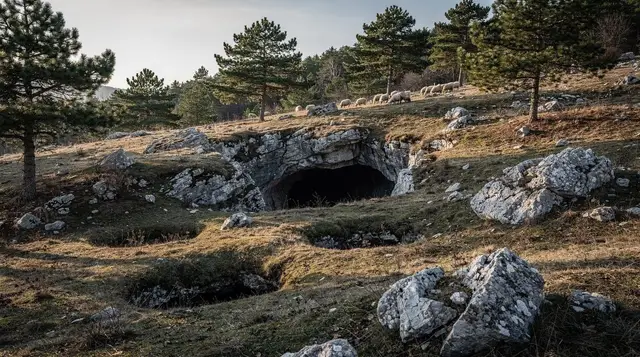
From Ilidža, it is about 30 kilometres and 45 minutes up to Bjelašnica, the mountain that hosted the men’s alpine skiing at the 1984 Winter Olympics. In summer the ski infrastructure sits quiet, but the setting explains itself: open alpine pasture, stone shepherd’s huts, and views back down over the whole Sarajevo canton. It is worth a proper stop, not a drive-through — an hour is a minimum, and the Bjelašnica summer guide has a fuller list of short walks from the road.
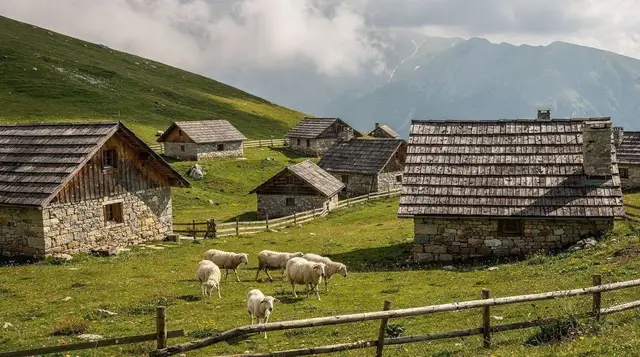
The final leg is Lukomir, about 50 kilometres from Sarajevo and roughly 1 hour 30 minutes away, the last stretch on an unpaved mountain track. At close to 1,469 metres, it is the highest permanently inhabited village in Bosnia and Herzegovina: stone houses under shingle roofs, cut off by snow for part of the winter, with the last families still spending summers here to graze livestock. It has no restaurant beyond a couple of seasonal homestead cafés serving simple food, so treat it as a place to walk and look, not a lunch stop.
The Rakitnica canyon runs just below the village and is a genuinely striking short walk, but this is also where the general rule about mines in Bosnia matters most directly: stay on the marked path, do not cut across open ground or wander toward the canyon rim off-trail, and take a local guide if you want to go beyond the village itself.
This is not a formality — suspected minefields remain in rural parts of the country, and Lukomir’s surroundings are one of the areas where that applies. Full route notes are in the Lukomir hike guide and the Rakitnica canyon trek; read the landmine safety guide in full before setting out, whichever route you take.
Head back to Sarajevo in the late afternoon; the drive down from Lukomir and Bjelašnica takes a similar length of time in reverse, so plan to be back in the city by early evening.
| Stop | Distance from Sarajevo | Time | Note |
|---|---|---|---|
| Vrelo Bosne (Ilidža) | 12 km | 25 min | Flat, walkable, fiacre available |
| Bjelašnica | 30 km | 45 min | 1984 Olympic alpine skiing venue |
| Lukomir | 50 km | 1 h 30 (unpaved track) | Stay on marked paths near the canyon |
FAQ: three days in Sarajevo, from Baščaršija to Lukomir
Is three days enough for Sarajevo?
Yes, if you use it the way this itinerary does: two days in the city and one in the mountains. Two days alone cover the old town and the siege sites well; three lets you add Bjelašnica and Lukomir without rushing either half.
Do I need a car for this itinerary?
No. Trams and taxis cover days one and two. Day three to Bjelašnica and Lukomir is easiest with a half-day tour or a hired driver, since the last stretch to Lukomir is an unpaved track; a rental car works too if you are comfortable on gravel.
How do I get to the Tunnel of Hope?
It is in Butmir, near the airport, about 20 to 25 minutes from the centre by taxi. Most half-day siege tours include it, which is the simplest option if you are also covering Sniper Alley and the Historical Museum that morning.
Is the Trebević bobsleigh track worth the trip?
Yes. It is a short cable car ride from the city, free to walk once you are up there, and it is one of the few places where the Olympic history and the siege history sit on the same slope, visibly, without a museum in between.
Is the road to Lukomir safe to drive?
The last stretch is an unpaved mountain track, fine in a normal car in dry summer conditions but rough after rain and closed by snow much of the year. Many visitors leave the driving to a guide or a tour rather than a rental car.
Are there landmines near Lukomir or the Rakitnica canyon?
Bosnia still has suspected minefields in rural areas, and the hills around Lukomir and the Rakitnica canyon are among them. Stay on marked paths and tracks, do not cross fences or wander off-trail, and take a guide for anything beyond the village itself.
Can I do the mountain day as an organised tour instead of self-driving?
Yes, and it is the easier choice for most visitors. Bjelašnica and Lukomir are commonly combined into a single day tour from Sarajevo; Vrelo Bosne is sometimes offered separately, paired with Baščaršija, since it sits close to the city on flat ground.
What should I wear for day three?
Proper footwear, even in summer: Vrelo Bosne is flat gravel and fine in trainers, but Bjelašnica and Lukomir sit above 1,400 metres and the weather turns faster than in the valley. Bring a layer even on a warm Sarajevo morning.
tours.3 days
Verified deep-linked GetYourGuide tours. Book through these links and we earn a small commission at no cost to you.
GetYourGuide does not provide a product photo for this activity — the image shows the meeting point, photographed by us.