A day trip to Lukomir, Bosnia's highest village
Is Lukomir worth the trip from Sarajevo, and can you drive there yourself?
Lukomir is worth the trip if you want to see a working stone-and-shingle village at 1,469m rather than a reconstruction, but the last stretch is an unpaved mountain track that a standard rental car handles poorly. Most visitors go with a 4x4 tour or a guided hike from Umoljani, which also covers the landmine-affected terrain safely.
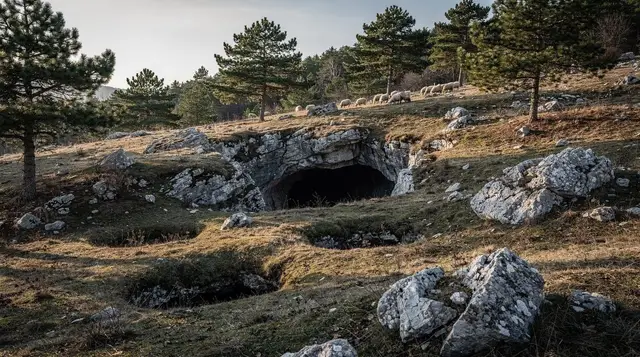
Lukomir sits at around 1,469m on the high shoulder of the Bjelašnica massif, and it holds one plain distinction: it’s the highest permanently inhabited village in Bosnia and Herzegovina. That fact gets repeated on every list of Sarajevo day trips, and it’s accurate, but it undersells what actually makes the place worth the drive. Lukomir isn’t a viewpoint with a name attached. It’s a working hamlet of stone houses under wooden shingle roofs, where a handful of families still bring livestock up for the summer, and where the road in is genuinely the point of difficulty, not a minor inconvenience mentioned in passing.
This page sets out what the trip involves honestly: the distance, the state of the track, when a guide or 4x4 makes more sense than a rental car, how Lukomir differs from the better-known village of Umoljani nearby, and the landmine rule that applies to the whole of this stretch of highland.
Where Lukomir is, and why the road matters more than the village
Lukomir is roughly 50km from central Sarajevo, which sounds like an hour’s drive on most maps. It isn’t. The route climbs out of the city towards Bjelašnica, passes through or near Umoljani, and then leaves the paved surface for an unmade mountain track for the final stretch onto the plateau above the Rakitnica canyon. Allow around 90 minutes each way rather than planning around the kilometre figure alone, and build in slack: a slow tractor, a herd being moved, or a patch of mud after rain can add time that a map won’t show.
The village itself is small — a few dozen stone houses, a mosque, and grazing land that falls away sharply towards the Rakitnica canyon below. There’s no visitor centre, no ticket booth, and nothing resembling an entrance fee. What there is, in summer, is a scattering of households who still spend the warm months up here as they and their families have for generations, tending sheep on the high pasture before moving back down before the snow.
Getting there: the track, not the distance
The paved road holds as far as Umoljani in good condition. Beyond that, the surface to Lukomir is an unsurfaced mountain track: loose stone in places, deep ruts after rain, sections with a drop to one side and no barrier. It’s passable to an ordinary car in dry summer weather with a cautious, experienced driver, but it isn’t the road to test yourself on for the first time in a rented city hatchback, and most rental agreements arranged in Sarajevo explicitly exclude unpaved roads from their insurance cover — worth checking before you set out, covered in more detail in the guide to car rental in Sarajevo and the wider notes on driving in Bosnia.
The three realistic ways to make the trip:
| Option | Who it suits | What it covers |
|---|---|---|
| Self-drive, own car | Confident drivers with off-road or gravel-track experience, dry season only | Just the road; no local knowledge, no safe hiking beyond the village |
| 4x4 tour from Sarajevo | Most visitors, especially without a car | The drive, usually a stop in Umoljani, time in Lukomir, often a viewpoint over the canyon |
| Guided hike from Umoljani | Visitors who want to walk part of the route on foot | A shorter drive to Umoljani, then a marked walk up to Lukomir with a guide who knows the safe paths |
A private 4x4 safari from Sarajevo to Lukomir removes the road question entirely: an experienced driver takes the track, and the group’s time in the village isn’t eaten up by concentrating on ruts and loose stone.
For a more active day, a guided hiking tour to Lukomir combines a shorter drive with a walk on foot along known, safe paths — the better choice if the appeal is the landscape as much as the village itself. Families or anyone wanting a slower pace can look at the version that builds in a proper stop to eat, a Lukomir hike with a picnic lunch included.
There’s also a self-drive-style option for travellers who want the 4x4 experience without committing to a rental car of their own: an off-road 4x4 tour to Lukomir village run in a vehicle built for the terrain, with a driver who does this route regularly rather than once.
What you’ll actually find in the village
Lukomir is easy to misdescribe as an open-air museum, and that framing does it a disservice. The houses are inhabited, at least seasonally — stone walls, timber upper floors, and roofs of hand-split wooden shingles that have to be replaced and maintained like any working roof, not preserved like an exhibit. Sheep graze the slopes right up to the houses. A small mosque serves the community. In summer you may see women in traditional dress working outdoors, weaving kilims or tending animals, and a few households sell simple food, coffee, or handwoven textiles directly from home — genuine income, not a staged performance for visitors.
Walk quietly, ask before photographing people directly, and treat the paths between houses as what they are: someone’s front garden and working yard, not a themed street. By late autumn most families have moved back down to lower villages for winter, and Lukomir empties out until the road becomes passable again the following spring — a rhythm that’s shaped the place for longer than tourism has existed here at all.
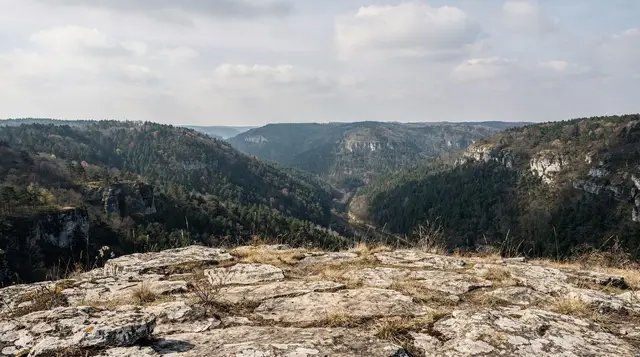
The main reason to linger, beyond the village itself, is the view: the ground falls away sharply to the north into the Rakitnica canyon, one of the deepest and least-touched canyons in this part of the Balkans, with the peaks of Visočica visible across the gap on a clear day.
Lukomir and Umoljani are not the same trip
It’s worth being direct about this, because the two villages are often mentioned in the same breath and confused as a result. Umoljani is lower, closer to Sarajevo, reachable on a paved or well-maintained road for almost its full length, and set up for visitors with guesthouses, marked walking trails, and a steady flow of day-trippers in summer. It’s a good, easy introduction to the Bjelašnica highlands and a sensible base if you want to walk rather than drive.
Lukomir is a step further in every sense: higher, harder to reach, with essentially no fixed tourist infrastructure, and a population that shrinks to a handful of households outside summer. Combining the two in one day — a stop in Umoljani, then on to Lukomir — is common and works well, covered in the Bjelašnica and Umoljani day trip guide, but don’t plan a Lukomir-standard trip expecting Umoljani’s ease of access, or the reverse.
The landmine rule: read this before you leave the road
This part of the Bjelašnica plateau, like much of the high ground around Sarajevo, was fought over during the 1992–1995 war, and mine clearance across Bosnia and Herzegovina remains incomplete decades later. The rule for visiting Lukomir and the surrounding hills is simple and non-negotiable: stay on the road, on marked paths, and on routes a local guide actively uses.
Don’t cross a field for a better photograph, don’t follow a shortcut that looks like a path but isn’t marked, and don’t wander off after livestock or a dropped item. Yellow and red hazard signs, where present, mean exactly what they say. The fuller explanation and the reasoning behind it is set out in the landmine safety guide for hiking in Bosnia, and it’s worth reading in full before any walk beyond the village itself, not just skimmed on the day.
This isn’t a reason to avoid Lukomir. It’s a reason to go with someone who knows the ground, whether that’s a licensed guide, a 4x4 driver who does the route regularly, or a marked trail with recent, credible information behind it.
Hiking from Lukomir
For visitors who want more than a look at the village, Lukomir is also a trailhead. Marked routes drop from the village edge towards the Rakitnica canyon, and the wider network connects into longer routes across the Bjelašnica–Visočica highlands. None of this is casual wandering territory: the terrain is steep, waymarking is inconsistent by Western European standards, and the landmine rule above applies with full force away from the village itself.
The Rakitnica canyon trek guide and the broader hiking around Sarajevo overview cover route options and what each one actually demands, and the Lukomir hike guide is the fuller companion to this page if walking, rather than the 4x4 drive, is the main goal.
Anyone building a longer stay around this landscape rather than a single day trip should look at the Bosnia nature week itinerary, and overnight hikers should check the Sarajevo mountain huts guide for where a night on the plateau is actually possible.
When to go
| Period | Conditions |
|---|---|
| Late April–May | Track often still wet or partly closed after winter; check locally before committing |
| June–August | Best window: dry track, village at its fullest, long daylight |
| September–early October | Good light, fewer visitors, some households already starting to wind down |
| November–March | Road frequently closed by snow; the village is largely or entirely empty of residents |
Lukomir is, in practice, a summer and early-autumn trip. Outside that window the track can be impassable and the village itself has little to show beyond the buildings — the point of visiting is as much the seasonal, working life of the place as the setting.
A day trip without a car
If you don’t have a rental car and don’t want the responsibility of the track, the practical answer for reaching Lukomir is a tour rather than public transport, since no scheduled bus serves the village. The best day trips from Sarajevo guide and the dedicated day trips without a car guide set out how this and similar high-country excursions work when you’re relying on organised transport rather than your own vehicle. For a version that pairs the drive with more of the wider Bjelašnica region in one outing, the Lukomir and Umoljani tour combining both villages covers the ground efficiently in a single day.
Frequently asked questions about visiting Lukomir
How far is Lukomir from Sarajevo, and how long does the drive take?
It’s about 50km, but the road climbs onto the Bjelašnica plateau and the final section is an unpaved track, so allow around 90 minutes each way rather than judging the trip by distance alone.
Can I drive to Lukomir in a normal rental car?
It’s possible in dry summer conditions with a careful driver, but the track has ruts, loose stone and no barriers, and a standard sedan or small hatchback struggles. Most rental agreements in Sarajevo exclude unpaved roads from their cover, so check the terms before you go.
Is Lukomir a real village or a tourist reconstruction?
It’s a real, still-inhabited village. A handful of families keep livestock there through the warmer months, and the stone houses with wooden shingle roofs are homes, not exhibits, even though most of the hamlet empties out once the snow closes the road.
What’s the difference between Lukomir and Umoljani?
Umoljani is a lower, easier village a short drive further along, with guesthouses, marked trails and a paved approach for most of the way. Lukomir sits higher, is harder to reach, and has far less visitor infrastructure. They’re often combined but shouldn’t be confused.
Are there mines near Lukomir?
The wider Bjelašnica area was on the confrontation line during the 1990s war and mine clearance is incomplete. Stay on the road, marked paths and trails used by guides; never cross a field, ruin or forest edge to get a better view or a shortcut.
When is Lukomir accessible?
Roughly from late April or May through October, weather permitting. Snow closes the track for much of the winter, and the last families typically leave before the first heavy falls.
Do I need a guide to visit Lukomir?
You don’t strictly need one to see the village itself, but a guide or organised 4x4 tour is the sensible choice for the drive and essential if you want to walk beyond the village into the Rakitnica canyon or surrounding hillsides.
Is there anywhere to eat or stay in Lukomir?
A small number of seasonal households serve simple meals in summer, but there’s no fixed restaurant or hotel. Most visitors treat Lukomir as a half-day stop within a longer Bjelašnica day trip based from Sarajevo or Umoljani.
Mountain excursions on GetYourGuide
Verified deep-linked GetYourGuide tours. Book through these links and we earn a small commission at no cost to you.
GetYourGuide does not provide a product photo for this activity — the image shows the meeting point, photographed by us.